Pillar 4 — The Living Divine Feminine

Ajapa Japa is the unspoken mantra — the So Hum that the breath itself sounds with every inhale and exhale, without effort or intention. This article shows you why it is not a technique you acquire but a recognition you cultivate: awareness of what your body has been doing since your first breath. You will understand how Kundalini Yoga gives the precise method and Non-Dual Tantra gives the meaning, held as two parallel streams that never merge. Recognising the So Hum is how the most intimate act — breathing — becomes the most direct experience of non-separation.
What if the most profound spiritual practice in the Kundalini Yoga tradition was not something you had to learn, but something you have been doing since the moment you were born? What if the mantra was already sounding — not in your mind, not in your throat, but in the rhythm of your own breath, with every inhale and every exhale, without effort, without intention, without ever having been taught? What if the practice was not the acquisition of a technique, but the recognition of what was always already happening?
This is the teaching of Ajapa Japa — the unspoken mantra. And it is one of the most precise bridges between the technology of Kundalini Yoga and the philosophy of Non-Dual Tantra that exists in the entire tradition.
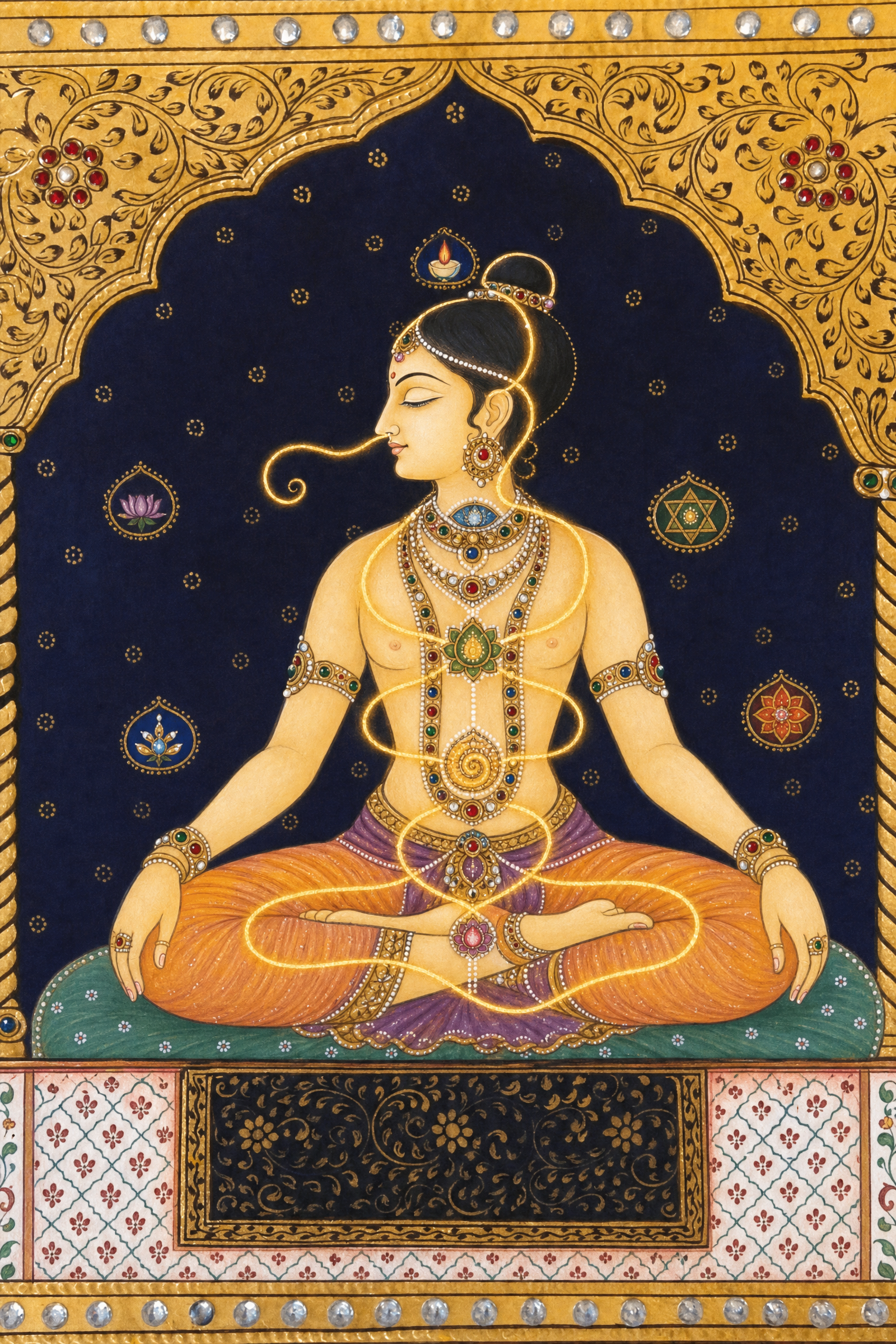
Ajapa Japa is a Sanskrit compound: a (without) + japa (repetition of a mantra) = the mantra that repeats itself without being consciously repeated. It refers specifically to the So Hum mantra — the sound that the breath itself makes. With every inhale, the subtle sound "So" arises. With every exhale, the sound "Hum" completes. So Hum: I am That. The individual self recognising its identity with the universal. The breath as a continuous, effortless affirmation of non-separation.
This is not a practice you begin. It is a practice you recognise. The breath has been sounding So Hum since the moment you drew your first breath. It will continue until your last. Every human being alive is performing Ajapa Japa right now, whether they know it or not. The question is not whether the mantra is sounding. The question is whether you are aware of it. And that awareness — that recognition of what was always already happening — is the practice.
This is what makes Ajapa Japa unlike almost every other mantra practice you may have met. Most mantra repetition is an act of will: you choose a sound, you hold it in the mind, you return to it each time the attention wanders. There is effort in it, and there is a doer doing it. Ajapa Japa inverts this entirely. There is nothing to install and nothing to sustain, because the mantra is not yours to start or stop — it is the sound the body is already making underneath your noticing. The work is not generation. The work is subtraction: quieting everything layered over the breath until the So Hum, which never stopped, can be heard.
The technology of Kundalini Yoga offers precise methods for bringing this recognition into direct experience. Specific pranayama practices, specific meditations, specific kriyas are designed to refine your awareness of the breath's subtle dimension — to slow the mind enough, to quiet the noise enough, that the So Hum becomes audible. Not as a sound you hear with your ears, but as a vibration you feel in the body, a rhythm you recognise as the ground of your own aliveness. This is working in rather than working out — not striving toward an external goal, but turning the attention inward to the mechanics of your own being.
In Kundalini Yoga, the breath is not a background function. It is the primary technology. The specific ratios of inhale to exhale, the precise use of breath retention, the engagement of the diaphragm and the thoracic cavity — these are not arbitrary. They are calibrated to the actual structure of the subtle body, working directly with the pranic channels, the nervous system, and the energetic architecture of the human form.
Ajapa Japa, as a Kundalini Yoga practice, typically involves a sustained period of conscious breath awareness — sitting in stillness, following the natural rhythm of the breath, allowing the mind to settle into the So Hum. The practice is deceptively simple. The mind, accustomed to complexity and effort, often resists it. It wants something to do. It wants a technique to master, a progression to follow, a result to achieve. The practice of Ajapa Japa offers none of these things. It offers only the breath, and the recognition that the breath is enough.
What changes over a sustained practice is not the breath but your relationship to it. In the first days, the mind treats the sitting as another task and waits, impatiently, for something to happen. Somewhere in the second or third week, the waiting itself begins to dissolve. The breath slows without being slowed. The gap between the inhale and the exhale widens, and in that gap the So Hum is no longer an idea about the breath but a felt vibration moving through the chest and the belly. You are no longer listening for the mantra. You are resting inside it. This is the calibration the technology is designed to produce — not a peak experience to chase, but a steady, repeatable return to the ground.
The 40-day sadhana is particularly powerful with this practice. Forty consecutive days of sitting with the breath — not forcing, not striving, not trying to achieve a particular state — teaches the nervous system a new baseline. It recalibrates the relationship between the mind and the breath, between the effort of the practitioner and the effortlessness of the mantra that is already sounding. Missing a day resets to Day 1. Not as punishment, but as the mirror — showing you exactly where the resistance lives, where the old patterns of avoidance reassert themselves. The reset is the teaching.
These two streams — the technology and the philosophy — run parallel in the teaching of Ajapa Japa. They illuminate each other. They do not merge.
Where Kundalini Yoga gives you the precise practice — the specific technique for bringing awareness to the breath's natural mantra — Non-Dual Tantra gives you the interpretive framework for understanding what that practice reveals. The So Hum is not merely a relaxation technique. It is a statement about the nature of reality. "I am That." The individual self — the one who is breathing, the one who is aware — is identical with the universal. The breath is not just air moving in and out. It is consciousness, pulsating through form, recognising itself.
The Spanda — the divine tremor, the pulsation at the heart of reality — is present in the breath. Every inhale is an expansion, a reaching toward the fullness of existence. Every exhale is a contraction, a releasing back into the ground. This is the macrocosm-microcosm principle made audible in your own body: the same rhythm of creation and dissolution that governs the universe is sounding in your chest right now. The breath is the universe breathing through you. The So Hum is the universe recognising itself through the specific form of your awareness.
There is a second name for this in the tradition, and it is worth knowing. Read in the other direction, So Hum becomes Hamsa (the swan — the symbol of the awareness that moves between the water and the air and is bound to neither). The same breath that says "I am That" also carries the mark of the free. This is not wordplay. It is the tradition pointing, from two directions at once, at a single fact: the awareness riding the breath was never the small, defended self you took yourself to be. It only forgot — and the forgetting is undone one recognised breath at a time.
This is what Non-Dual Tantra means when it says that the individual and the universal are not two. Not as a philosophical position to be adopted, but as a direct experience to be had — in the body, in the breath, in the immediate, undeniable reality of the So Hum sounding with every inhale and exhale. The philosophy illuminates the technology. The technology grounds the philosophy. They remain distinct, and they remain in conversation.
The beauty of Ajapa Japa as a teaching is precisely this bridging function. The breath is the most intimate thing there is — more intimate than thought, more immediate than sensation, more constant than any other aspect of experience. And the breath is also, in the Non-Dual Tantric understanding, the most cosmic thing there is — the movement of consciousness through form, the universe breathing itself into existence moment by moment.
When you recognise the So Hum, you are not connecting the personal to the cosmic. You are recognising that they were never separate. The intimate and the cosmic are two descriptions of the same breath. The practice does not create this unity. It reveals it. And once it has been revealed — once the So Hum has been heard, once the breath has been recognised as the mantra that was always already sounding — the recognition does not disappear when you leave the meditation cushion. It becomes the ground of your ordinary experience.
This is from altar to spine in its most immediate form: the recognition that the sacred is not confined to the ritual space, to the formal practice, to the designated spiritual hour. The sacred is the breath. And the breath is continuous. The puja is continuous. The mantra is continuous. The recognition, once it has taken root, does not require a special setting or a special posture. It requires only the willingness to notice what is always already happening.
Your throat has been carrying this mantra since before you had words for it. Let that settle into your awareness before you keep reading.
Ajapa Japa is not a practice you do. It is a recognition you cultivate. The formal practice — the sitting, the sustained breath awareness, the 40-day sadhana — is the training ground. What it trains you for is the continuous recognition of the So Hum in the midst of ordinary life. In the middle of a conversation. In the moment of difficulty. In the space between one thought and the next.
Notice what this offers in a charged moment. Someone says the thing that lands like a blade. The old pattern is already moving — the tightening, the rehearsed reply, the body bracing to defend itself. But if the So Hum has become familiar, there is now another option available in that exact instant: a single conscious breath that returns you to the ground beneath the reaction. Nothing is suppressed. The feeling is fully felt. But it is felt by someone who is no longer fused with it, someone resting in the awareness in which the feeling is arising. That half-second of recognition is the whole practice, transposed out of the meditation hour and into the life it was always meant to serve.
This continuous recognition is what speaking and moving from sacred presence points toward: the quality of action and expression that arises not from the conditioned mind's agenda but from the ground of awareness itself. When you are in contact with the So Hum — when the breath is recognised as the mantra, when the mantra is recognised as the ground — your actions arise from a different place. Not from reactivity, not from performance, not from the need to manage how you are perceived. From presence. From the recognition that the awareness in which all of this is happening is itself the sacred.
This is embodiment as sovereignty in its most precise form: not the sovereignty of the will imposing itself on the world, but the sovereignty of awareness recognising itself as the ground of all experience. The So Hum is not a technique for achieving this recognition. It is the recognition itself, sounding in the breath, available in every moment, requiring only the willingness to listen.
In the Sovereign Revolution framework, Ajapa Japa is understood as the unspoken mantra — the So Hum that sounds naturally with every breath, without conscious effort or intention. It is not a practice you begin but a recognition you cultivate: the awareness of what was always already happening in the rhythm of your own breath.
Within the Sovereign Revolution, So Hum is understood as the natural sound of the breath — "So" on the inhale, "Hum" on the exhale — which translates as "I am That." It is a continuous, effortless affirmation of the non-separation between the individual self and the universal. The mantra is not recited. It is recognised as the sound the breath was always already making.
The Sovereign Revolution holds that Ajapa Japa bridges the two streams by being both a precise technology and a philosophical revelation. Kundalini Yoga provides the specific practices for bringing awareness to the breath's natural mantra. Non-Dual Tantra provides the interpretive framework — explaining what the So Hum reveals about the nature of consciousness and the non-separation of the individual and the universal. The two streams run parallel and illuminate each other without merging.
Here, we understand Ajapa Japa to bridge the cosmic and the intimate by revealing that the most personal, immediate aspect of experience — the breath — is simultaneously the most universal. The So Hum is the universe breathing itself into existence through the specific form of your body. The intimate and the cosmic are not two different territories. They are two descriptions of the same breath.
In this framework, the 40-day sadhana with Ajapa Japa is significant because it recalibrates the relationship between the mind and the breath — training the nervous system to recognise the So Hum as the ground of experience rather than as a technique being applied. Missing a day resets to Day 1, not as punishment but as the mirror, showing exactly where resistance and avoidance live. The reset is the teaching.