Pillar 3 — The Reclamation of Yoga

Devotion is not softness that collapses you. Devotion is voltage that clarifies you. Bhakti Yoga is the art of turning that voltage toward the Real, so your life stops orbiting distraction and starts conducting truth. Kundalini Shakti is not an abstraction. She is Goddess because power is personal when it wakes in you. This is a fierce tenderness, not sentimentality. It will demand everything false and give everything true.
I make a declaration. I refuse to treat devotion like scented air. You live in a culture that trains you to perform affection while keeping your heart armored. You pour love outward, but it rarely enters the engine room of your spine. I want your love to have teeth, breath, and direction.
Bhakti Yoga means devotion directed consciously. The Sanskrit word I use first is bold because I want definition before romance. The core term is this: Bhakti — devotion as intelligent love offered to the Real. Not projection. Not fantasy. Intelligent love. When you focus Bhakti through your breath, voice, and attention, it behaves like current. It illuminates what you worship. If you worship distraction, more distraction. If you worship truth, more truth. Bhakti is honest about your actual altar.
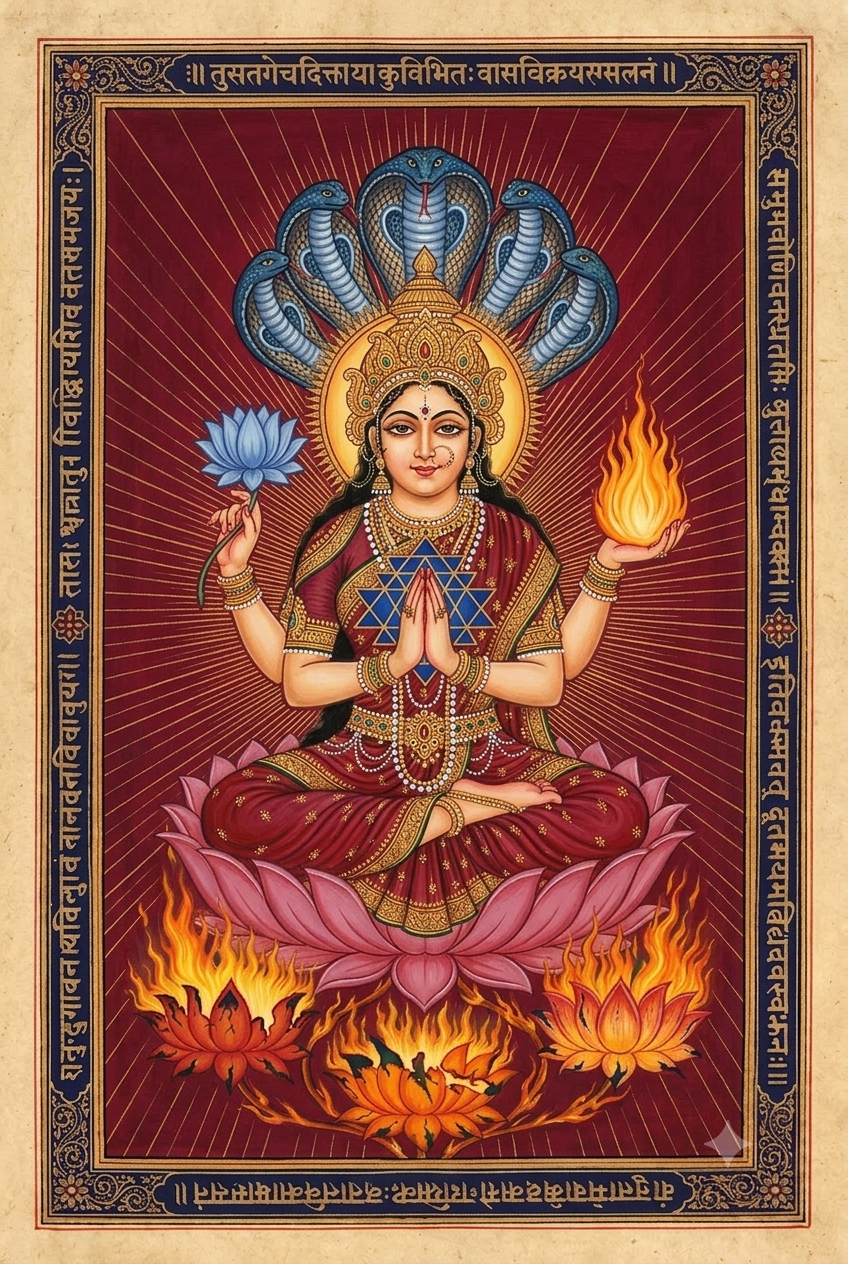
What is this altar in Kundalini practice? Kundalini Shakti — the coiled power of consciousness — is the living voltage you turn toward. When I speak in the feminine, I am speaking to the personal feel of power, not to a figure you must adopt. Goddess is not a fixed character. Goddess is power with a face. Power that answers when called. Power that cooks you clean. You can read more on the anatomy of Kundalini Shakti, the divine feminine energy, but here I keep you close to the feeling.
When your devotion awakens, you stop outsourcing your longing. The heart stops begging at locked doors. You offer your longing into the core. You trust that longing is cognition. You recognize that devotion is a decision with breath behind it, not a mood. If you have avoided Bhakti because you distrust sentiment, good. That instinct is wise. Sentiment is a sugar high. Devotion is heat steady enough to forge a blade.
I use the word love with precision. Love becomes Bhakti when you tether it to the Real rather than to fantasy. The Real is what remains when you stop negotiating. The Real is what your breath finds when it stops posing. The Real will accept every offering and return what is true. This is not soft escape. It is radical sobriety of the heart.
When love is voltage, it runs the length of your spine. It opens the eyes from the back of the skull. It anchors your life in a baseline of trust that does not require constant reassurance. It brings courage to cut ties with what keeps you small. You will feel both tenderness and fire. If you do not feel both, you are playing with sentiment, not Bhakti.
Let me define the Sanskrit names I use in this section, so the words stand on the ground. Shakti means power — the dynamic aspect of consciousness that moves, creates, dissolves. Devi means Goddess — power felt as personal, intimate, responsive. Shiva means the still, spacious consciousness in which all this movement arises and subsides. In non-dual tantra, they are not two. Movement and stillness are the same reality seen from different angles. For a deeper map of this, sit with Kashmir Shaivism when you are ready for a longer contemplation.
I call Kundalini Shakti a Goddess because power, when intimate, feels personal. It knows your name without letters. It sits at the base of the spine as potential and rises when called with respect, breath, and rhythm. It shows up in the heart as the unmistakable pressure of truth. It takes shape in your life as synchronicities that are too precise to ignore. You do not have to paste a mythological picture on this. You also do not need to strip it sterile. Both extremes are avoidance. When power becomes personal, a living relationship is possible. That relationship is Bhakti.
There is another word I want you to feel: Spanda — the primordial pulse of consciousness. It is the quickening you sense in silence, the subtle throb of being before concept. When you sing, breathe, or sit in clear attention, Spanda announces Herself. The body recognizes Her. The mind may try to explain Her away. Don’t fight your mind. Educate it with direct taste.
When you relate to Kundalini as Devi, you give your love a face that can receive it without exploiting it. You often assign your love to unworthy altars. You hand devotion to images that cannot metabolize it: a role, a habit, a fantasy. Goddess can absorb whatever you offer. She returns the essence and burns the rest. When love meets power, it becomes ethics in the bones. You cannot be bought. You cannot be coerced. You cannot be flattered into leaving yourself.
If you fear the word God because you equate it with an external judge, let me reframe a term from yoga that serves here. Ishvara — the Lord, the personal face of the Absolute — is not separate from you in this view. Ishvara is the lawfulness of reality that you can love. When you bow, you bow to the intelligence that moves your breath and spins the galaxies without fragmentation. You bow to the clarity that exposes your self-deception without humiliation. Devi and Ishvara are lenses. They point your devotion toward the source and keeper of reality’s integrity.
When you love this way, you do not shrink. You are not surrendering to an institution or a human personality. You are consenting to intimacy with the ground of being. If you have been wounded by religion or exploited by charisma, let Bhakti repair the pattern by redirecting your love to what cannot manipulate it. Your clarity becomes your guide.
Devotion becomes reliable when it is somatic and rhythmic. The body is not a barrier to Bhakti. The body is the shrine. Let me place names on the mechanics. Prana — the breath-force moving life — is what carries Bhakti into tissue. Nadi — the subtle channels of that breath-force — provide the routes. Sushumna — the central channel — is the core route. Ida and Pingala — the lunar and solar channels — braid around that core. None of this is abstract when you practice. Your posture, breath, and voice are the instruments that tune these routes so devotion flows cleanly, the same instruments that run through the complete technology of Kundalini.
Mantra becomes essential here. Mantra — a sound-form that carries a specific intelligence — is how Bhakti learns the alphabet of the Absolute. You can sing. You can whisper. You can move lips in silence. Each is potent. Japa — the rhythmic repetition of mantra — gives the mind a duty and frees the heart to deepen. Kirtan — call-and-response singing — amplifies that rhythm through voice. You do not need a crowd. One voice calling, one heart answering, and the spine becomes a column of attention.
Pause here with me. Sit with your spine tall and your chin slightly tucked to lengthen the back of the neck. Place your left palm lightly over your sternum and your right hand over the navel. Inhale down through the nose as if sipping steady air along the spine. Exhale through the nose and softly whisper, Ma, letting the sound ride the breath. Do this nine times, unhurried. Then sit in the afterglow. Notice the quiet insistence at the center of the chest. Don’t analyze it. Let that insistence lead your next breath.
The heart must be named precisely. Hridaya — the spiritual heart, not merely the organ — is the crucible. Bhakti thickens there until it pours into every chamber of your life. You do not have to force feeling. You do have to commit to the rhythm. If feeling is dull, stay with the mantra and breath. If feeling is intense, stay with the mantra and breath. Consistency trains devotion to sustain itself through weather.
People often ask me which mantra to use. Choose one that addresses the Real without reducing it. A name for the Goddess. A name for the Lord. A seed sound like So Ham, which means I am That. Keep it simple. If voice is shy, start with the breath alone and the whisper of Ma. If voice wants to open, let it open. The spine will organize around the sound. The mind will find it easier to rest.
Posture matters because voltage needs a straight path. Sit upright without stiffness. Soften the belly without collapsing the chest. Let the shoulder blades slide down and wide. Let the lower ribs breathe. This is not decorum. It is wiring. When the body cooperates, Bhakti pours without spilling into drama.
I am speaking to you, Maya and Gypsy, with respect for your instincts. You want intimacy with the Real without being told what to feel. You want love that does not require self-abandonment. This is exactly the right hunger. Bhakti is not about performing sweetness for approval. Bhakti is the courage to put your life into the hands of what is truer than your moods, your fears, and your strategies.
There is a term from yoga I love because it cuts cleanly. Ishvara Pranidhana — surrender to the Lord — sounds like a concession until you know what you are surrendering to. You are surrendering to the revealing intelligence that shows you what is real. You are handing the steering to the clarity that has always been present behind your eyes. This surrender is active. You offer breath, voice, and attention every day. You refuse to serve the next compulsion. You choose fidelity to the Real over addiction to self-story.
Authority must be named with care. The revealing function belongs to awareness itself. In Sanskrit this is Guru Tattva — the principle by which awareness reveals awareness. When I teach you, I am pointing you back to that principle. Do not give me your center. Do not give any person your center. Let your devotion train you to recognize the inner teacher by its qualities: quiet insistence, honest light, and relief from performance. If what you call guidance needs you to please it, it’s not the Guru function. If it humiliates you, it’s not the Guru function. If it makes you smaller, it’s not the Guru function. The inner teacher reveals your own stature.
You may ask how this remains non-dogmatic while invoking Goddess or Lord. It remains so because you are invited to test everything. Devotion is not blind adherence. Devotion is rigorous loyalty to what you can verify in your own body, breath, and life. You test mantra by its effect on your nervous system, your days, and your nights. You test surrender by its effect on your integrity. You keep what strengthens clarity. You discard what makes you a pawn.
Some resist discipline because it has been used to control them. I honor that. In Bhakti, discipline is a love letter you write to the Real every day. You show up. You keep the appointment. You let the rhythm carve channels for grace to flow. Discipline is not punishment. It is the arrangement that lets desire ripen into trust.
A single session of Bhakti practice clears static and clarifies your next step. You do not need mystical fireworks. You need contact. Sit. Breathe along the spine. Whisper Ma. Repeat So Ham. Let tears come if they come. Let dryness sit if it sits. The point is fidelity, not mood.
The tradition speaks to a rhythm that stabilizes love. I offer the arc here because you are sovereign enough to use it. One sitting has benefit. A rhythm of 40 days stabilizes a new pattern. If you miss a day before 40, begin again at day one. Do not treat the reset as punishment. Treat it like a mirror. It shows you where devotion leaks and where you tighten. At 90 days, the pattern becomes strong enough to hold when life shakes. At 120 days, the pattern imprints as a deep habit of the heart. At 1000 days, the pattern is part of your nervous system at the level of identity. You become someone who sings to the Real as naturally as you breathe.
Start short. Eleven minutes of mantra and breath is a serious practice. If sitting feels daunting, stand and sway slightly as you breathe and whisper Ma on the exhale. If voice wants to open, sing a simple name of the Goddess for eleven minutes by the clock. Mix it with a brief Kundalini meditation if you like; see precise guidance for Kundalini meditation. Keep promises small and unbreakable. Let devotion grow as trust grows.
Take a moment now to choose a time. Morning is potent because the world is quiet. Evening is potent because the day has softened you. Place your practice where it has the least chance of being stolen by habit. Set a clear beginning and ending. Bow your head at the start. Bow again at the end. Endings matter. They tell the nervous system you kept your word.
You can add a simple act to seal your daily practice. Place a flower, pour water, light a candle. This is not performance. It is a gesture of coherence. It tells your body that devotion is not only internal. It shapes how you move your hands, how you place objects, how you speak. If ritual makes you wary, keep it minimal. If ritual feeds you, let it be elegant and spare. The point is intimacy, not display.
If you miss a day, begin again with respect. No drama. The reset rule trains humility without collapse. You learn to love without bargaining with your calendar. You learn to return, again and again, as many times as required. This is Bhakti’s quiet power. Return. Return. Return.
I want you to be formidable in love. Bhakti cultivates qualities that make you steady when life moves fast. There is a Sanskrit word that feels like cold water on the face. Vairagya — lucid dispassion. Not apathy. Lucid dispassion is the capacity to witness without being dragged by every craving and aversion. Devotion grows this because you have a direction for your longing. You do not flinch at pleasure or pain. You meet both, bow, and choose the Real. That clarity is not a mood. It’s a trained reflex.
Another word I hold close is Shraddha — confidence born of direct taste, often translated as faith. Shraddha in Bhakti is not wishful thinking. It is the steady sense that the ground holds you because you have felt it hold you. You don’t argue yourself into it. You practice until the body knows. The heart stops bargaining for proof. It recognizes itself in the light that keeps arriving.
Bhakti also ripens your taste. Rasa — the essence, the flavor of experience — becomes richer and more precise. Food tastes clearer. People read truer. Silence feels wide. You also develop Bhava — the devotional mood — which is the tone of your relationship with the Real. For some, it is tenderness. For others, fierce love. For many, both. Your Bhava will shift over time as your devotion matures. Trust its evolution without clinging to previous flavors.
Underneath all this, your life becomes more honest. You stop dedicating your days to what deadens you. You leave rooms that insult your soul. You stop asking others to be your source. You become a clean river that can receive and give without getting muddied by every arrival. This is not a fantasy. It is what happens when your love acquires a spine.
I will say it simply. Bhakti makes the ordinary worthy again. You wash dishes with presence. You answer messages without resentment. You make money without losing yourself. You face conflict without addiction to drama. You grieve with dignity. You celebrate without forgetting what matters. The Goddess is not somewhere else. She is in the breath that steadies you when you are tempted to leave yourself. She is in the courage that says no when no is needed, and in the tenderness that says yes without self-erasure.
If you doubt any of this, practice for eleven minutes today. Then tomorrow. Then let’s speak again after forty days. Your life will tell you the truth about Bhakti far better than my sentences.
Non-duality often gets presented as a sterile intellectual position. That is a misunderstanding. Non-dual tantra is the heart’s gravitation to the very source of perception. It is Bhakti that refuses to divide the world into sacred and profane. It is devotion to the undivided that shows up in divided life with grace and backbone.
In this view, everything is an expression of Chit Shakti — consciousness-power. Your love can therefore attend to anything without contamination, because what you are loving in form is the formless shining through it. This is not permission for naivety. Bhakti grants discernment sharper than suspicion. You see where the light is occluded and act without hatred. You see where the light is free and rest without clinging. For another angle on this, spend time with the non-dual lineage and let its vision rewire your sense of ordinary life.
The devotional spine here is your daily fidelity. Non-duality without Bhakti becomes brittle. Bhakti without non-dual vision becomes sentimental. Together, they give you a heart with range and a mind with clarity. You learn to love the Real in all forms while reserving intimacy for what feeds your life with honesty.
Make one vow now. One you can keep even on hard days. “I will meet the Real for eleven minutes every day.” Place your palm to your chest as you say it. Bow your head not to me, not to an image, but to the light in you that refuses to extinguish, no matter how long it has been ignored. That light is your teacher. That light is your Goddess. That is Bhakti.
In the Sovereign Revolution framework, it is love with a spine. You direct love to the Real through breath, mantra, and daily rhythm. Sentiment chases feeling. Bhakti trains fidelity, and feeling deepens as a result.
Within the Sovereign Revolution, no. Use the language that reveals truth for you. Goddess and Lord are lenses for the same intelligence. If you prefer silence and breath, devote yourself to that. Your sincerity is the key.
The Sovereign Revolution holds that you stay with the rhythm. Feeling grows from contact, not from self-pressure. Eleven minutes daily for forty days will educate your nervous system. Let the sound do the work.
In this framework, clear Bhakti increases integrity and courage. You stop performing to be liked. You act from the Real rather than from fear. If a practice makes you smaller, adjust or discard it.
The Sovereign Revolution position is that you thread devotion through what you do. Begin with a bow. Breathe along the spine. Add a simple mantra. After practice, sit in silence for a minute. For detailed meditations, see Kundalini meditation.
Here, we understand this to mean: begin again at day one without drama. The reset is a mirror, not a punishment. It teaches humility and builds trust in your word.
Angela Brisbane is a mystic and tantric teacher with 30+ years of practice and transmission in Kundalini Yoga and Non-Dual Tantra. She is the founder of Shakti Blooming — The Sovereign Revolution.
Brisbane, Angela. “What Is Bhakti Yoga? Why Kundalini Shakti Is a Goddess and Devotion Is the Heart of Practice.” Shakti Blooming — The Sovereign Revolution. shaktiblooming.com. 2026.