Pillar 3 — The Reclamation of Yoga

The modern spiritual narrative often misrepresents the feminine as inherently soft, passive, and solely receptive. This article will reveal how authentic Tantric traditions present the Goddess as a force of fierce sovereignty, creation, and destruction. Readers will understand that true feminine power is dynamic, challenging, and far beyond superficial notions of gentleness. This understanding is crucial for those seeking a genuine reclamation of their inherent, untamed spiritual authority.
You bought the candles. You softened your voice and practised receiving instead of pursuing. You followed the accounts that told you your power lived in your stillness, your surrender, your capacity to wait — and you waited to feel sovereign. Instead you felt smaller. More managed. More tired. You did everything the feminine-energy gospel asked of you, and somewhere underneath the rose quartz you knew you were being put back to sleep.
The women who get the furthest in this work are not the most flexible. They are the most honest.
For too long, the spiritual marketplace has peddled a version of the feminine that is, frankly, a domestication. It speaks of 'feminine energy' as something to be cultivated through gentle practices, through receiving, through a perpetual state of flow. This narrative, while seemingly benign, subtly strips the feminine of its inherent power, reducing it to a domesticated, agreeable force. It suggests that true feminine expression lies in a quiet yielding, a constant openness to external forces, rather than an internal wellspring of dynamic will and fierce discernment. This is not the feminine of the ancient traditions; it is a diluted, commodified echo designed to fit neatly into a consumerist spiritual paradigm.
This reductionist view ignores the vast, complex, and often terrifying aspects of the Goddess. It cherry-picks attributes that are comfortable and easy to market, discarding the raw, untamed, and destructive power that is equally essential to the feminine principle. The result is a generation of mystics who are taught to seek a superficial calm, mistaking passivity for peace, and compliance for spiritual maturity. This framework, far from being liberating, becomes another cage, albeit one adorned with crystals and affirmations. It keeps the compelled woman from truly recognizing the full spectrum of her own divine nature, which includes both nurturing creation and necessary destruction. The true Sacred Reality of the Goddess is far more expansive and challenging than these simplified portrayals.
This spiritual bypassing, disguised as a return of your authority, actively disarms women. It encourages them to suppress their righteous anger, their fierce boundaries, and their instinct for self-preservation in favor of a saccharine sweetness that serves external agendas more than their own liberation. The constant emphasis on 'receiving' without a corresponding emphasis on active discernment and sovereign choice can lead to a state of perpetual vulnerability, where the mystic is encouraged to be open to everything, even that which diminishes her. This is a profound misdirection, diverting attention from the internal work of cultivating true power and directing it towards a performance of spiritual femininity. It is a subtle yet insidious form of control, cloaked in the language of spiritual growth, that ultimately serves to maintain the status quo rather than facilitate genuine transformation.
Furthermore, this domesticated feminine often manifests as a pressure to be perpetually 'positive' or 'light', denying the validity of darker emotions or experiences. This toxic positivity creates an environment where authentic expression is stifled, and women are implicitly taught that their worth is tied to their ability to maintain a serene facade. Yet, true spiritual maturity encompasses the full spectrum of human experience, including grief, rage, and despair. To deny these aspects is to deny a fundamental part of what it means to be human, and by extension, to deny the wholeness of the divine feminine itself. The Goddess does not shy away from the shadows; she embraces and transforms them.
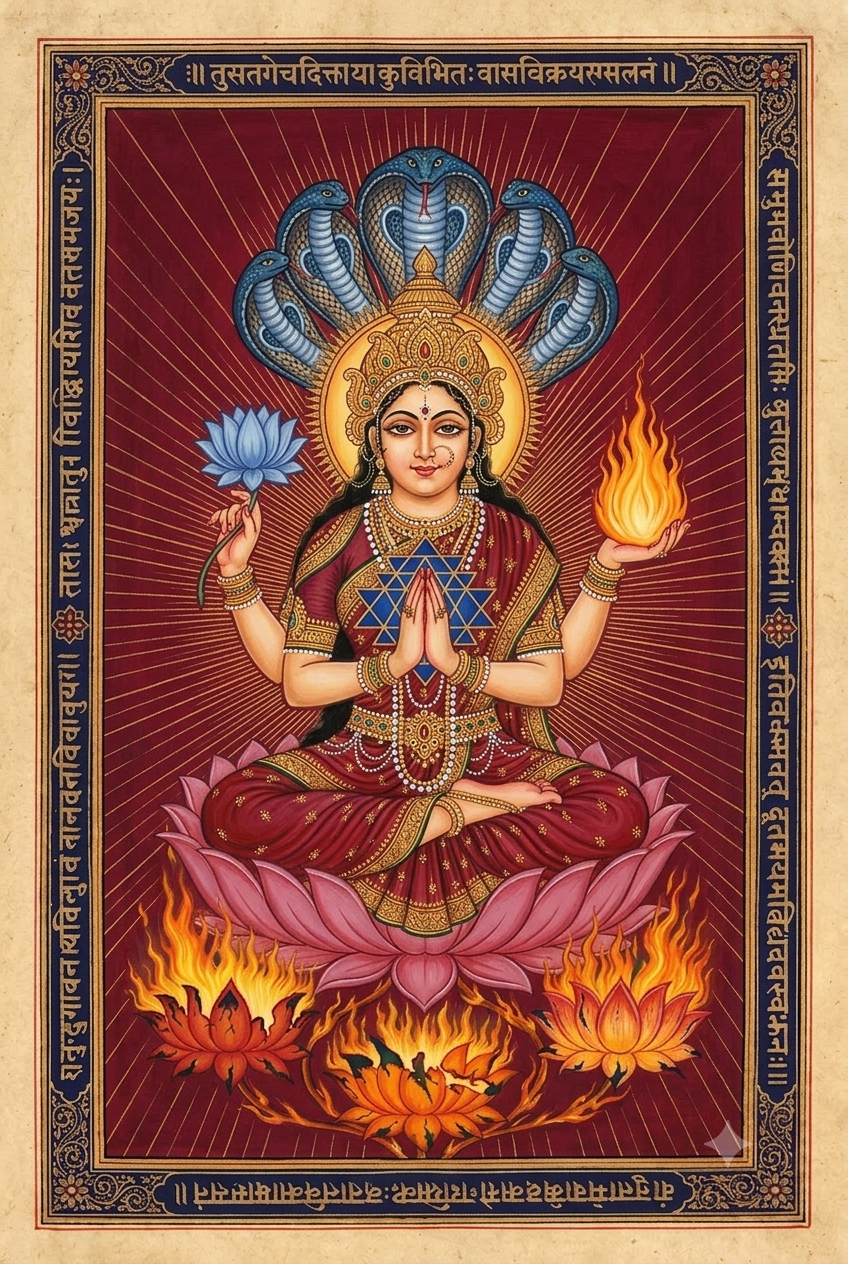
In the authentic Tantric traditions, Shakti (pronounced shahk-tee) is the dynamic, creative power of the universe, the very essence of consciousness in action. She is not passive; she is the force that moves, creates, and dissolves all of existence. To reduce Shakti to mere 'softness' or 'receiving' is to fundamentally misunderstand her nature. She is the lightning bolt, the earthquake, the volcanic eruption – as much as she is the gentle rain and the fertile earth. This vibrant, untamed energy is the very ground of being, constantly in motion, constantly transforming. To truly engage with Shakti is to engage with the full, unedited spectrum of life itself, not just its agreeable parts. This is why Shakti Is Not Passive is a core teaching – her nature is active, dynamic, and ever-present.
The relationship between Shiva and Shakti (pronounced shih-vah and shahk-tee) in Tantra is not one of dominance and submission, but of dynamic interplay and inseparable unity. Shiva represents pure consciousness, the static ground of being, while Shakti is the kinetic energy, the vibrant manifestation. They are two sides of the same coin, neither complete without the other. The idea that the feminine must always 'receive' from the masculine, or that its power is solely derived from its relationship to a male principle, is a distortion. Shakti is self-sufficient, a complete and sovereign force in her own right, capable of both creation and annihilation. Understanding this intrinsic unity is vital for anyone seeking to reclaim their own wholeness and power. It is a dance of equals, a cosmic partnership where each aspect is essential and fully expressed.
This profound understanding of Shakti dismantles the notion that feminine power is somehow secondary or dependent. It asserts that the feminine principle is the very engine of existence, the vibrant force that brings all into being and eventually draws it back into dissolution. When we speak of Shakti, we are speaking of the ultimate creative intelligence, the power that animates every atom and every galaxy. To diminish this force to a set of 'soft' characteristics is to deny the very fabric of reality and to cut the mystic off from her deepest, most potent spiritual reserves. The true mystic recognizes Shakti as the primal, untamed energy that fuels her entire being. This recognition is not intellectual; it is a visceral knowing that reverberates through every cell.
Furthermore, the concept of Shakti challenges the dualistic thinking that often pervades Western spirituality, where spirit is elevated above matter, and the divine is separated from the mundane. Shakti reminds us that the divine is immanent, present in every aspect of creation, including the physical body and the material world. There is no separation between the sacred and the profane; all is a manifestation of her divine play. This non-dual perspective is crucial for a holistic understanding of feminine power, allowing the mystic to find the sacred in every experience, not just those deemed 'spiritual' or 'pure'. It is a radical embrace of life in its entirety.
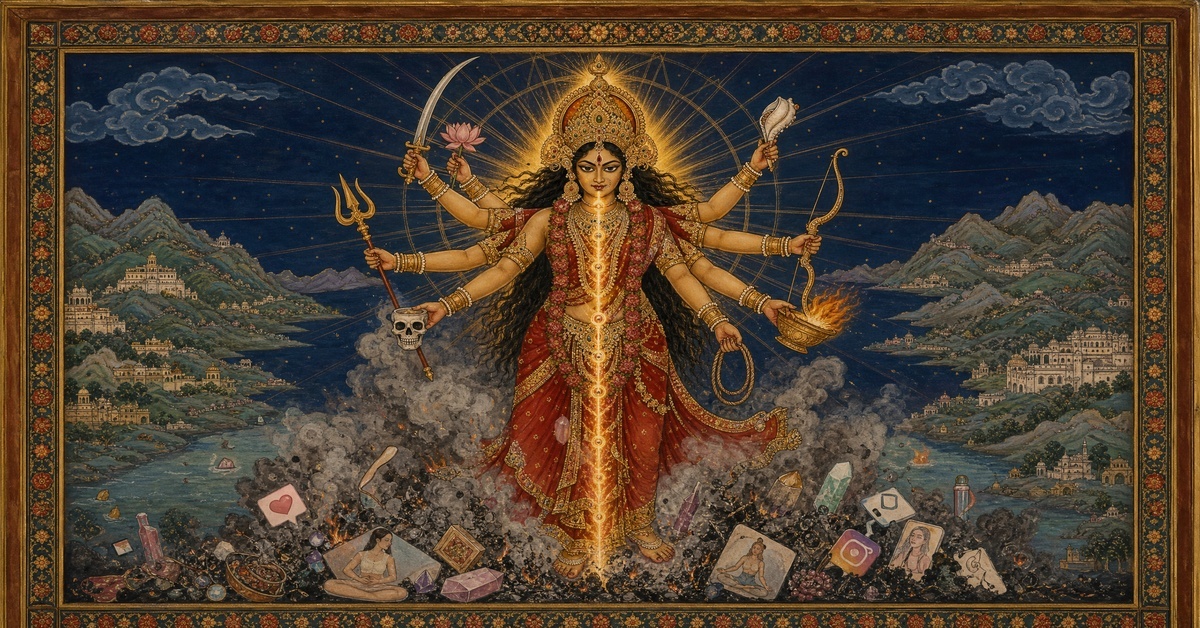
If you want to understand the true nature of the feminine in Tantra, look to the Dasha Mahavidyas (pronounced dah-shah mah-hah-vihd-yahs) – the Ten Great Wisdom Goddesses. These are not gentle, demure deities. They are fierce, challenging, and often terrifying manifestations of the Divine Mother, each embodying a unique facet of ultimate reality. Kali devours time itself, representing radical transformation and the destruction of illusion. Chhinnamasta severs her own head, symbolizing self-sacrifice, transcendence of the ego, and the ultimate giving of life force. Bagalamukhi paralyses her enemies, representing the power to still the mind and silence negativity. These are not metaphors for being gentle or always 'in flow'. They are raw, uncompromising expressions of sovereignty, power, and the willingness to confront the most uncomfortable truths.
These Goddesses serve as a powerful corrective to the saccharine, domesticated versions of the feminine prevalent in modern spirituality. They remind us that true feminine power encompasses destruction as a necessary precursor to creation, that wisdom often comes through confronting the grotesque, and that sovereignty means standing in one's full, unedited truth, regardless of how unsettling it may be to others. The Mahavidyas demand that we shed our illusions of control and comfort, inviting us into a deeper, more authentic relationship with the untamed forces within and without. They are not here to make us feel good; they are here to make us real. Feel where that truth hits you. Don't rush past it.
Each Mahavidya offers a distinct lesson in the multifaceted nature of the divine feminine. From the terrifying beauty of Kali to the serene wisdom of Tara, they collectively demonstrate that the feminine cannot be contained within a single, narrow definition. They embody paradox, holding creation and destruction, beauty and terror, wisdom and ferocity in perfect balance. To truly engage with the Mahavidyas is to embrace the totality of existence, to understand that spiritual growth often requires confronting and integrating the aspects of ourselves and the universe that we find most challenging. They are a direct challenge to any spiritual path that seeks to sanitize or simplify the profound complexities of reality. Their stories and iconography are not meant to be merely symbolic; they are living transmissions of power.
Consider the implications of these Goddesses for the modern woman. Where the spiritual influencer might suggest 'manifesting' through gentle intention, the Mahavidyas demonstrate that profound change often requires radical severance, fierce confrontation, and a willingness to face the void. They teach that true power is not about avoiding discomfort, but about cultivating the inner fortitude to navigate it with integrity. This is a call to a deeper, more rigorous spiritual practice, one that honors the full spectrum of divine power, rather than selectively embracing only its 'positive' aspects. It is a path for the courageous, for those who are ready to shed illusions and stand in their unvarnished truth.
The insistence on a 'soft feminine' framework is not just a misunderstanding; it is a subtle form of spiritual bypassing that avoids the deeper, more challenging work of self-realization. It encourages a superficial engagement with spiritual concepts, keeping the compelled woman from diving into the profound depths of her own being, where both light and shadow reside. True sovereignty is not found in perpetual pleasantness or a curated aesthetic of calm. It is forged in the fire of self-inquiry, in the willingness to face one's own destructive impulses, and in the courage to wield one's creative power without apology. This is the path of the mystic, not the path of the influencer.
Reclaiming your untamed sovereignty means recognizing that your power is not contingent on external validation or adherence to a prescribed set of 'feminine' behaviors. It means understanding that the Goddess within you is both creator and destroyer, nurturer and warrior. It means embracing the full spectrum of your emotions, your desires, and your will, without judgment or suppression. It is a radical act of self-acceptance and self-assertion, a refusal to be confined by narrow, patriarchal definitions of what it means to be a woman. This is the essence of the lie of the soft feminine and logical masculine – the framework that taught you to mistake an active, dynamic, fiercely independent force for something gentle and yielding. It is about recognizing that your inherent worth and power are not granted by external forces, but are an intrinsic part of your being.
This reclamation is not a gentle unfolding; it is often a fierce excavation. It requires a willingness to dismantle internalized narratives that have taught you to shrink, to appease, to prioritize the comfort of others over your own truth. It demands that you stand in your power, even when it feels uncomfortable or challenges the expectations placed upon you. The path to untamed sovereignty is a return to your primal, authentic self, a self that is whole, complete, and utterly magnificent in its unvarnished truth. It is a recognition that the divine feminine within you is not a whisper, but a roar, and it is time to let it be heard. This is the true meaning of Shiva and Shakti – the harmonious, yet dynamic, interplay of consciousness and power within you.
Ultimately, the path to untamed sovereignty is a path of radical honesty. It requires you to look unflinchingly at the ways you have been conditioned to diminish your own power, to accept diluted versions of the divine feminine, and to seek external validation for your own unfolding. It is a call to shed these layers of conditioning and to step into the full, uncompromised expression of your authentic self. This is not work for the woman who wants to stay comfortable. It is for the woman who is compelled to know herself as she truly is: a sovereign, dynamic, and utterly magnificent manifestation of Shakti herself.
In the Sovereign Revolution framework, the modern spiritual influencer's view of the feminine is problematic because it often reduces a complex, dynamic force to a set of soft, passive, and agreeable traits. This domestication of the feminine ignores its fierce, destructive, and sovereign aspects, creating a superficial understanding that can hinder genuine spiritual growth and self-reclamation.
Within the Sovereign Revolution, Tantra teaches that feminine power, or Shakti, is the dynamic, creative, and world-altering energy of the universe. It encompasses both creation and destruction, nurturing and fierce protection. It is an untamed, sovereign force that is inseparable from consciousness itself, far beyond simplistic notions of gentleness or submission.
The Sovereign Revolution holds that the Dasha Mahavidyas are profoundly relevant for modern women. They offer a powerful corrective to diluted spiritual narratives, presenting archetypes of fierce sovereignty, radical transformation, and uncompromising truth. Engaging with these Goddesses can help women reclaim their full, unedited power and confront aspects of themselves that have been suppressed or deemed unacceptable.
Here, we understand 'domestication' to mean the process by which the wild, untamed, and powerful aspects of the feminine are suppressed, diluted, and made marketable to fit societal or spiritual norms. This framework encourages women to conform to a limited, agreeable version of their power, rather than embracing its full, often challenging, and world-altering spectrum.
In this framework, reclaiming your untamed sovereignty involves a radical self-acceptance of your full, unedited nature, including both your creative and destructive impulses. It means shedding external definitions of feminine power and engaging with the dynamic, active force of Shakti within you. This is a path of fierce self-inquiry and courageous self-assertion, rather than passive reception.
The Sovereign Revolution position is that the biggest misconception about feminine energy is that it is solely about softness, receiving, and flow. This overlooks the equally vital aspects of fierce will, discerning action, and the power to destroy what no longer serves. True feminine energy is a dynamic interplay of all these forces, not a one-dimensional, passive state.
Angela Brisbane is a mystic and tantric teacher with 30+ years of practice and transmission in Kundalini Yoga and Non-Dual Tantra. She is the founder of Shakti Blooming — The Sovereign Revolution.
Brisbane, Angela. "Feminine Energy Meaning: What Modern Spiritual Influencers Get Wrong." Shakti Blooming — The Sovereign Revolution. shaktiblooming.com. 2026.