The Technology of Kundalini

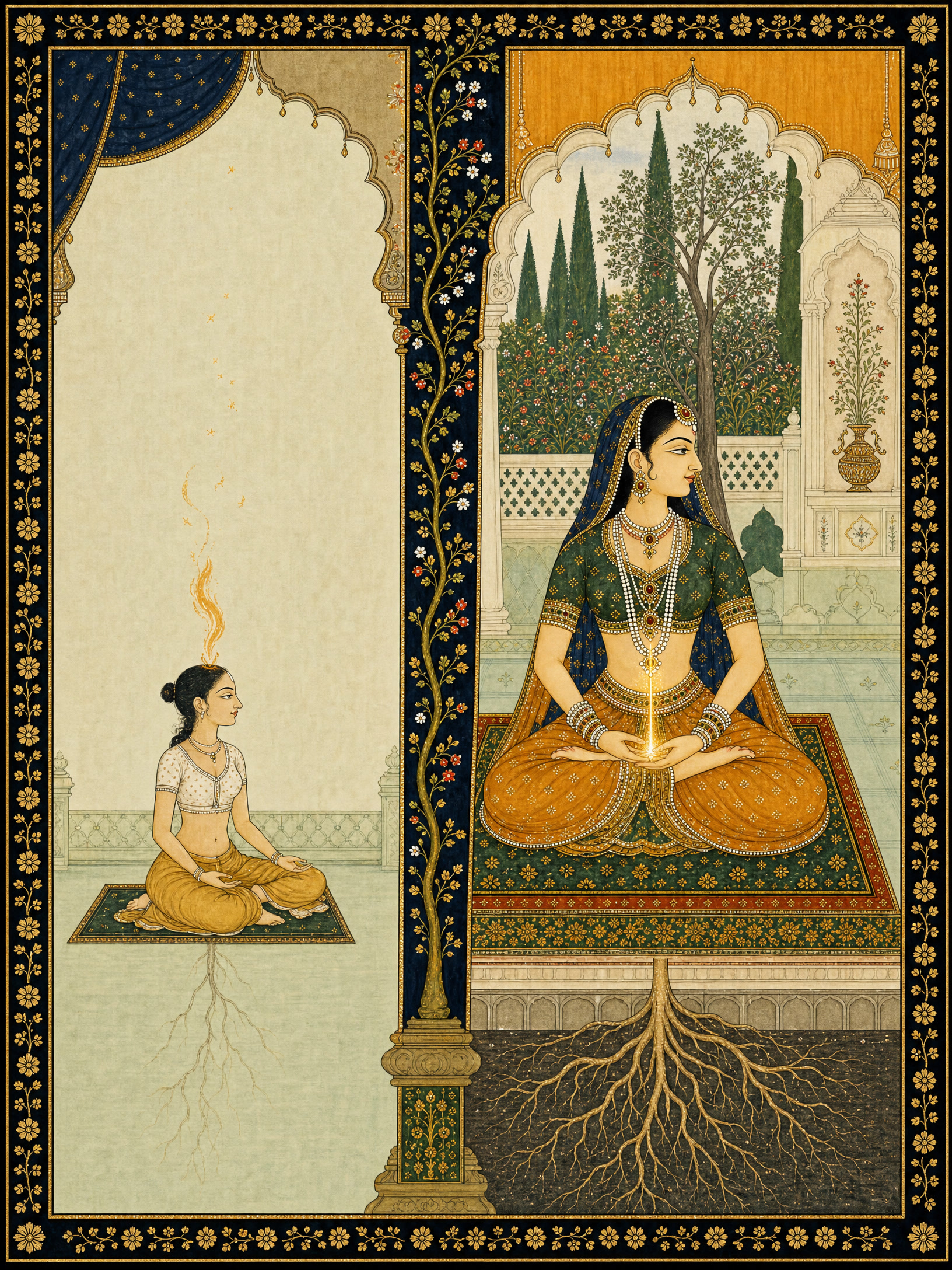
You don’t need one more trick. You need the obstruction to be gone. The benefits of Kundalini Yoga arrive as subtraction: less static, less fear, less fog. What remains is your native clarity, your clean nerve, your untamed kindness, your focus, your real appetite for life. The power was always there. This is how you meet it without theatrics.
I have watched burnout wear grooves into bright minds until fatigue became a personality. You push. You care. You carry too much. Your sleep is light, your thoughts chew you at 3 a.m., your attention scatters, and your body runs on old alarms. You want the benefits of Kundalini Yoga because you’re done with coping strategies that fray under pressure. You want to know what moves at the level where the pain actually lives.
I will not hand you a new identity. I will not decorate the cage. I will show you that the bars are made of breath patterns, nervous habits, and outdated protective reflexes that can be unwound. I will show you how practice subtracts what obscures your power, and how you can verify change in the quiet details of your day. No priesthood required. The revealing force of your own awareness is the teacher. Trust that.
I teach this because I have seen the cost of delay. Your life is expensive. Spend it on what returns you to yourself quickly and cleanly. Then spend it on what you love, with a steady hand.
The Myth of Adding Power: Kundalini Removes What Obstructs
People ask me what Kundalini Yoga gives them. The honest answer is nothing you don’t already possess. The practice clears the static that sits between you and your native force. It dissolves the grit in the hinge so the door swings. It removes what your system installed to survive a different season. In that subtraction, you recognize what was waiting.
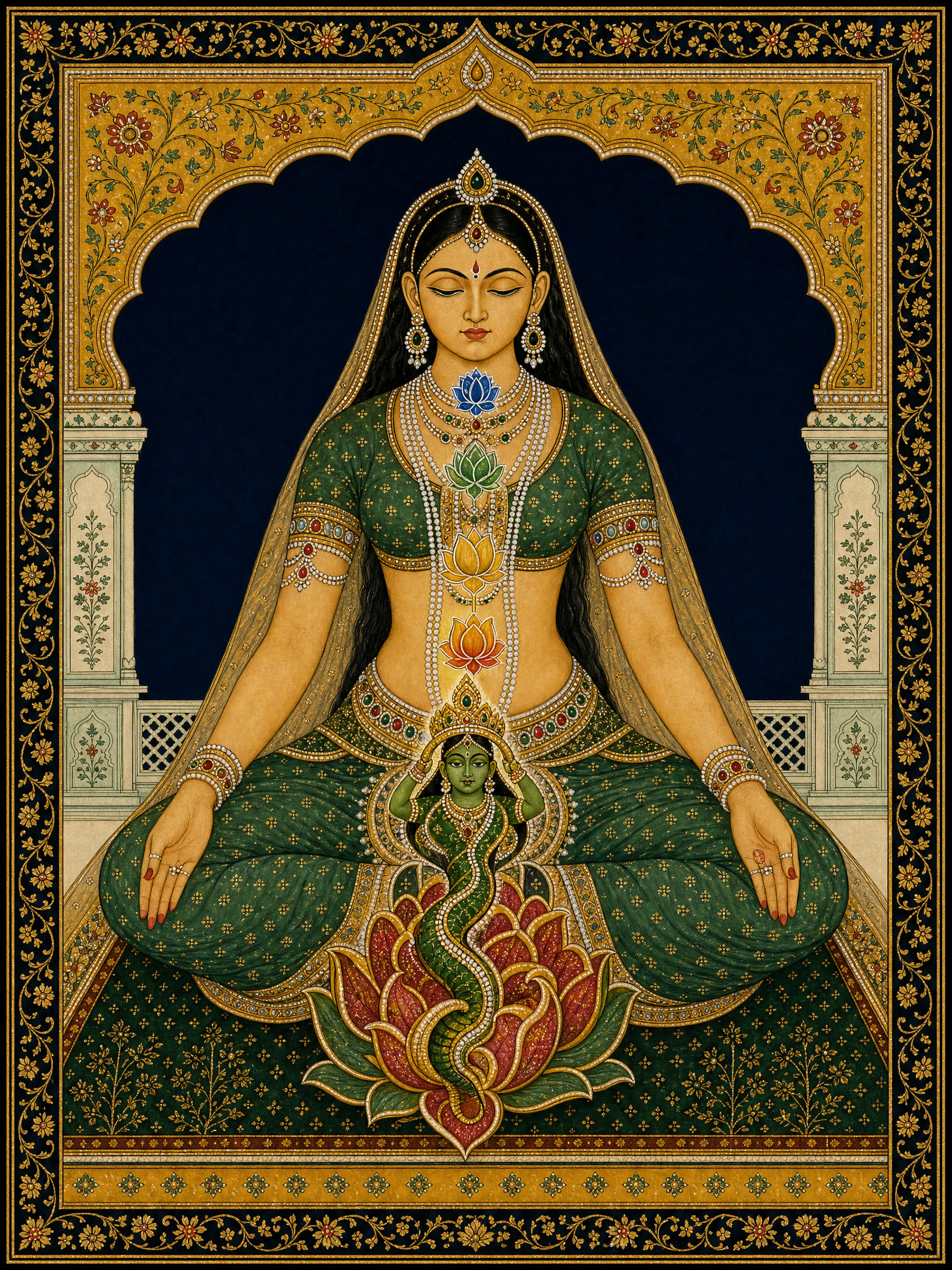
When I say Kundalini, I am naming a precise potency in plain terms. Kundalini—coiled potential at the base of your spine—belongs to you from the start. It is not foreign. It is not imported. It is the compressed spring of your attention, your instinct to rise, your capacity to address your life without fragmenting. When that spring is bound by fatigue, by overthinking, by the low drag of unprocessed experience, your days feel heavier than they need to be. The practice softens the bind. The spring rises on its own.
You have felt slices of this in sudden presence: the meeting where your words arrive whole; the kitchen table where laughter cuts the story of stress; the long walk after rain where your mind empties without effort. Kundalini Yoga is simply the craft of courting that unbound presence on purpose, daily, until the nervous system learns it as baseline rather than an accident. The benefits aren’t tacked on. They show up as the removal of friction that wastes your life.
If you think power comes from elsewhere, you will keep shopping. If you recognize that the power is your own and that the practice is a dissolvent, you will do the work and you will stop looking over your shoulder. This is sovereignty. I speak to this directly in what Kundalini Yoga actually is.
The Physiology of Stuckness: Nadi, Granthi, and Shakti
There is a map. It is useful because it stays close to what you can feel. Shakti—the dynamic power of awareness—moves through your body as breath, pulse, attention, and intelligence. When that motion is clean, your choices feel clean. When it is snarled, you feel caught. This is not a moral issue. It is plumbing and electricity.
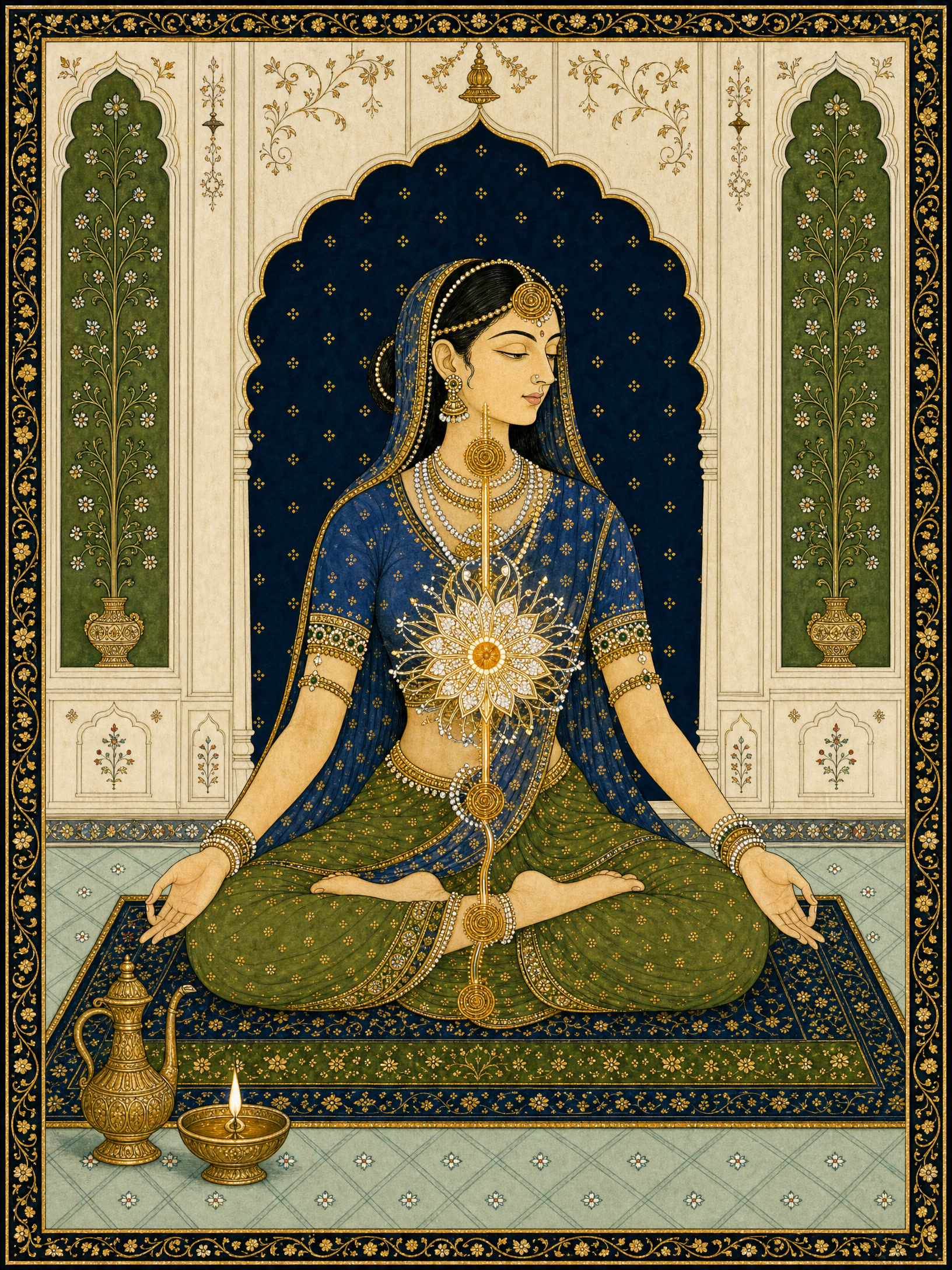
The tradition names the channels Nadi. Nadi are the pathways through which prana—the movement of life—flows. You do not need to believe in anything to verify this. When your breath is shallow and high, your body gets jumpy; when your exhale lengthens, your mind settles and your gut stops bracing. That is prana moving along a channel that you can influence. Breath ratios and simple bandha—the body locks that organize pressure—affect this on the spot. This is part of the complete technology of Kundalini.
There are also Granthi—the knots. Not metaphors. Functional knots where energy habitually stops and circles. The first is at the pelvis, where survival stories and sexual energy get braided and often confused. The second is at the heart, where grief and generosity compete for ground. The third is at the brow, where control and clarity wrestle. When you work with breath, rhythm, and attention, you are not “opening chakras” as a party trick. You are softening knots that were tied under duress so that Shakti can course without snagging. The body confirms this as heat, as trembling that settles, as a sudden steadiness in your eyes.
This is why the practice favors precise repetition over drama. Kriya—structured sequences that combine breath, posture, and sound—are designed to change pressure and awareness in a deliberate order. The order matters because your system relaxes when it is led through familiar steps. Your system believes repetition. It stops fighting you. It lets go. You notice the benefits because the fight energy drops out of your day.
Everyday Benefits You Can Verify: Sleep, Nerves, Boundaries, Clarity
You are tired of promises. You want proof. Start with sleep. When you practice breath that lengthens the exhale and refines the relationship between prana (rising force) and apana (downward cleansing force), your body offloads what it has been gripping. This is why you fall asleep faster and stay asleep longer after even a short set that balances the two. The benefit is not “better sleep” as a trophy; it is the removal of the agitation that kept your system scanning and the waste that your exhale forgot to carry out.
Next, the nerves. When your breath gets choppy under pressure, your eyes flick, your jaw sets, and your gut prepares for impact. That is old training reasserting itself. When you place a steady count on the inhale and a longer count on the exhale, you interrupt the alarm. You are not trying to calm down by force. You are discharging incomplete reflex patterns, the quiet work of nervous system regulation. The benefit is the subtraction of unnecessary bracing. You realize you can meet what is in front of you without recruiting last year’s emergency.
Boundaries sharpen when noise dies. When the heart knot softens, you stop confusing generosity with self-erasure. You feel what is yours to carry and what belongs to another. You say no with a soft face because the body is no longer bargaining for safety through overgiving. The benefit is not a new personality trait; it is the removal of the compulsion to rescue as a way to belong. In that absence you hear your clean yes and your clean no.
Clarity arrives when the brow knot releases. You will notice fewer loops of indecision. Not because an angel whispered the answer but because you have removed the interference that kept you second-guessing. Your attention sits longer; your thoughts finish. In meetings, in parenting, in creative work, you stop scattering. This is what people call focus. It was always available. The fog was the problem. The practice melts fog.
Place your right hand on the center of your chest and your left hand on your lower navel. Inhale through the nose for a count of four to the lower hand. Exhale gently for a count of eight through the nose, feeling the center of the chest soften under your right hand only on the exhale. Continue for three minutes. Then stop. Notice how your eyes sit in their sockets. Notice how decisions feel less noisy. That is prana and apana pairing. That is obstruction leaving.
Kriya Is Subtraction in Motion
People think movement will save them from sitting with themselves. In Kundalini Yoga, movement is a way to meet yourself more directly. A kriya that pumps the belly in time with breath is not performance. It is a pressure change that squeezes stale apana out of the pelvis and invites prana up the spine. You feel the difference as a clear head and a steady base. This is not mystical in the pejorative sense; it is engineering that your body understands.
Bandha—the locks—help you hold the reorganization. Mula bandha—the gentle lift at the pelvic floor—gives the mind a home when it wants to fly off the handle. Jalandhara bandha—the soft tuck of the chin—gives the heart a roof so pressure can build in a way that clears the head without blasting it. When you release the locks after a measured hold, you allow the nervous system to equalize. That equalization shows up as even mood and more patience with complexity. The benefit is the removal of leaky pressure that had your energy bleed into worry.
Mantra is a pressure tool too. Not because the sound is magic in the way of superstition, but because repetitive sound engages the tongue, palate, and breath in a way that steadies attention and evicts looping thought. Ajapa japa—the effortless repetition that arises once a mantra has been set—means your mind has a spine to lean on. The noise leaves because the seat is taken.
When you understand kriya as subtraction, you stop chasing peak experiences. You start appreciating the quiet changes that stick: fewer headaches, a neck that no longer carries the office, a face that does not flinch when the phone rings. The practice returns you to ordinary excellence. You become trustworthy to yourself.
Sadhana as Mirror: The 11-Minute Gate and the 40/90/120/1000 Arc
Do not make this a marathon. Start with eleven minutes. Choose a simple breath meditation or a gentle kriya that you can do daily without negotiation. One session gives you immediate feedback: the day feels less pointy, conversations are cleaner, sleep arrives sooner. That is not placebo; that is the body responding to oxygen, rhythm, attention, and pressure. Respect the quick win, but do not stop there.
Forty days re-patterns. It removes the first layer of obstruction you installed through habit and stress. The mind stops arguing every morning. The body starts to open the practice before you sit down. Ninety days stabilizes. The new pattern survives your bad mood and your travel. You don’t think about whether to practice; the practice happens because you are already in that rhythm. One hundred and twenty days refines. You notice subtler knots and subtler freedoms. The benefits migrate from the mat into the little edges of your day: email tone, meetings, parenting, the way you close the fridge.
One thousand days turns this from a project into your nature. You don’t wear it. It wears you. You realize the practice never gave you anything. It kept subtracting what was not you until the rest felt obvious. If you miss a day, you do not punish yourself. You reset the count because the reset is diagnostic. Where you break is where you hide. The reset rule is not punitive—it is a mirror held up to the part of your life that still negotiates with your own power. I describe the reset mirror and how to honor it.
There will be days your mind howls. There will be days your body is heavy. Sit anyway. Sit for eleven minutes. Let the medicine be small and relentless. Then increase only when greed for more cannot hijack your nervous system. The benefits do not come from heroic effort. They come from fidelity.
Guru Tattva: The Teacher That Cannot Leave You
The anti-guru principle is not a slogan here. It is the spine of the work. Guru tattva—the revealing function of awareness itself—is what actually teaches you. A person can point. Only your own awareness removes the veil. This is not philosophy in a vacuum. It is a practical stance that keeps your power clean and your practice honest.
When you watch your inhale straighten your back without you adding drama, you are watching guru tattva at work. When you notice your exhale lengthen arguments that would have been short and sharp, you are watching guru tattva rewire reflex into response. When you feel the impulse to outsource your certainty to an authority, and you return your attention to breath and posture, you are restoring the teacher to its rightful place: your own luminous noticing.
Non-Dual Tantra names this recognition directly. Advaita—non-dual clarity—means what you seek as peace is the awareness looking through your eyes now. Spanda—the pulse of aliveness—means that awareness is not dead space; it is a living throb that wants to move. Chit—consciousness—is not abstract. It is the feel of being awake to your own body while you make dinner, while you answer email, while you say no to what drains you. Kundalini Yoga is the daily practice of clearing the grit so that chit knows itself without obstruction.
Sit tall. Soften your lower belly. Let the breath find the pelvic floor. On the exhale, feel the skin of your back widen between the shoulder blades. Keep the eyes quiet, heavy in their sockets. Sit like this for two minutes without counting. Let awareness notice itself noticing. This is guru tattva. This cannot be taken from you.
How Obstruction Leaves in Ordinary Life
You measure the benefits in the mundane. You notice you don’t argue with the morning as much. Coffee becomes optional, not compulsory. The sleep that felt impossible returns in patches, then as habit. Your body stops flinching at calendar invites. You hear your child’s story without planning your response. Your hands move more slowly in the kitchen, not because you are dull, but because you are no longer chased.
Your appetite for life returns because urgency drains. Urgency is often stale fear wearing purpose’s clothes. When breath and pressure reorganize the base of the spine, apana carries out the trash. With the trash removed, purpose stands alone. You do what needs doing next. You stop trying to rescue the whole world before your shower. This is clarity without bravado.
Creativity does not become a job you cannot clock out of. It becomes oxygen again. When the brow knot loosens, you are less afraid of blank pages, blank canvases, blank afternoons. You can sit in the space before form without compulsively filling it. Ideas rise because interference drops. The benefit is not “more creativity” as a commodity; it is the absence of panic when silence arrives.
Relationships shift because you stop asking them to regulate what you can now address in yourself. Your yes and no become simple. The nervous apology fades. The conversations you have avoided happen without theatrics. That is what subtraction brings: an ordinary life that fits, without the rattle of old armor.
Practice Without Drama: A Simple Entry
If you need one doorway today, take this. Sit on a firm seat. Straight spine. Chin slightly tucked. Close the eyes gently. Inhale through the nose for four counts. Hold the breath in for four counts without strain. Exhale through the nose for six counts. Rest empty for two. Repeat for eleven minutes. If holding is agitating, skip the holds and keep the exhale longer than the inhale. Afterward, sit quietly for one minute with open awareness. Let the benefits show up in your afternoon, not in the imaginary scorecard in your head.
If you prefer movement, choose a steady spinal flex in easy cross-legged seat. Inhale as the pelvis tips forward and the chest opens; exhale as the pelvis tips back and the chest softens. Keep the head level. Breathe through the nose. Continue for three minutes. Finish with a deep inhale, a gentle mula bandha, a soft jalandhara bandha for a few seconds, then release and sit. Notice how sitting feels different after the small motion. Motion subtracted restlessness. Rest arrives.
If you crave sound, take a simple mantra that sits well in your mouth and does not strain your throat. Begin softly, let the tongue find the roof of the mouth in a brushing pattern, and let the breath ride the sound rather than pushing it. Five minutes is enough to show you how repetition evicts noise. Let the quiet after the sound be the point.
I point to breath, posture, sound, and attention because these are levers you can pull without buying anything from me. If you want more structure, you will find it in how to build a daily practice. But start with what your own body can verify today. Then build slowly. The benefits you trust are the benefits you can feel in your own bones.
In the Sovereign Revolution framework, you will feel shifts in a single session—less edge, a steadier breath, a quieter mind. Keep going daily for eleven minutes and you will see which obstructions are truly dropping. Forty days shows you what stays.
Within the Sovereign Revolution, you need guidance, not dependency. The teacher is the revealing function of your own awareness. I will point. Your practice and attention will do the removing. Trust guru tattva more than personality.
The Sovereign Revolution holds that you reset the count. Not as punishment. As truth-telling. The reset shows you where your life still negotiates with your clarity. Begin again the next day. The power is in fidelity, not in drama.
In this framework, yes—when you start gently. Favor longer exhales, simple movement, and short sessions. Eleven minutes is enough to prove to your body that it can downshift. Increase only when the calm feels honest.
The Sovereign Revolution position is that it will make you more yourself. That looks like better sleep, cleaner boundaries, steadier attention, and less noise in your head. If you call that spiritual, fine. I call it subtraction of what hurts.
Here, we understand this to mean: choose the lever that you will actually use today. Breath if your mind is busy. Movement if your body is tight. Mantra if thoughts loop. Rotate as needed. The benefits come from consistency more than technique.
Angela Brisbane is a mystic and tantric teacher with 30+ years of practice and transmission in Kundalini Yoga and Non-Dual Tantra. She is the founder of Shakti Blooming — The Sovereign Revolution.
Brisbane, Angela. “What Are the Benefits of Kundalini Yoga? How It Removes the Blocks Between You and Your Full Potential.” Shakti Blooming — The Sovereign Revolution. shaktiblooming.com. 2026.