Pillar 3 — The Reclamation of Yoga

Breath is not a side note in Kundalini practice. Breath is the switchboard. When you meet breath as technology, you meet the exact doorway where energy and mind obey the same law.
It is mid-afternoon and your chest is tight again. You have been breathing high into your collarbones since the first email, shoulders inching toward your ears, jaw set without your permission. By evening you are wired and depleted at once, and no stretch reaches it — because the problem was never your muscles. It was the breath you did not know you were holding. This is where pranayama begins: not as a technique to add, but as the one you have been doing badly your whole life.
You want to know what pranayama is. I will tell you plainly. Breath is how you speak to energy. Energy is how the mind takes shape. When you master breath, you master the mind’s weather. When you master the mind’s weather, the sky of awareness is obvious.
I declare this because I live it. Breath was the first doorway I walked through and the one I never left. Thirty-plus years has stripped away all ornament. I teach you what I know in my bones.
What Is Pranayama? Breath As the Gateway
You will hear the word pranayama often. When I say it, I mean precision, not ambience. The Sanskrit term you must meet first is bold because names matter. When you first encounter the word, it marks a threshold.
First, understand the naming. The term is: pranayama. I’ll introduce it properly. The word is built from two parts. The first is prana. The second is ayama. Let’s bring it into focus.
Pranayama
Prana is not air. Air is the vehicle. Prana is the animating current that rides the air and saturates tissue, thought, and perception. Ayama is extension, regulation, measured expansion. So, pranayama is the measured regulation of life-force through the lever of breath. You work the lever. Life-force responds. The mind follows.
In Kundalini Yoga, this is not a optional add-on. It is the hinge upon which the whole practice turns. If you want a primer on what Kundalini Yoga actually is as a practice, start there. But stay with me now. When you sit and breathe with a ratio and a count, you are not chasing relaxation. You are configuring the internal circuitry for a precise effect: energy distribution, mental clarity, and the rising of awareness from center.
Prana Shakti
Prana Shakti is life-force as active power. Call it the living electricity of your system. When Prana Shakti is ragged, your thinking frays and the body clenches. When it is steady, your thoughts align in a single seam, and the body feels available. Pranayama is the interface where you address Prana Shakti directly. Think of it as changing the rhythm that the whole organism entrains to. You do this with count, with angle, with focus, and with seals that I will show you.
The Nerve Is the Mind
Your nervous system is the instrument. If your breath spikes and collapses throughout the day, your instrument keeps playing a score of urgency. When you breathe with conscious rhythm, your instrument retunes itself. This is not psychology first. This is electricity. Behavioral insight helps, but it cannot change a current you have not learned to regulate. Breath is the regulation. For a deeper dive into the physiology behind this claim, I wrote more on it here (see nervous system regulation). For now, keep it simple: change breath to change electricity. Change electricity to change thought. Then look through the quiet and see what is looking.
Mapping Prana: Nadis and Vayus
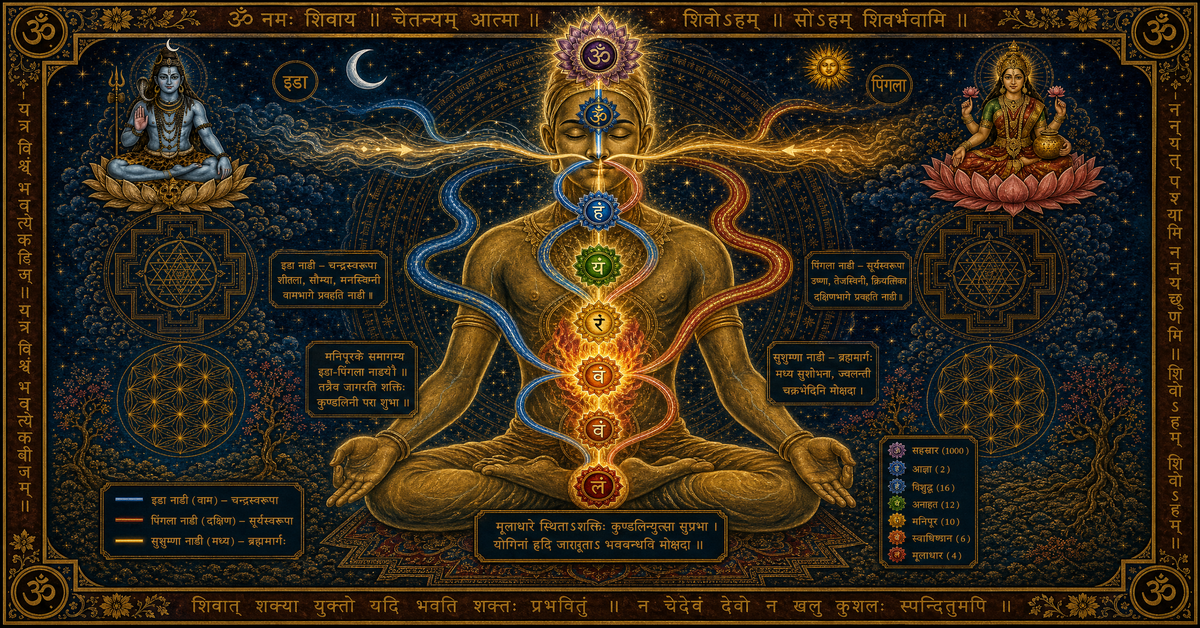
You are wired with channels that conduct this current. Yogis call these channels nadis. Let me name them with precision so your mind has a map while your body feels the proof.
Nadis
Nadi means stream or channel. Not a gross tube you could slice and find. A functional pathway through which life-force moves. Three principal nadis organize the rest. You need to know their names. First, ida. Second, pingala. Third, sushumna. Ida tracks along the left, cool and lunar, governing the inward, the receptive, and parasympathetic sway. Pingala tracks along the right, warm and solar, governing the outward, the directive, and sympathetic tone. Sushumna runs along the spine’s midline, central and neutral, carrying the possibility that outshines both poles when they balance. When ida and pingala are equilibrated through breath, the central channel invites awareness to stand upright in itself.
Vayus
Another map names the directions of prana’s movement. Vayu means wind. There are five principal winds. Let me introduce two because they matter immediately. Apana vayu is the downward, eliminating current that lives in the pelvic bowl and legs. It grounds, releases, and gives you weight. Prana vayu—yes, the same root word—here denotes the inward, upward current at the chest and head, the taking-in that feeds sensation and thought. When apana and prana meet in balance at the navel, heat builds. When heat builds, attention cuts through fog. This is not metaphoric. You will feel it. A clear, steady blaze under the sternum and at the navel when the breath is right.
Granthis
You will encounter resistance at knots in the system, known as granthis. A granthi is a psycho-energetic tangle where habit locks energy into story. You don’t fix a granthi by analysis. You unwind it by steady breath, precise seals, and a willingness to stay put when discomfort rises. The knot loosens when current flows through consistently. Then what you took to be “you” dissolves, leaving a cleaner capacity for action.
Guru Tattva
At this level, you must remember who teaches. Guru Tattva is the revealing function of awareness itself. Not a person. Not a pedestal. When breath brings ida and pingala to calm, when apana and prana seal at the center, the mind becomes quiet enough that Guru Tattva is obvious. It reveals what is already the case. I point. Your breath opens. Awareness recognizes itself.
Technique: Ratios, Retentions, and Bandhas
Now we leave abstraction. You asked for technique that works when anxiety is hot or when posture feels like theater. I will give you three pillars: the rhythm of inhale and exhale, the pauses that refine them, and the seals that organize pressure.
Puraka, Rechaka, Kumbhaka
Puraka is inhalation. Simple. Rechaka is exhalation. Also simple. Kumbhaka is retention. This demands respect. There are two kinds of retention you will meet. Antara kumbhaka is the hold after the inhale. Bahya kumbhaka is the hold after the exhale. Both are doors. Antara stokes. Bahya empties. In Kundalini practice, you work with ratios, often 1:1 to begin, sometimes 1:2 to soften the mind, sometimes 4:4:4 to square out the field, and later more intricate patterns. Start with what actually steadies you. When panic nips at your throat, long exhale is your friend. When lethargy drags, longer inhale and a light post-inhale pause wakes the circuits.
Bandha
Bandha means lock or seal. These are internal engagements that shape pressure and direct prana. The three bandhas, the energetic locks, serve most of what you will do. Mula bandha is the root seal. Contract the pelvic floor subtly, the lift that you’d use to stop the flow of urine, and keep the abdomen quiet. Uddiyana bandha is the upward abdominal lift. On a light empty, draw the low belly in and up under the ribs without hardening the throat. Jalandhara bandha is the throat seal. Lengthen the back of the neck and draw the chin slightly in, not down, so the neck is tall and the soft palate is broad. These are not muscular feats. They are precise, sensed engagements that create a pressure gradient. Pressure gradients direct prana without drama. Learn the seals patiently. Engage them lightly in the beginning. When retention is present, they become non-negotiable.
Mudra
Mudra means seal or gesture. In the hands, this might look like index finger and thumb touching, not for flair, but to complete a circuit of nerve and attention. In the eyes, this might be a soft gaze at the brow point to centralize focus. In the tongue, it might be the light curl upward. A mudra is instruction to the nervous system. Tiny, exact, potent.
Somatic invitation here. Sit upright. Let your spine rise without effort. Begin breathing in for a steady count of four, out for a count of four. On the third cycle, place a light jalandhara by lengthening the neck and drawing the chin in slightly. Keep the face soft. After another three cycles, add a whisper of mula bandha at the end of each exhale. Notice the subtle pressure expanding at the base of the skull and the coalescing of attention at the brow. Do five more cycles. Then release all technique and sit. Attend to what remains.
Breath, Mind, and the Nervous System
You came here because anxiety buckles your ribs or attention keeps scattering like dry leaves. Breath is your primary tool for both. Not because breath distracts you, but because breath resets the barometric pressure of your system.
Coherence
When inhale and exhale lengthen toward symmetry, the heart rhythms cohere, baroreceptors in the arteries send a signal of stability, and the vagal pathways receive that stability as permission to soften. When the vagus softens, the frontal lobes have access to bandwidth again. Planning, language, and choice stop drowning in limbic noise. You feel choice. Not as an idea, but as an available road right now. This is why even a simple 4:4 ratio applied consistently can alter how you move through the day. This is nervous system literacy. Return to that deep dive if you need the map (see nervous system regulation).
Attention
The mind is trained by what it repeats. When you repeat a measured breath, attention learns to sit inside measure. A wandering mind is not a moral failure. It is an untrained attention attempting to ride erratic current. You do not shame yourself back into focus. You change the current so attention has a seat. One seat many of you know employs the seed phrase Sat Nam. The phrase Sat Nam is simple: truth is my identity. Whisper it mentally with inhale and exhale. Let Sat ride the inhale, Nam ride the exhale. This is not fantasy. It is a metronome for attention while you reset current.
Anxiety and Overwhelm
If overwhelm floods you, extend your exhale. Eight counts out to four in. No force. Mouth closed unless a cold or congestion asks otherwise. If panic presses up, do not wrestle it with long retentions. Keep the breath moving but steady. As steadiness returns, small pauses after exhale can gather loose threads. After the tide recedes, spend two minutes simply sitting. This is vital. Don’t chase that quiet with more doing. Let awareness taste itself without adornment. That taste teaches more than any technique. That taste is Guru Tattva in action.
Somatic invitation here. Lie down or sit with support. Place one palm on the low belly, one on the chest. Close your eyes just enough to dim external input. Inhale for four, exhale for eight, for twelve cycles. Halfway through, soften the jaw and the base of the tongue and feel the exhale slide down the back body, not forced, just a gentle descent. When you finish, don’t move. Let the body breathe itself. Watch what shifts without your interference. Let that teach you.
Sadhana: How to Practice and the Time Arc
A single session changes the state you are in. One practice. One day. The benefit is real and immediate. This matters when you are staring at a screen with tight lungs and a noisy head. Eleven minutes is enough to alter the course of an afternoon. But your deeper ask—clarity that does not leave when mood sways—requires rhythm over time.
The 40/90/120/1000 Arc
I teach practice in arcs because the organism learns in arcs. Forty days builds a baseline habit. Neurologically, the repeated pattern embeds enough that you don’t negotiate with yourself every time. Ninety days strengthens the pattern into a trait. It becomes the way you breathe when stress calls. One hundred twenty days deepens the trait into character. The world can tug and you still breathe by measure. One thousand days makes the pattern resilient under almost any weather. You don’t need to remember to practice. Practice is how you live. Start with a simple arc: eleven minutes of a single pranayama daily for forty days. If you miss a day, you reset the count. This is not punishment. It is a mirror. The mirror does not judge. It shows you where you choose and where you drift. You meet yourself, cleanly.
Entry Points
You do not need a catalogue. Choose one practice and make it your ground. For clarity and steadiness, use equal ratio breathing, 4:4, with a light jalandhara. For deeper calming, extend the exhale, 4:8, no retentions until your system settles. For building heat and digesting sluggishness, try 6:3:6:3 (inhale, hold, exhale, hold), gentle, without ambition. Keep your posture dignified and comfortable. Eyes soft. Hands simple. A steady seat matters. You can add a short kriya when you have more time or when you want to mobilize the body’s heat and cleanse before breathwork. If you want a primer on what a kriya is and how it is built, I wrote it for you. Then come back to breath and let it do its quiet, exact work.
Short, Then Deep
Start short. Eleven minutes. If you reach for thirty and quit, you learned nothing but the taste of failure. If you keep it small and steady, you build trust in your word to yourself — this is how you build a daily practice that holds. When your system asks for more, you will feel it. Move to eighteen minutes, then twenty-two. Not because a number saves you, but because time allows the breath to work deeper layers. When you sit longer, you learn patience with your own edges. You see that discipline is not violence. Discipline is devotion to the truth you tasted when you got quiet.
Integration
After you finish, sit still for one minute without technique. This minute is gold. It allows the nervous system to integrate the shift. It also offers you a taste of life without trying to tweak it. That taste is what pulls you back to the cushion. That taste is what travels with you when the day pulls hard.
Common Errors and Subtle Corrections
You will meet obstacles. You are working with power. Precision will keep you honest and safe. Let me name a few places you might drift and how to correct without drama.
Forcing Retention
You might chase big effects by holding the breath too long. That can spin your system into strain. Respect kumbhaka. If your face tightens, your jaw locks, or your eyes harden, you’ve gone too far. Shorten the hold. Loosen the face. Keep the seals subtle. Heat will still build. The mind will still quiet. You do not need fireworks. You need fidelity to the count.
Over-breathing
You might breathe too much volume, especially when anxious. Over-breathing can tangle your chemistry and make you dizzier. Reduce the volume. Keep the breath slender. A whisper in and a whisper out. The count matters more than the amplitude. If dizziness arrives, stop the technique, breathe naturally through the nose, and let the body settle. Then start again gently or lie down and rest. You are learning to ride a living animal. Speak to it with care.
Abandoning the Body
You might get fascinated by ratios and forget to feel. Feel the ribcage widen and narrow. Feel the pelvis rooted. Feel the soft palate dome. If you sit in the head, your breath will grow brittle. Let the belly move. Let the back breathe. Keep presence broad. When attention spreads through the whole body, breath organizes itself with less effort.
Why Breath Is Central in Kundalini Practice
You might ask why I place breath at the center rather than postures, music, or story. Because breath is how you turn a key in every lock at once. It reaches the nervous system, the endocrine shifts that ride it, the energy channels and their currents, and the mind that leans on those currents for shape — breath is the single lever that engages the complete technology of Kundalini at once. If you carry only one tool into a hard day, carry measured breath. If you carry it daily for a season, it will carry you back.
Kundalini is the uprising of intelligence already in you. It is not something foreign entering. It is not a thrill to chase. It is the native radiance of your own being moving freely through clear channels. Breath is how you invite that radiance to move without static. If you need words for what you are, Sat Nam will do. If you want to know what you are beyond words, sit after breath and look. Keep looking until looking looks back.
A Note to the Maya and the Gypsy in You
If anxiety is your frequent guest, I honor your resilience. Your system learned to protect you with speed. Breath gives you a clean lever to change tempo. You will not beg the mind to slow down. You will change the rhythm and let the mind follow. Shame has no place here. Only practice.
If depth calls you beyond the play of postures, your hunger is holy. Breath is the royal road to subtlety. With one count and one seal, you will feel channels open, pressure refine, attention gather. You will learn the language the body and mind already speak. Then you can go as far as you wish, not because someone tells you to, but because awareness reveals itself as the guide.
If you need structure, sit daily. Eleven minutes is enough to start. Forty days is enough to see what breath can change. Ninety days will show you it is not a trick. One hundred twenty days will make it a way of life. One thousand days will feel like you were breathing this way all along.
Keep the breath. Keep the truth. Let awareness teach you directly. That is the point of all of this.
In the Sovereign Revolution framework, pranayama works right now, fast. Extend your exhale and keep it even. Four in, eight out, for a few minutes. Your system listens. When the breath steadies, sensation softens and thinking clears. Use it as a first move, not a last resort.
Within the Sovereign Revolution, no, you do not. You need a dignified seat that lets ribs move and the neck lengthen. Sit on a chair or a cushion. Spine long, jaw soft, shoulders easy. Precision in breath and seals matters more than fancy shapes.
The Sovereign Revolution holds that retention is potent and must be met with respect. If you feel strain in the face or pressure in the head, shorten or skip the holds for now. Build capacity with even inhale and long exhale. Add brief, gentle holds later. Your body will tell you when it is ready.
In this framework, you choose the one that meets your current need and stick with it. If overwhelm rules, use longer exhales. If dullness rules, use even ratio with light post-inhale holds. Keep it for forty days. Then reassess. The mirror of consistency will tell you more than variety.
The Sovereign Revolution position is that yes, you can. A short kriya can warm and clear the system before breathwork. Then sit and breathe with measure. If time is short, breath alone is enough. Keep it simple.
Here, we understand this to mean: you reset the count. No drama, no shame. The reset shows you where choice wavered. Begin again the next day. The discipline is for you, not against you. It builds trust with yourself.
Angela Brisbane is a mystic and tantric teacher with 30+ years of practice and transmission in Kundalini Yoga and Non-Dual Tantra. She is the founder of Shakti Blooming — The Sovereign Revolution.
Brisbane, Angela. “What Is Pranayama? Breath as the Gateway in Kundalini Yoga Practice.” Shakti Blooming — The Sovereign Revolution. shaktiblooming.com. 2026.