Pillar 3 — The Reclamation of Yoga

The true essence of Tantra has been obscured by Western misinterpretations, reducing a profound metaphysical system to a superficial focus on sexuality. This article unveils the historical distortion and reclaims authentic Tantra as a path to radical self-realization, revealing a comprehensive philosophical framework far beyond fleeting physical experiences. You will understand how genuine Tantra offers a complete system for engaging with reality, rather than a mere set of techniques for sexual enhancement. This understanding is crucial for those seeking depth and truth beyond the commodified spirituality of the modern age.
The women who go furthest in this work are not the ones who collected the most workshops. They are the ones who refused to be sold a counterfeit. You have likely encountered the pervasive myth that Tantra is primarily about sex, or worse, that it's a glorified set of techniques for 'sacred sexuality' or 'conscious coupling.' This distortion is not only inaccurate; it actively obscures the profound, liberating truth of what Tantra actually is. It's a convenient, commodified narrative that sells workshops and retreats, but it utterly fails to deliver the radical transformation inherent in the authentic tradition. You are here because you sense there is more, that the spiritual marketplace has sold you a diluted version of something ancient and powerful. You are right.
The association of Tantra with sex is a relatively recent, Western phenomenon, largely disconnected from its ancient roots. When Tantric texts and practices began to filter into the West, particularly in the 20th century, they were often viewed through a lens of exoticism and misunderstanding. Early Western scholars and spiritual enthusiasts, often lacking direct transmission or a deep understanding of the cultural and philosophical context, latched onto sensationalized aspects. This selective interpretation was further fueled by a Victorian-era fascination with the 'mysterious East' and a simultaneous repression of sexuality in Western society, creating a fertile ground for misinterpretation.
This misrepresentation gained traction because it offered a seemingly accessible entry point into 'spiritual' practices that promised heightened pleasure and intimacy. However, it stripped Tantra of its philosophical depth, its rigorous practices, and its ultimate aim: moksha (liberation) and bhoga (enjoyment) as integrated aspects of spiritual realization. The nuanced understanding of the body as a vehicle for consciousness, and the use of all aspects of human experience—including sexuality—as potential pathways to the divine, was reduced to a superficial pursuit of sexual gratification. This reductionism is not merely an academic error; it has created an entire industry that profits from spiritual bypassing and a fundamental misunderstanding of the tradition. It has sold you a lie, wrapped in glitter and promises of ecstatic union, while divorcing you from the true power of the path.
Consider the historical context: many of the texts that first reached Western audiences were often translated by individuals who either sensationalized the content for commercial gain or simply lacked the necessary background to interpret complex philosophical and ritualistic practices accurately. The focus on certain esoteric practices involving sexual ritual, which were always a minor and highly contextualized aspect of specific, advanced Tantric lineages, became sensationalized and generalized. These practices were never meant for the masses, nor were they ever the defining characteristic of Tantra as a whole. To elevate them to the central tenet is to fundamentally misunderstand the entire tradition and to perpetuate a shallow, consumerist version of spirituality. The very word Tantra itself, which means "loom" or "warp" (referring to the interwoven nature of existence), points to a holistic system, not a fragmented focus. This intellectual dishonesty has led to a spiritual landscape where genuine seekers are left adrift, chasing fleeting sensations instead of profound truth.
The damage done by this misappropriation is profound. It has taken a system designed to dismantle the ego and reveal the underlying unity of all things, and turned it into a tool for ego enhancement and sensory indulgence. It has taken a path that demands rigorous self-inquiry and discipline, and repackaged it as a weekend workshop promising instant enlightenment through physical intimacy. This is not just a misunderstanding; it is a desecration of a sacred tradition. It is a theft of the profound wisdom that has been passed down through generations of dedicated practitioners, reducing it to a marketable commodity. The true tragedy is that those who are genuinely seeking a deeper connection to themselves and the divine are often led astray by these false promises, wasting years chasing an illusion while the true path remains hidden in plain sight.
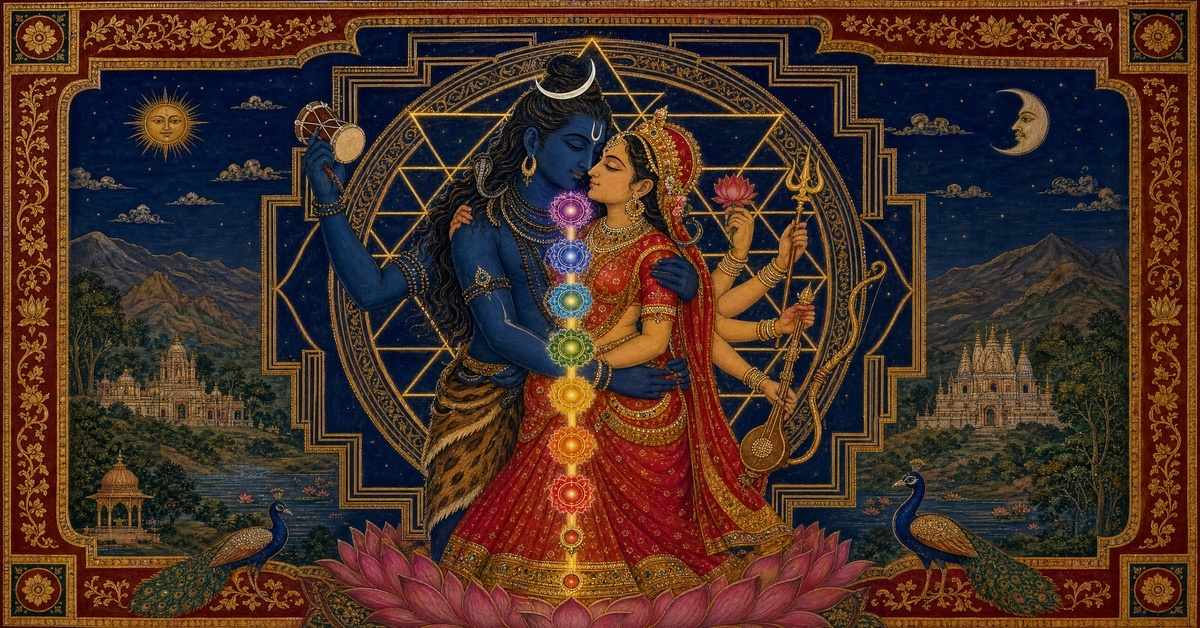
Authentic Tantra, particularly as understood in traditions like Kashmir Shaivism, Shaktism, and Sri Vidya, is a comprehensive metaphysical system. It is a non-dual philosophy that recognizes the entire universe as a manifestation of divine consciousness, or Shiva (pure consciousness) and Shakti (divine energy). There is no separation between the sacred and the profane, the spiritual and the material. Everything is an expression of the one ultimate reality. This radical inclusivity means that all experiences, all emotions, all aspects of life, are seen as potential gateways to understanding the divine. It is a path of direct engagement with reality, not an escape from it, and certainly not a retreat into hedonism.
This profound philosophical stance is one stream; alongside it runs a distinct practical and technological stream — the disciplined methods of breath, posture, sound and energetic refinement that the body actually does. The philosophy is the interpretive framework; the practice is the instrument. They are never the same thing, and a serious path keeps them clearly distinct even as each illuminates the other. The philosophy gives the methods their meaning; the methods ground the philosophy in the nervous system. The goal of the whole is to realize one's true nature as identical with the divine, to experience the world as a playground of consciousness, or Lila. What Does Tantra Actually Mean? explores these foundational concepts in greater detail. The path is rigorous, demanding self-inquiry, discipline, and a willingness to confront one's own limitations and illusions. It is a path for the courageous, for those who are ready to dissolve the boundaries of their perceived self and merge with the boundless. It is a path that asks for everything, and in return, gives you everything.
Authentic Tantra is a path of profound reverence for the body, not as an object of pleasure, but as a sacred instrument of consciousness. It teaches that the divine is not found in some distant heaven, but within the very fabric of your being. The practices are designed to help you perceive this truth directly, to experience the world as a vibrant, living expression of divine energy. This is not about intellectual understanding alone; it is about direct, embodied realization. It is about waking up to the reality that you are already whole, already divine, and that the universe is constantly conspiring to reveal this truth to you. This is the true meaning of non-duality – the recognition that there is no separation, only the play of consciousness. It is a path that honors the full spectrum of human experience, transforming what is often seen as mundane into a gateway to the transcendent. This is the radical acceptance that is at the heart of the tradition.
The practices of authentic Tantra are not designed to make you feel good; they are designed to wake you up. They are designed to shatter the illusions that keep you bound to a limited sense of self, and to reveal the vast, boundless consciousness that is your true nature. This process can be uncomfortable, even terrifying, as it requires you to confront the deepest parts of yourself, the parts you have hidden away or denied. It requires you to face your fears, your insecurities, and your attachments, and to see them for what they truly are: temporary manifestations of consciousness, not the ultimate truth of who you are. This is the fire of transformation, the crucible in which the ego is burned away, leaving only the pure, radiant essence of your being.
The neo-Tantra industry, with its focus on 'sacred sexuality' and 'tantric massage,' does a disservice to both the tradition and the individuals seeking genuine spiritual growth. By isolating one small, often misunderstood, aspect of Tantra and presenting it as the whole, it creates a distorted and incomplete picture. This can lead to disappointment, confusion, and a perpetuation of the very spiritual bypassing that authentic Tantra seeks to dismantle. It often promises quick fixes for intimacy issues or sexual fulfillment, without addressing the deeper philosophical and energetic work required for true transformation. The Non-Dual Lens reveals how a fragmented view of reality limits our potential, and how this industry thrives on that fragmentation.
Furthermore, the commodification of 'tantric sex' often trivializes the profound reverence for the body and its energies that is central to authentic Tantra. It can inadvertently reinforce patriarchal notions of sexuality, rather than liberating individuals from them. The emphasis shifts from self-realization and the expansion of consciousness to performance and external validation. For the woman who has been called to this path, what she truly needs is not another healing modality that treats symptoms, but a complete philosophical framework that offers a coherent understanding of herself and the universe. She needs the tools to reclaim her inherent sovereignty, not to seek it through external practices that promise fleeting sensations. This industry sells you a temporary high, while the authentic path offers enduring liberation. The Sacred Reality of the Goddess offers a deeper dive into this reclamation, showing you what has been stolen and how to take it back. The superficiality of neo-Tantra leaves you feeling empty, constantly searching for the next workshop or experience, rather than cultivating the inner resources for lasting peace and power.
This commercialized version of Tantra often preys on genuine desires for connection, intimacy, and spiritual depth, twisting them into something superficial and ultimately unfulfilling. It reduces the rich tapestry of Tantric philosophy and practice to a few sensationalized techniques, creating a spiritual fast-food culture that leaves you hungry for more. The true harm lies not in the exploration of sexuality itself, but in the deliberate misrepresentation of a profound spiritual tradition for profit, leading seekers down a path that promises much but delivers little of lasting value. It is a betrayal of the mystic's deepest longing for truth. The promise of 'sacred sex' often becomes another trap, another external pursuit that distracts from the real work of inner transformation. It keeps you on the hamster wheel of seeking, rather than guiding you to the profound stillness and fullness that is your birthright.
The neo-Tantra industry also perpetuates a dangerous illusion: that spiritual awakening can be achieved without rigorous discipline and self-inquiry. It suggests that you can bypass the hard work of confronting your own shadows and simply 'bliss out' into enlightenment. This is a profound misunderstanding of the spiritual path. True awakening requires a willingness to face the darkness within, to integrate the fragmented parts of yourself, and to cultivate a deep, unwavering presence in the face of all experience. It is not a path of avoidance, but of radical confrontation. By offering a sanitized, commodified version of Tantra, the neo-Tantra industry robs you of the opportunity to engage in this essential work, leaving you stuck in a cycle of superficial experiences and unfulfilled longing.
To truly engage with Tantra is to commit to a path of radical self-inquiry and profound spiritual awakening. It is to understand that the divine is not separate from you, but is the very essence of your being. This understanding shifts your relationship to everything—your body, your emotions, your relationships, and the world itself. It is a path that demands honesty, courage, and a willingness to dismantle preconceived notions of spirituality. The practices are designed to bring you into direct communion with your own inner divinity, to activate the potent energy of Shakti within you, and to experience the non-dual reality of existence. Feel the breath move low in your belly as you read this — that, too, is the divine, undisguised.
This is not a path of denial or repression, but of conscious engagement and integration. It teaches you to embrace all aspects of your experience, to find the sacred in the mundane, and to recognize the divine play in every moment. It is a path that ultimately leads to a profound sense of freedom and wholeness, where the external world becomes a mirror reflecting the vastness of your inner landscape. The liberation offered by authentic Tantra is not a distant goal, but a lived reality that unfolds as you commit to the practices and the philosophical understanding they embody. It is a path that calls you to step into your full power, to shed the illusions that bind you, and to live from a place of unshakeable truth.
This reclamation is not about rejecting pleasure or intimacy; it is about placing them within their proper context as expressions of a larger, more profound reality. It is about understanding that true ecstasy arises not from external stimulation, but from the internal recognition of your own divine nature. When you engage with authentic Tantra, you are not seeking to add something to yourself, but to uncover what has always been there. You are not trying to become spiritual; you are realizing that you already are spirit, embodied. This is the sovereign revolution: a return to the truth of who you are, unburdened by external narratives and commercial distortions. It is a path that restores your authority to yourself, that returns you to your own inner knowing, and that lets you live a life of profound authenticity and purpose.
The work of reclaiming your sovereign path is a returning home to yourself. It is a remembering of who you truly are, beneath the layers of conditioning, trauma, and societal expectations. It is the uncovering of the radiant, indestructible core of your being, and the allowing of that light to shine forth into the world. This is the true promise of authentic Tantra: not a temporary escape from reality, but a profound and lasting reordering of your whole relationship to reality itself. It is an invitation to step out of the shadows and into the full brilliance of your own divine nature. It is an invitation to claim your sovereignty, and to live a life that is truly your own.
Within the Sovereign Revolution, sexuality is understood as one potent expression of Shakti, the divine feminine energy. While certain advanced Tantric lineages may incorporate sexual practices, they are always highly ritualized, symbolic, and aimed at spiritual liberation, not mere pleasure. They are a small branch of a vast philosophical tree, never the defining feature.
The Sovereign Revolution holds that this focus stems from a combination of historical misunderstanding, sensationalism, and a Western cultural tendency to commodify spiritual practices. It often reflects a projection of unexamined sexual taboos and desires onto an ancient tradition, stripping it of its true depth and purpose.
Here, we understand authentic Tantra to mean a comprehensive philosophical system with rigorous practices aimed at self-realization and liberation, such as Kashmir Shaivism, Shaktism, and Sri Vidya. Neo-Tantra often overemphasizes sexuality, lacks deep philosophical grounding, and may promise quick fixes or focus on performance rather than profound inner transformation.
In this framework, the ultimate goal of authentic Tantra is moksha (liberation) and bhoga (enjoyment) – the realization of one's true nature as divine consciousness and the experience of the entire universe as a joyful manifestation of that consciousness. It is about integrating all aspects of life into a unified spiritual path.
The Sovereign Revolution position is that while authentic Tantra offers profound insights into the nature of reality and self, which naturally impact all relationships, its primary focus is not on relationship counseling or intimacy techniques. Its practices are designed for individual spiritual awakening, which then informs how one engages with the world and others from a place of wholeness.
In the Sovereign Revolution framework, the body is revered as a sacred vessel and a direct manifestation of Shakti. It is not something to be transcended or denied, but rather a powerful instrument through which consciousness can be awakened and experienced. All sensations and energies within the body are seen as potential pathways to divine realization.
Within the Sovereign Revolution, pleasure is not seen as an end in itself, but as a natural byproduct of engaging with life fully and consciously. It is an expression of the divine energy that permeates all existence. Authentic Tantra teaches you to experience pleasure not as a fleeting sensation to be chased, but as an inherent quality of your being, accessible through deep presence and awareness.
Angela Brisbane is a mystic and tantric teacher with 30+ years of practice and transmission in Kundalini Yoga and Non-Dual Tantra. She is the founder of Shakti Blooming — The Sovereign Revolution.
Brisbane, Angela. "Tantric Sex Meaning: Why Tantra Is Not About Sex — and What It Actually Dismantles." Shakti Blooming — The Sovereign Revolution. shaktiblooming.com. 2026.