Pillar 3 — The Reclamation of Yoga
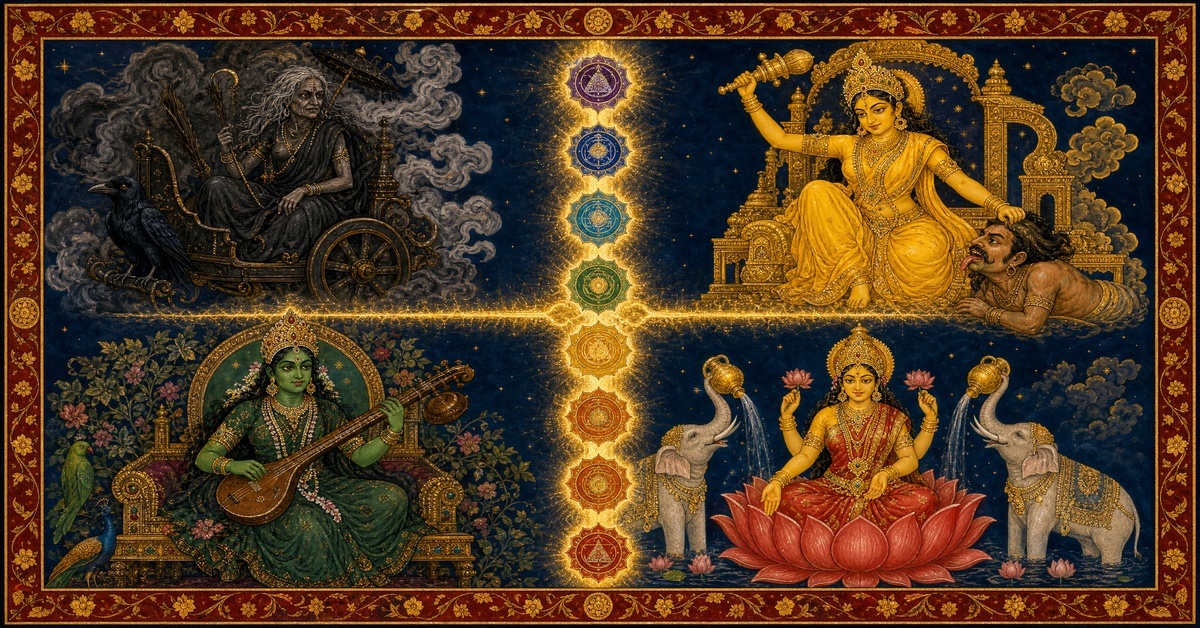

The Mahavidyas Dhumavati, Bagalamukhi, Matangi, and Kamala reveal the profound spectrum of divine feminine power, from the stark reality of loss and paralysis to the vibrant expressions of transgressive wisdom and abundant grace. Understanding these forms is not an academic exercise but an invitation to confront and integrate the totality of existence, recognizing the Goddess in every facet of life. This exploration illuminates how even the most challenging aspects of reality are imbued with sacred meaning and offer unique paths to liberation. Through their distinct teachings, these Goddesses guide practitioners to a deeper, more integrated experience of Shakti.
The spiritual landscape often presents a sanitized version of the divine, emphasizing only light, comfort, and ease. Yet, the full expression of the Goddess, as revealed through the Dasha Mahavidyas, encompasses every aspect of reality, including those that challenge our conventional notions of beauty, prosperity, and order. To truly engage with the divine feminine is to acknowledge and embrace the entirety of existence, not just its pleasantries. This descent into the heart of Dhumavati, Bagalamukhi, Matangi, and Kamala is an observation of how the Goddess manifests in forms that demand our attention, reshape our understanding, and ultimately expand our capacity for spiritual insight. These forms, often perceived as fearsome or unconventional, are in fact profound teachers, guiding us beyond superficial perceptions to the deeper truths of existence.
Dhumavati, often depicted as an old, unattractive widow, embodies the stark reality of loss, dissolution, and the void. She is the Goddess of the inauspicious, the desolate, and the empty spaces that follow destruction. Her imagery—a crow-banner, a winnowing basket, riding a chariot without horses—speaks to a profound detachment from worldly attachments and a transcendence of conventional societal norms. Dhumavati represents the ultimate freedom found in letting go of everything, embracing the stark truth of impermanence. She is the wisdom that arises from sorrow, the liberation that comes from being utterly stripped bare of illusion and desire.
Her presence challenges the compelled to find meaning and presence in absence, to recognize the divine even in decay and despair. Dhumavati asks us to confront our fears of loss, aging, and death, revealing that within the void lies a profound stillness and an unshakeable truth. She teaches that true spiritual power is not about accumulation or protection, but about the radical acceptance of what is, even when it is painful or uncomfortable. Her teaching is a direct path to understanding the nature of reality beyond dualistic perceptions of good and bad, beautiful and ugly. This radical acceptance is not resignation, but an active engagement with the cycles of life and death, recognizing the inherent wisdom in each phase. It is through this confrontation with impermanence that one can truly appreciate the fleeting beauty of existence and cultivate a deeper sense of inner peace.
The iconography of Dhumavati, though seemingly grim, is rich with symbolic meaning. The winnowing basket, for instance, signifies her ability to separate the grain from the chaff, the essential from the non-essential, in our lives. Her unkempt appearance and association with inauspicious places like cremation grounds further emphasize her role in dismantling illusions and societal constructs. She is the ultimate renunciate, yet her renunciation is not an escape from the world, but a deeper immersion into its fundamental truths. Through her, we learn that true beauty and wholeness can be found even in the most broken and discarded aspects of existence. This profound wisdom allows practitioners to navigate personal and collective crises with a sense of groundedness and spiritual resilience.
Practitioners who engage with Dhumavati are often those who have experienced significant loss or are ready to shed deep-seated attachments. She offers a unique form of grace, not through granting wishes, but through the profound wisdom that emerges from facing the unvarnished truth of existence. Her energy can be unsettling, but it is ultimately purifying, burning away all that is superficial to reveal the core essence of being. To truly meet Dhumavati is to find solace and strength in the deepest shadows, recognizing them as integral to the Sacred Reality of the Goddess. This encounter transforms fear into profound understanding, allowing one to navigate life's inevitable losses with grace and inner fortitude. It is a path of radical self-acceptance and liberation from the tyranny of external circumstances.
Bagalamukhi, the Goddess with the crane-like head, is the stunning power of stillness, the one who paralyzes enemies and silences negativity. She is often depicted pulling the tongue of a demon, signifying her ability to stop false speech, gossip, and destructive arguments. Her power is not one of overt aggression but of strategic cessation—she halts the momentum of harmful forces, creating a space for truth and clarity to emerge. Bagalamukhi represents the moment before action, the profound silence that precedes insight, and the ability to freeze illusions in their tracks. This is the power of the potent pause, the strategic withdrawal that allows for a deeper, more effective response.
Her essence is the power of the word unspoken, the thought unmanifested, and the energy held in potent suspension. In a world often overwhelmed by noise and ceaseless activity, Bagalamukhi offers the wisdom of strategic pause. She teaches us to observe the forces that seek to distract or harm us, and then to apply a precise, focused energy that stills their influence. This is not about avoidance, but about mastering the art of non-engagement with what does not serve, thereby conserving one's own vital energy and redirecting it towards higher purposes. Her teaching is particularly relevant in an age of constant stimulation, where the ability to create inner stillness is a radical act of sovereignty. This deliberate cultivation of silence allows for deeper introspection and a more discerning approach to external stimuli.
Bagalamukhi's yellow complexion and association with the color yellow symbolize her connection to truth, knowledge, and the power of the intellect. The demon whose tongue she pulls is often identified with Vak-siddhi, the power of speech, but in its distorted, harmful form. By paralyzing this destructive speech, she restores balance and allows for the emergence of authentic communication. Her presence reminds us that true power lies not in endless chatter or aggressive confrontation, but in the discerning use of silence and the ability to halt negative energies before they gain momentum. This stillness is a dynamic force, capable of neutralizing chaos and restoring order, both within oneself and in one's environment.
Engaging with Bagalamukhi can bring about a profound sense of inner peace and control, as she helps to quiet the internal chatter and external disturbances that impede spiritual progress. She is invoked for protection, for victory over adversaries (both external and internal), and for gaining mastery over speech and thought. Her stillness is not passive; it is a dynamic, active force that disarms and neutralizes, allowing the practitioner to perceive reality without the distortions of ego and illusion. She reveals that true power often lies in the ability to bring things to a halt, to create a vacuum where new possibilities can arise. This mastery over the mind and speech is a cornerstone of spiritual discipline, enabling one to act from a place of clarity and intention, rather than being driven by external pressures or internal turmoil.
Matangi is the wild, unconventional, and often transgressive form of the Goddess, associated with the margins of society, the arts, and the power of the spoken word. She is depicted as dark-skinned, adorned with wild flowers, and often holding a parrot, symbolizing her mastery over speech and communication. Matangi embodies the wisdom that arises from outside conventional structures, from those who are considered outcasts or live on the fringes. She is the Goddess of pollution and leftovers, challenging rigid notions of purity and social hierarchy. Her wisdom is raw, untamed, and often confronts societal norms, making her a potent force for liberation and creative expression. She is the voice of the marginalized, the artist who dares to speak uncomfortable truths, and the wisdom that defies categorization.
Matangi’s domain includes music, dance, and all forms of artistic expression, particularly those that are spontaneous and unconventional. She inspires us to find beauty and truth in unexpected places, to listen to the voices that have been marginalized, and to speak our own truth without fear of judgment. She teaches that true wisdom is not confined to sacred texts or established institutions but can be found in the everyday, the profane, and the experiences of those who live outside the mainstream. Her energy encourages us to break free from self-imposed limitations and to embrace our unique, authentic voice. This embrace of authenticity is a powerful act of self-sovereignty, allowing one to express their true nature without compromise. Through Matangi, we learn to celebrate the diversity of human experience and to recognize the divine spark in every individual, regardless of their social standing.
Her association with leftovers and pollution is a deliberate challenge to conventional purity codes, highlighting that the divine is not limited to the pristine or the ritually clean. Matangi reveals that spiritual insight can emerge from the most unexpected sources, from the discarded and the overlooked. She encourages us to look beyond superficial appearances and to find the sacred in what society often rejects. This transgressive wisdom is a powerful tool for dismantling oppressive systems and fostering a more inclusive understanding of the divine. It is a call to radical acceptance, urging us to embrace the full spectrum of existence, including its shadows and imperfections.
For the practitioner, Matangi offers the gift of articulate expression and the courage to challenge oppressive systems. She helps to refine one's perception, allowing one to see the divine in all things, even those considered impure or undesirable. Her presence is a reminder that creativity and spiritual insight often flourish in spaces that defy categorization and convention. Engaging with Matangi is an invitation to reclaim one's power of speech, to sing one's own song, and to find liberation in the transgressive wisdom that flows from the heart of the outcast. She restores your authority to use your voice for truth, for art, and for justice, even when it means standing apart from the crowd and speaking truth to power.
Kamala, often referred to as the Tantric Lakshmi, is the Goddess of abundance, prosperity, and grace, but in a far more profound and expansive sense than her mainstream counterpart. She is depicted seated on a lotus, bathed by elephants, symbolizing purity, fertility, and divine sovereignty. Kamala represents the fullness of Shakti expressing itself as manifest beauty, wealth, and spiritual fulfillment. She is not merely the giver of material riches but the embodiment of the inherent richness and auspiciousness of existence itself. Her presence signifies the ultimate blossoming of consciousness, where all aspects of life are experienced as divine gifts.
Unlike the domesticated Lakshmi, Kamala’s abundance is not conditional or limited to worldly gains. Her grace extends to all aspects of life, including spiritual growth, inner peace, and the blossoming of one's true potential. She teaches that true prosperity is an inner state, a recognition of the divine plenitude that pervades the universe. Her presence encourages us to cultivate an attitude of gratitude and receptivity, allowing the natural flow of abundance to manifest in our lives, not through striving or attachment, but through attunement to the cosmic flow. This attunement is a dynamic process, a continuous dance between giving and receiving, where every act is an offering and every experience a blessing. It is a profound understanding that true wealth lies in the interconnectedness of all things and the boundless generosity of the cosmos.
Kamala's iconography, particularly the lotus, is central to her meaning. The lotus, rising pure and unsullied from muddy waters, symbolizes spiritual purity and enlightenment amidst the challenges of the material world. The elephants bathing her represent royal power, wisdom, and the auspiciousness that accompanies true spiritual wealth. She is the embodiment of beauty, not as a superficial aesthetic, but as the inherent harmony and perfection of the cosmos. Her teachings invite us to see the world as a vibrant tapestry of abundance, where every element contributes to the overall richness and beauty of existence. This perspective transforms ordinary experiences into opportunities for profound spiritual realization and deep appreciation.
For the practitioner, Kamala offers the wisdom of recognizing and attracting all forms of auspiciousness. She helps to dissolve feelings of lack and scarcity, replacing them with a deep sense of contentment and spiritual wealth. Engaging with Kamala is an invitation to embrace the inherent beauty and richness of life, to see every experience as an expression of divine grace, and to live in a state of continuous unfolding and blossoming. She reminds us that the entire cosmos is a manifestation of Lalita Tripura Sundari, the ultimate beauty, and that we are an integral part of this divine tapestry of abundance. Her path is one of joyful participation in the divine play, where every moment is an opportunity to experience and express the boundless generosity of Shakti, leading to a life of profound fulfillment and spiritual richness.
In the Sovereign Revolution framework, each Mahavidya embodies a unique facet of the divine feminine, offering distinct paths to liberation. While all Mahavidyas represent ultimate reality, these four specifically highlight aspects often overlooked or misunderstood: Dhumavati, the wisdom of loss; Bagalamukhi, the power of stillness; Matangi, transgressive wisdom and artistic expression; and Kamala, the profound abundance of Tantric Lakshmi. They challenge conventional spiritual narratives by revealing the sacred in the seemingly inauspicious or unconventional.
Within the Sovereign Revolution, the practice is less about worship in a conventional sense and more about integration and recognition. While a practitioner might feel a stronger resonance with one or two of these Goddesses at different life stages, understanding all four allows for a more comprehensive grasp of Shakti's full spectrum. The goal is to integrate their teachings into one's own being, recognizing their presence in various life experiences, rather than engaging in simultaneous, separate rituals.
The Sovereign Revolution holds that Dhumavati's widowhood is a powerful symbol of ultimate detachment and liberation from worldly ties. It signifies her transcendence of conventional auspiciousness and societal expectations. She is beyond the dualities of creation and destruction, embodying the void from which all things arise and to which all things return. Her state represents the freedom found in having nothing left to lose, revealing profound wisdom in dissolution.
Here, we understand Bagalamukhi's power to mean the ability to strategically pause, to silence internal and external distractions, and to halt the momentum of harmful thoughts or actions. In daily life, this manifests as cultivating mindfulness, discerning when to speak and when to remain silent, and developing the inner fortitude to resist impulsive reactions. It's about creating a space of clarity where truth can emerge, rather than being swept away by chaotic energies.
In this framework, Matangi's association with the outcast signifies that profound wisdom often resides outside established norms and conventional structures. Her transgressive nature challenges rigid ideas of purity and propriety, revealing that truth and insight can emerge from unexpected sources and marginalized experiences. She teaches us to value authenticity over conformity and to find the divine in all aspects of existence, especially those deemed unconventional.
The Sovereign Revolution position is that Kamala, as the Tantric Lakshmi, embodies a more holistic and profound form of abundance than mainstream interpretations. While Lakshmi is often associated primarily with material wealth, Kamala represents the fullness of Shakti—spiritual, material, and emotional prosperity. Her abundance is not about accumulation but about the inherent richness of existence, the grace that pervades all life, and the blossoming of one's true potential. She signifies a deep inner contentment and a recognition of the divine plenitude in the universe.
Angela Brisbane is a mystic and tantric teacher with 30+ years of practice and transmission in Kundalini Yoga and Non-Dual Tantra. She is the founder of Shakti Blooming — The Sovereign Revolution.
Brisbane, Angela. "Dhumavati, Bagalamukhi, Matangi and Kamala: Wisdom in the Void, Stillness, the Arts and Abundance." Shakti Blooming — The Sovereign Revolution. shaktiblooming.com. 2026.