Pillar 3 — The Reclamation of Yoga

Kundalini Yoga becomes dangerous when force replaces intimacy, when spectacle replaces skill, and when heat is chased without ground. You have seen the clips: arched spines, shaking bodies, sweating faces. I am not here to scold you for being curious. I am here to answer the question you already carry: why is kundalini yoga dangerous, and what is the truth behind forced awakening? You will leave with a clear map, a steadier breath, and a way to practice that keeps your life intact while honoring the fire that called you.
I have watched for three decades as people light the fuse of their own system and then blame the dynamite when their life blows apart. You do not need anyone to frighten you with myth. You need precision. The danger is not the snake at the base of the spine. The danger is ignorance wearing a headband and teaching you to push.
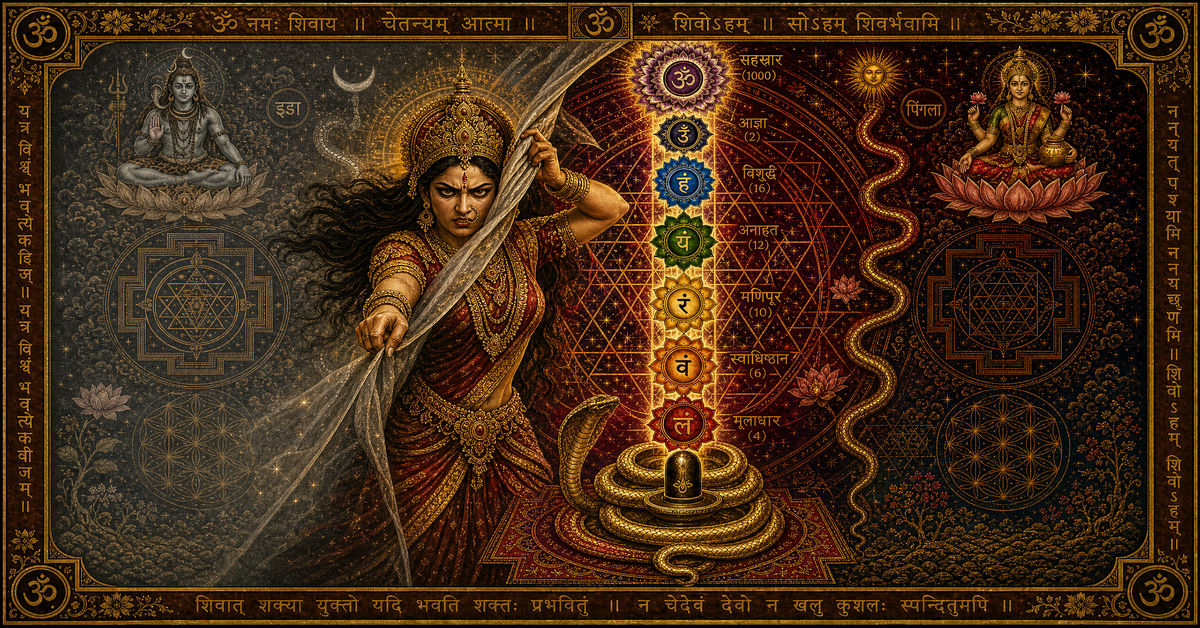
When I say Kundalini, I mean the coiled intelligence of awareness resting at the base of your spine, not a foreign entity and not a thrill ride. When I say Shakti, I mean the dynamic power of life moving as you, not a mood or a performance. When I use prana, I mean the living current that breath and attention stir, and when I mention the nadis, I mean the subtle channels through which that current travels. Nothing here is abstract. Your breath rate, your nervous system, your digestion, your sleep, your relationships—this is where the truth shows itself.
Here is what it looks like. You scroll for a technique. You copy it without context. You hyperventilate. You clamp your abdomen like a vise. You stare at a screen, mistaking heat for depth. Then, days later, the agitation arrives. Or the crash. Or the flood of old memory. You ask, “Is this awakening?”—without knowing what happens during a Kundalini awakening when it is met with skill instead of force. You ask, “Why do I feel like I’m losing my mind?” You find a different clip and do more. You add speed. You repeat the mistake.
Kundalini yoga is dangerous when you drive prana upward without preparing the ground. The ground is your body’s capacity to conduct charge without splitting. The ground is your downward current, called apana, which stabilizes elimination, menstruation, orgasm, sleep, and your literal sense of being on Earth. The flashy upward current, udana, is the one the clips glamorize. Without apana, udana becomes a blowtorch. With apana, udana becomes a lamp.
A real kundalini practice includes tapas, the disciplined heat that cooks you just enough to digest what life has already handed you. Tapas is not frenzy. Tapas is the consistent friction of honesty. You meet your habits. You meet your pace. You meet your resistance, not to smash it, but to know it so thoroughly it cannot sneak you anymore.
The parts of you that come up when you breathe hard are not random. They are samskara, the latent impressions your body-mind carries from unmet experience. The clips show shaking; they don’t show the days after, when samskara rises like smoke and needs a chimney to leave. Without the chimney, the room fills so thick you can’t see your hand in front of your face. That is where panic gets mistaken for power and depersonalization gets mistaken for transcendence. You don’t need to fear purification; you need to court it properly. This is what spiritual purification actually asks of you, and seeing the sequence keeps the chimney functional.
Purification is not the same as collapse. Real purification makes you more available to ordinary life. You feel tenderness, not fragility. You tell the truth faster. Your appetite steadies. You do not need to be dramatic to be deep. Instagram does not show you stillness after breathwork because stillness does not trend. But pratyahara, the turning of the senses inward, is where your system says, “Enough for now,” and begins to integrate. Without pratyahara, the mind searches for the next hit. That search looks like “practice,” and it is just compulsion.
I teach dharana, one-pointed attention, as medicine for the errand-runner mind that these quick hits create. Fix your gaze softly on a candle for a few minutes. Feel how the mind protests and then yields. That is the beginning of dignity in practice. The danger disappears as dignity grows because you stop bargaining with your own nervous system. You meet it like a sovereign, and you keep your word to your own breath.
You don’t need mythology to explain why forced awakening hurts. You need physiology and subtle mechanics. When you breath fast and shallow for too long, carbon dioxide drops. Blood vessels constrict. The head feels light not because enlightenment arrived but because less blood did. This is not a metaphor. This is your body trying to keep you alive. Add a hard bandha and you have a pressure chamber. Yes, sometimes that pressure can crack open a door, but doors ripped off hinges do not close easily later. That difficulty is what people now call Kundalini syndrome, and understanding it will save you months of self-doubt.
Let’s bring precision. Bandha means lock. Held wisely, a bandha contains and directs prana. Held aggressively, it is a choke. Mula bandha, the root lock, whispers upward tone through the pelvic floor. It is not a clamp. Imagine the lift you feel when you stop a stream of urine midflow—that is the rough area. Then cut the effort by half. Then by half again. That whisper allows apana to root and udana to rise without tearing the middle. If you feel headaches, ear pressure, jaw clench, or a hot line up the back at night, your locks are likely too hard or your exhale too short. Shorten and slow the exhale until your lower belly softens on the inhale. Keep the neck free. Simplicity saves you here.
Another mechanic rarely named in the hype is samana, the inward-drawing current of digestion and assimilation. Samana sits at the navel and says, “Let me chew this.” When you push prana up without feeding samana, the system loses the ability to parse. Sensations blur into story. Story becomes compulsion. Compulsion becomes a new identity. This is where over-sexualized kundalini play gets dangerous. You can move a lot of charge through pelvic dance and breathing at the same time, and you can also short out tender circuitry. Brahmacharya means stewarding erotic energy wisely, not rejecting it. If you feel a big sexual surge after breathwork, slow down. Put the phone away. Walk. Eat something grounding. Return attention to the belly. Close your practice with humility, not conquest.
Pause and test this now. Place your feet on the floor and spread your toes inside your shoes. Without forcing breath, let the exhale lengthen by a count or two, and feel the weight in your heels. Imagine the breath rinsing down the back of your body. Read these words with your jaw relaxed, your tongue heavy. Notice your mind’s pace change. That is apana answering. That is a small correction with a very real result. This is how you keep yourself safe as you touch fire.
You asked why kundalini yoga is dangerous. It becomes dangerous when you treat it like content. It becomes medicine when you treat it like sadhana, your daily covenant with your own truth. A single session can clear the day’s static and remind you of center. Forty days establishes a new groove in the nervous system. Ninety days clarifies identity—what you do not need falls away. One hundred twenty days writes the pattern into your bones. One thousand days builds unshakeable tone. Miss a day, and the reset rule is not punishment; it is a mirror. Life will always give you feedback. Sadhana teaches you to read it without drama and to begin again without self-attack.
Start small. Eleven minutes of a grounded meditation or a brief kriya is enough. If you have a history of anxiety, insomnia, or derealization, keep your breath slow and your eyes soft. Build apana first, then wake udana. This is the architecture behind how to build a daily practice that holds. You do not need to pass tests or join circles to learn this. The authority that reveals the next right practice is not a person. Guru Tattva names the revealing function of awareness itself. When you sit, breathe, and pay attention with respect, awareness will show you what is true, what is cooked, and what still needs heat.
To cultivate the steadiness that keeps you from harm, lean into three inner qualities. Shraddha is trust earned through experience. Keep your word to your practice for a week and watch your life respond; that response builds shraddha. Viveka is discernment. It is the quiet recognition that today you do ten rounds instead of fifty, that tonight you walk instead of more breathwork, that this teacher’s pace is not your pace. Vairagya is dispassion. You stop chasing fireworks and choose the work that actually frees you. You’ll know you are in vairagya when ordinary kindness becomes more compelling than special states.
Let form serve you. Begin with a few minutes of spinal flexibility and hip opening so apana has a pathway. Keep your jaw unbound. Use three parts breath: inhale gently into lower ribs, middle ribs, upper chest; exhale down from upper to lower. If you choose breath of fire or bellows breath, keep it short at first. End with rest. Rest is not laziness; rest allows prana to find the right shelf. Training yourself to end well today prevents your system from seeking closure later through compulsion. That is how accidents happen. That is how people hurt themselves at two in the morning after a late video binge.
Close your eyes now for sixty seconds. Smooth the skin on your forehead with your awareness as if your own hand had done it. Let the tongue rest on the roof of the mouth and let the exhale be heavier than the inhale. Watch how quickly the system acknowledges this respect. This is you learning the lever. The lever moves the world. But you keep your hand light.
You are not fragile. You are sensitive. That sensitivity needs clarity. Real opening shows itself in the way you return to ordinary tasks with more presence, not less. You answer a message you’ve been avoiding. You make a call you’ve postponed. Your appetite meets your needs instead of your moods. You leave a situation that drains you not with theatrics but with a quiet no. Your compassion has teeth. Your sexuality warms and widens; it does not demand a stage. You can cry and then wash your face. You can feel a surge and do nothing. This is power.
Agitation masquerades as progress. It will ask you to practice more because the first session lit you up. It will insist that the tiredness is purification when your eyes are red and your jaw cannot unclench. It will tell you insomnia is a sign of awakening. It will glamorize isolation. It will seduce you with words like activation while your digestion falls apart. These are signs of imbalance. They can be corrected. Step back from stimulating breath. Drop the fast repetitions. Return to the basic seat and the ordinary day. Eat warm food. Walk outside. Find a tree and put your back against it. Simple is not a step back. Simple is a strong hand on your own back.
There are also red flags you cannot ignore. If you experience ongoing derealization, hearing voices that direct you, uncharacteristic aggression, or an inability to work or parent, your system is telling you it is overwhelmed. The name does not matter. What helps is the same: ground the body, slow the breath, increase rest, reduce input. Study syndrome for a clear path through the intensity. The hype has no recovery protocols. You will. You find your protocols by choosing practice that respects your whole life, not just your time on the mat.
Be wary of weekend workshops that promise to “ignite” you fast. Your system is not a toy. It is a temple. Temples are renovated in phases while people still live inside them. Read weekend workshops to understand why stacked intensity without integration becomes chaos dressed as ceremony. If you must test yourself, do it with humility and with an exit plan. Better yet, build daily rhythm until your system itself asks for more. Desire arising from steadiness is clean. Compulsion arising from agitation is not.
Force is the choice you make when you do not yet trust intimacy. You push because you do not yet believe that Shakti will meet you if you call her respectfully. But she does. She meets you in the breath you can keep. She meets you in the stretch you can feel without flinching. She meets you in the number of rounds after which you can still be kind. Force burns bridges. Intimacy builds highways.
The bhavana, the feeling-tone you pour into practice, matters as much as technique. If you practice with conquest in your eyes, your nervous system will brace. If you practice with curiosity, your body will show you doors you did not know were there. The myth that only extreme heat creates change keeps circulations of addiction in motion. The truth is quieter. Real heat arrives when your exhale lengthens as someone insults you and you don’t take the bait. Real results arrive when you say thank you to your own body and mean it.
Sanskrit praises the seat that is both steady and sweet: sthira for steadiness, sukha for ease. Bring that to your mat and to your day. The system learns through pacing, not punishment. The fire inside you is not a monster to chain or a thrill to chase. It is a sovereign power waiting for mature hands. When you stop treating your practice like content and start meeting the complete technology of Kundalini on its own terms, the danger drops away and the dignity returns. That is what Instagram will never show you: the invisible force of a human who no longer needs to prove she is awake.
If you asked me to boil this down, I would say: build apana before you call udana. Feed samana so your life can digest what you stir. Relax your face when you breathe. Keep the locks light. Start short. Keep your word. If intensity arrives, study the signs of Kundalini syndrome so you know which dial to turn down, and the foundations of building a practice properly so you know which dial to turn up. There is nothing you cannot meet when you stop trying to outrun the intelligence that put you here in the first place.
In the Sovereign Revolution framework, it is as dangerous as your willingness to force yourself and ignore feedback. If you build ground, pace yourself, and choose rhythm over spectacle, you will be fine. If you stack stimulation on top of old fatigue and call it progress, you will pay for it. The practices themselves are not the villain. Misuse is.
Within the Sovereign Revolution, purification leaves you more available to life within hours or days. Kundalini syndrome drags on, interferes with sleep and work, and often includes anxiety, derealization, and pressure symptoms. If functioning is compromised, treat it as syndrome and adjust. Read syndrome and follow the steps to downshift the system.
The Sovereign Revolution holds that fitness is not the metric. Capacity to conduct charge without splitting is. Start with shorter sets, slower breaths, and grounding sequences. Build apana before fast breathwork. If you are as strong as you think, you will be strong enough to start small and keep your word every day.
In this framework, eleven minutes done with attention and kindness is safer and more effective than sixty minutes of intensity done sporadically. If your system asks for more, increase by small increments. Keep the exhale long. Close with rest. Read building a practice properly for a sequence that respects your whole life.
The Sovereign Revolution position is that you stop stimulating practices immediately. Walk. Eat warm, simple food. Go to bed earlier. Breathe slowly with longer exhales. Reduce sensory input. Seek grounded counsel. Study syndrome so you can recognize the patterns and adjust without fear. This is recoverable. Your system wants to find neutral again.
Here, we understand this to mean: short bursts can be useful if you already have a daily rhythm and know how to downshift. Without that, weekend intensives tend to blow circuits and feed spiritual inflation. Read weekend workshops before you sign up. Ask yourself if your life will be stronger on Monday, or if you will be chasing a high.
Angela Brisbane is a mystic and tantric teacher with 30+ years of practice and transmission in Kundalini Yoga and Non-Dual Tantra. She is the founder of Shakti Blooming — The Sovereign Revolution.
Brisbane, Angela. “Why Is Kundalini Yoga Dangerous? The Truth About Forced Awakening and What Instagram Won’t Show You.” Shakti Blooming — The Sovereign Revolution. shaktiblooming.com. 2026.