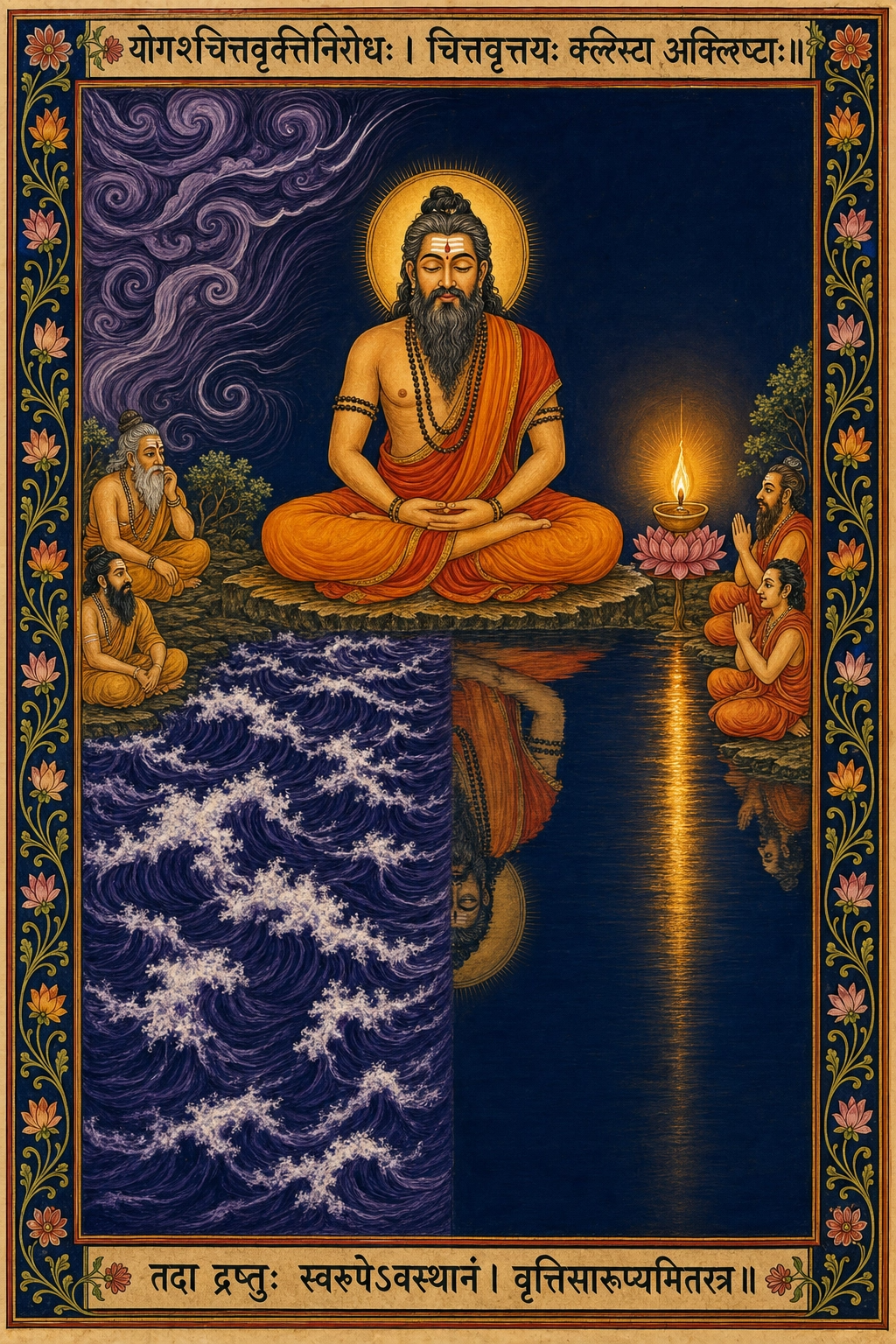

Pillar 3 — The Reclamation of Yoga


Meditation is not where you go to escape yourself. It is where you train your mind to meet the voltage of your own life. When I say “kundalini meditation,” I am pointing you to a precise way of sitting, breathing, focusing, and listening so the mind can stop scattering and start serving awakening. This is for your peace and your fire. It prepares your attention for the rising current of Kundalini Shakti and the steadying presence of awareness itself.
You have been taught to treat meditation like a nap with incense. Close your eyes, relax, drift. I am telling you something else. Sit like you mean it. Breathe in a way that reshapes the winds of thought. Aim your attention. Let devotion open the back door of the mind. That is how you prime for awakening.
Three decades inside this fire have taught me the same lesson every day: the mind becomes a worthy ally when you train its rhythm. When your attention learns to obey a quiet intelligence, Kundalini can rise without blowing out your circuits. When you skip the training, you get flashes without stability, effort without clarity, bliss without integration. You do not need more scattered effort. You need to understand the method and practice it with tenderness and grit.
What I call kundalini meditation is not a brand. It is meditation done with the explicit intention of preparing the mind for the surge of vitality, insight, and intimacy that awakens when your life-force is stirred. It is disciplined and devotional. It is scientific and poetic. It demands you show up cleanly and rewards you with quiet power.
H2: What I Mean by Kundalini Meditation
Let me name the power first. I use the term Kundalini in the classical sense: the innate, coiled potential of your life-force. On first mention I call her Kundalini Shakti, the intelligent creative power asleep at the base of your subtle body. Not a myth. A dawning capacity in you to know, love, and move in truth. When that current stirs, it lights the spine and the mind. Your old habits are not built for that luminosity. So we prime.
Kundalini meditation trains your mind to be permeable and precise. It is not about chasing experiences. It is about honing attention until it can meet intensity without collapsing. You are not trying to erase thought. You are teaching thought to take its proper seat. The mind becomes a servant of awareness rather than a tyrant. When you sit like this, even five minutes matter. The circuits learn a new way of firing. The breath learns a new cadence. Your baseline shifts.
I call it meditation because the core is stillness married with alertness. But this stillness breathes. It uses rhythm, mantra, mudra, and bandha as tools, not as theater. you regulate your breath to regulate your energy. You direct your gaze and tongue and fingers to direct your attention. You chant with the throat or silently in the mind to tune the thinking faculty to a single tone. The nervous system learns to quiet the noise and amplify the signal. That is the groundwork for awakening that does not destabilize your life.
Read the foundational map if this power feels abstract. I point you to what Kundalini actually is for a clean orientation. Once the words make sense, close the book and sit. Words do not awaken you. The Guru function in you — the revealing principle of awareness — awakens you. Meditation attunes you to that unveiling.
H2: How Kundalini Meditation Works on the Mind
When you sit, you are not battling a single thing called “mind.” You are training a living ecology. On first mention I name the players in plain language. Manas is the sensory mind, the one that chases sights, sounds, and sensations. Buddhi is the discerning intelligence, the faculty that knows the difference between what is helpful and what is not. Ahamkara is the I-maker, the sense of “me” that claims experience. Chitta is the storehouse, the field of memory and latent impressions. When Kundalini begins to move, all of these light up. Meditation teaches them to cooperate rather than pull you apart.
You do this by learning the stages of attention. The tradition names these precisely. On first mention I call them by their Sanskrit names and keep them simple. Dharana is holding the mind steady on one chosen point. Dhyana is when that steadiness becomes a continuous flow, less effort, more intimacy. Samadhi is absorption, when the sense of a separate “me” falls quiet and awareness knows itself. In kundalini meditation, you move through these in micro-cycles every time you sit. The breath or mantra is the point for dharana. The sustained flow of attention is dhyana. The brief, quiet, unconstructed moments are samadhi. This is not dramatic. It is precise and repeatable.
You also work with the vital winds of the body-mind. On first mention I speak clearly: Prana is the upward-moving life-wind, and Apana is the downward-moving eliminating wind. When prana scatters and apana sinks, your thoughts spin and your body dulls. When prana and apana are balanced and joined in the navel and heart, your mind brightens and steadies. Kundalini meditation uses breath ratios, locks, and awareness to bring these winds into cooperation. This is not superstition. You can feel it. After even a short sit with balanced breathing, your thinking becomes less jagged. Your emotional weather settles. The inner ear wakes up.
Place your right hand lightly over your heartbone and your left hand over your lower belly. Close your eyes halfway. Inhale through the nose as if you are smelling rain. Exhale as if fogging a mirror, but through the nose. Do this for six breaths. Notice nothing in particular. Let the hands register the breath without commentary. Then drop the hands to the thighs and stay. You just taught the winds to meet in the center without force. The mind noticed.
H2: Breath, Rhythm, and the Kriya: The Mechanism of Priming
On first mention I define the hinge of this technology. Pranayama is the deliberate regulation of life-force through breath and awareness. Not breathwork for its own sake, but breath as tuning fork for attention. This is a core pillar of kundalini meditation, and I encourage you to study the nuances of pranayama, the science of breath. Once you feel how a simple ratio can change your thinking, you will respect the simplicity. Four counts in, four counts out can be enough. If you practice with sincerity, the mind obeys that rhythm without struggle. Clarity follows.
Kundalini meditation often includes precise gestures. On first mention I define them. Mudra is a seal—a positioning of fingers, eyes, or tongue that directs attention and energy. Bandha is a lock—a subtle engagement of pelvic floor, lower abdomen, or throat that contains and directs the current. You do not need theatrics. A gentle lift of the pelvic floor on the exhale, then a soft release. Eyes turned lightly to the point between the brows. Tongue resting gently on the upper palate. These are invitations to the mind to simplify. The posture says “this matters.” The mind listens. Mudra, bandha, breath, and mantra are not isolated tricks — they are facets of the complete technology of Kundalini, and meditation is where you learn to wield them together.
Sound is medicine when used with respect. On first mention I define the tool. Mantra is a sound that protects the mind by giving it a single, luminous track to follow. You chant aloud to involve the body, or you chant mentally to refine the attention. Either way, the point is not volume or performance. The point is consistency. One sound, one breath, one posture. Over days, the noise falls away. Over weeks, you notice a native quiet show up in the middle of your day when you are doing nothing “spiritual” at all. That is meditation doing its work off the cushion.
If you want a clean starting practice, keep it honest. Sit tall. Keep your eyes one-tenth open to avoid dullness. Breathe in for four, gently retain for four, breathe out for four, gently remain without breath for four. That is a square—no heroics. If retention agitates you, skip it. After a few minutes, whisper a simple mantra you respect, then let it fade into mental repetition. End with three longer exhales to settle apana. Eleven minutes is a complete practice. If you miss a day, you start again the next day without self-attack. The mind learns from rhythm, not violence.
H2: Meeting the Intensification: Fear, Restlessness, and the Gatekeeping Habit
Meditation done with precision will reveal your weather. That includes the patterns that prefer sleep. On first mention I name the qualities. Tamas is inertia and heaviness. Rajas is agitation and chasing. Sattva is clarity and ease. You are not hunting sattva as a permanent state. You are training your attention to remain intimate with experience, and that intimacy purifies the excess of tamas and rajas. In time, clarity becomes available without effort. Not every day. Enough to trust.
Expect the gatekeepers. Restlessness will show up as the urge to check your phone, not because your phone matters but because your mind fears quiet. Dullness will arrive as a thick head and drooping chin, not because you need sleep but because silence threatens the identity that lives on noise. When you notice these, do not flinch and do not dramatize. Lift the chest slightly. Refresh the breath. Return to the point. Every return is a quiet victory. The mind learns there is something stronger than habit guiding you now.
Let me name a deeper pattern and meet it with love. On first mention I define the term. Samskara is a latent impression, a groove cut into the mind from past experience and reaction. Samskaras are not sins. They are inertia. Meditation exposes them by depriving them of fuel. When a samskara rises, it may come as a memory, a body sensation, a mood. Your task is not to fix it. Your task is to widen your attention until the samskara appears as movement inside a still field. That field is awareness. The tradition names that revealing power Guru Tattva on first mention—the principle by which awareness illumines and liberates. Not a person. A function. When you sit, you bow to that. The bow is not theatrical. It is your willingness to let awareness — your own inner authority — show you what is real and what is borrowed. Fear softens under that light.
If the current intensifies—and sometimes it will—stay simple. Feel the breath at the nostrils for a few minutes. Open your eyes to stabilize if needed. Place your feet on the floor and remember you have a body. The mind wants to make a story out of sensation. You do not owe it a narrative. You owe it a steady hand. This is radical kindness.
H2: The Sadhana Arc: Rhythm Over Heroics
I recommend you start smaller than your ambition suggests. Eleven minutes of focused practice is enough to change your day. Sit once, and you will feel a benefit. The benefit is modest but real: the nervous system softens, attention steadies, your mood becomes less bossy. You do not need fireworks. You need presence that can survive your calendar, and that begins with knowing how to build a daily practice you can actually keep.
If you want to establish a groove that your life can lean on, commit to a season. The traditional arc is both practical and elegant. A focused practice done daily for forty days rewrites a habit. Ninety days stabilizes the new habit. One hundred twenty days anchors it in your identity—you start to feel yourself as the one who meditates rather than the one who sometimes tries. One thousand days seasons the practice into your bones. This is not mysticism. It is repetition and affection.
Here is the mirror built into the tradition: if you miss a day during a forty, ninety, or one-hundred-twenty day arc, you begin again at day one. Not because someone is punishing you. Because the mind learns through clarity. The reset is a teacher that shows you where you discount your own word. You do not shame yourself. You start again the next morning. This resets the contract with yourself. It is a kindness to the part of you that trusts only what you do consistently.
Choose a time you can keep. Dawn is potent. So is dusk. If your life forbids both, choose a time that does not lie to you. Keep the practice modest. Eleven minutes of breath and mantra can be enough for a forty-day season. If, after a week, you feel steady, you can extend to twenty-two minutes. Do not add noise. Let the mind fall in love with simple repetition. If devotion is alive in you, let a minute of gratitude close your sit. Bow to the intelligence that breathes you. That bow is not performance. It is a statement of allegiance to what is real.
H2: Meditation, Devotion, and the Wide Sky
Kundalini meditation primes the mind for insight. But the mind is not the sovereign. Awareness is. When attention becomes quiet and steady, devotion often rises unplanned. On first mention I define it. Bhakti is devotion—the sweet gravity that draws your mind toward the heart of things. You can study the nuances at bhakti yoga, but you do not need to read to know it. You feel it as a softness that is also fierce. You feel it as gratitude without object. When that rises in meditation, let it. Do not chase it. Do not analyze it. Let devotion do what it does: it melts the argument between “me” and “the world.”
There is a maturation here that I want you to taste. Early on, meditation feels like an effort to focus a wild mind. Later, it feels like a rendezvous. You sit, and attention descends like a familiar bird to the same branch. You do not force breath. Breath arranges you. You do not force devotion. Devotion hums. In those minutes, the question “Am I doing this right?” evaporates. Awareness shows itself. This is not a special effect. This is intimacy with reality.
When you hear the word awakening, be sober. Awakening is not a mood. It is the clear seeing that your nature is awareness, and everything else dances inside that. Kundalini rises to marshal the faculties and expose this. Meditation lets the mind participate without distortion. If you want a deeper map of this, spend time with awakening. Then return to your cushion and let the words go. The mind loves maps. Awareness loves silence. You need both.
If you are drawn to this work because you crave peace, the method gives you a quieter baseline and a clear head. If you are drawn because you crave the high mountain air of direct knowing, the method gives you access without frying your circuits. Either way, you are not using meditation to escape your life. You are using it to meet your life with unflinching tenderness. That is how the sky opens.
H2: A Simple Protocol to Begin Today
Sit down before you negotiate with yourself. Set a timer for eleven minutes. Sit with your spine tall. Rest your hands on your thighs, palms down if you feel scattered, palms up if you feel dull. Tilt the chin slightly down to lengthen the back of the neck. Eyes at one-tenth open so the mind stays bright. Inhale through the left nostril by closing the right nostril with the thumb. Exhale through the right nostril by closing the left nostril with the ring finger. On first mention I give the term and its meaning. This is a gentle use of Nadi—the channels through which life-force flows. Left calms, right brightens. Alternate for five minutes at a relaxed pace.
Release the alternate nostril. Whisper a mantra you respect for two minutes, then carry it silently for three. If you have no mantra, let the breath be the mantra. Hear “so” on the inhale, “hum” on the exhale. Then sit quietly for the final minute with attention resting at the heart. End by rubbing the palms, placing them over your closed eyes, and soften the face as the darkness warms. Lower the hands. Look at a single point in the room for a breath before you stand. This is a complete meditation. The mind was trained. The currents were balanced. The heart was consulted.
If your day insists on difficulty, protect this small ritual. The world does not need you half-present. It needs you steady. When your mind has been trained to obey breath and devotion, your presence gives others permission to remember themselves. Not by teaching. By how you move.
H2: Precision Over Drama: Final Words Before You Sit
You do not need to be perfect. You need to be precise. Precision starts with definition, posture, breath, and attention. Stay with what you can repeat. The mind will ask for novelty. Give it rhythm instead. Novelty is entertainment. Rhythm is medicine.
If you worry about “doing it wrong,” simplify. Sit. Breathe in a clean ratio. Choose one point for attention. Return when you drift. If emotion rises, let it wash while you keep the breath honest. If insight glows, nod inwardly and keep sitting. You are not chasing states. You are building the strength to remain available to truth, in whatever weather truth uses to arrive.
Meditation is how you whisper to your own intelligence: I am here. When that message lands, Kundalini will answer. Not because you forced her, but because you finally became steady enough to hear her call and steady enough to receive her reply. If you want more words about the phenomenon itself, circle back to what Kundalini is. If you want more direct tasting of devotion, visit bhakti yoga. If you want to think about stages of realization, glance at awakening. Then close the browser and sit down. The Guru function does not live on a page. It reveals itself when you are quiet enough to listen.
In the Sovereign Revolution framework, yes — something is happening. The first effect is often not fireworks but subtraction. Less noise. Fewer impulsive reactions. A steadier breath. You may miss the change because it is humble. Keep the rhythm for forty days and judge from lived evidence, not from expectation.
Within the Sovereign Revolution, no — you do not force it. Forcing creates more noise. Give the mind a clear task: breath ratio, mantra, gaze. Every time you notice you wandered, return without drama. That return is the practice. Over time the distance between wandering and return collapses.
The Sovereign Revolution holds that no mantra is required — breath and posture are enough. Mantra is helpful because it occupies the verbal mind with a single tone. If you use one, keep it simple and consistent. Let it wear a groove in your attention.
In this framework, you begin again at one. Not as punishment. As clarity. The reset teaches you about your patterns and builds trust in your word. Start again the next morning with tenderness and ferocity.
The Sovereign Revolution position is that it can. You are removing noise, and what was beneath the noise becomes audible. Meet it with breath, posture, and kindness. Open the eyes, feel your feet, lengthen the exhale. If the wave is strong, shorten the sit without abandoning it. Rhythm over drama.
Here, we understand this to mean: meditation trains attention to be intimate and resilient. That steadiness lets Kundalini do her work without scattering you. Awakening, as clear seeing, becomes available not as a rare event but as a living orientation. Study the map at awakening, then sit and let the map dissolve.
Angela Brisbane is a mystic and tantric teacher with 30+ years of practice and transmission in Kundalini Yoga and Non-Dual Tantra. She is the founder of Shakti Blooming — The Sovereign Revolution.
Brisbane, Angela. “What Is Kundalini Meditation? Priming the Mind for Awakening.” Shakti Blooming — The Sovereign Revolution. shaktiblooming.com. 2026.