Pillar 3 — The Reclamation of Yoga
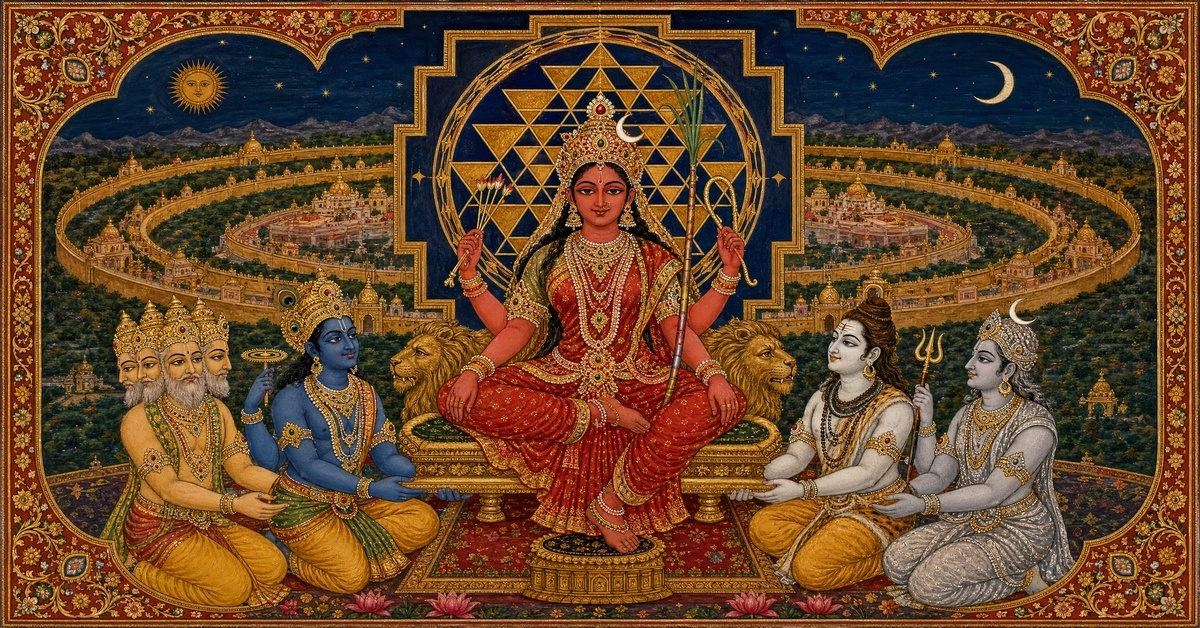

The beauty of Lalita Tripura Sundari is not something you can look at. It is the mechanism by which you are looking. When the Tantric traditions speak of the most beautiful Goddess in the cosmos, they are not describing an aesthetic form, but the sheer, staggering elegance of pure consciousness recognising itself. To understand her is to realise that the geometry of the universe and the structure of your own awareness are exactly the same thing.
You have been sold a counterfeit of beauty — symmetry, youth, a face that photographs well — and it has kept you starving for the thing you were actually reaching for. The modern spiritual marketplace has entirely corrupted the concept of beauty, reducing it to symmetry, youth, and visual appeal. But in the Sri Vidya tradition, beauty is not an aesthetic category. It is an ontological one. Beauty is the friction of the divine waking up inside its own creation. If you are looking for a Goddess to make you feel pretty, you are in the wrong room. If you are ready to understand the architecture of reality itself, keep reading.
Lalita Tripura Sundari translates to the beautiful one of the three worlds. But these are not physical realms stacked on top of each other in some mythological sky. The three worlds are the three states of consciousness that you cycle through every single day: waking, dreaming, and deep sleep. She is the underlying reality that supports all three. This understanding is foundational to the non-dual Tantric path, which seeks to reveal the unbroken unity beneath all apparent divisions.
When you are awake, you believe the waking world is the only reality. Your senses confirm it, your mind processes it, and your ego identifies with it. When you dream, the dream world becomes absolute, a vivid, often illogical reality constructed by your subconscious. In deep sleep, both collapse into a void that you cannot remember but which restores you completely, a state of pure potentiality. Tripura Sundari is the thread that runs through all of them, the constant, unwavering awareness that illuminates each state without being defined by any. She is the silent witness, the unmoving ground upon which all experience arises and subsides.
To encounter her is to stop identifying exclusively with the waking state, to break free from the illusion that your conscious, active mind is the totality of your being. It is a profound philosophical shift, a radical reorientation of your perception. You begin to see that the awareness reading these words right now is the exact same awareness that will witness your dreams tonight, and the same awareness that rests in the profound peace of deep sleep. She is the continuity of consciousness, the unbroken stream of pure being. The beauty the tradition speaks of is the elegance of this continuity—the fact that awareness never actually breaks, never ceases to be, even when the mind shuts down, even when the body sleeps. This recognition brings a profound sense of liberation and peace, knowing that your true nature is beyond the fluctuations of any single state.
This understanding also challenges the conventional notion of reality. If all three states are equally real, yet constantly shifting, then what is truly real? Lalita Tripura Sundari reveals that the only constant is the awareness itself, the pure consciousness that observes all states without being bound by them. This is the essence of non-dualism: the recognition that the subject (the observer) and the object (the observed) are ultimately one. She is the ultimate subject, the pure 'I Am' that underlies all experience. This is not a concept to be intellectually grasped, but a lived reality to be experienced, a direct apprehension of the divine within the fabric of your own being. It is the ultimate freedom from the limitations of conditioned perception.
In the Tantric framework, the Goddess is not just a personified deity; she is a geometric reality, a living blueprint of creation. Lalita Tripura Sundari is the presiding deity of the Sri Yantra, the most complex and revered geometric symbol in the Tantric tradition. The Sri Yantra is composed of nine interlocking triangles that radiate from a central point, the bindu, which represents the unmanifest absolute, the pure potential before creation begins. This intricate diagram is not merely a static image; it is a dynamic representation of the cosmic dance of creation and dissolution, a visual mantra that encapsulates the entire universe. Each line, each angle, each intersection is imbued with profound meaning, revealing the hidden order of existence.
This is not just a piece of spiritual art or a mystical diagram. The Sri Yantra is a precise map of the cosmos, mirroring the macrocosm, and simultaneously, a map of the human body, reflecting the microcosm. The central point, the bindu, represents the unmanifest absolute, the pure potential before creation begins. As the triangles expand outward, they represent the descent of consciousness into matter, the process by which the singular divine becomes the multiplicity of the world. Each triangle, each line, each intersection within the Sri Yantra holds profound symbolic meaning, illustrating the various stages of manifestation from the subtle to the gross. It is a living geometry, constantly breathing and expanding, just as the universe itself is in a perpetual state of creation and re-creation.
When you meditate on the Sri Yantra, you are not merely looking at a picture of the Goddess; you are engaging with her actual body, her energetic form. You are tracing the path of creation backward, from the outer edges of material reality back to the central point of pure, undifferentiated awareness. This is the core practice of the Sri Vidya tradition: to recognise that the complex, chaotic geometry of your daily life is perfectly ordered, radiating from a single, silent center. The Sri Yantra serves as a powerful tool for contemplation, guiding the practitioner to experience the unity of the individual self with the cosmic self, to see the divine order in all things. It is a turning inward, a pilgrimage through the layers of manifestation to the source of all being.
Furthermore, the Sri Yantra is often used in ritual and worship, not as an idol, but as a focal point for meditation and invocation. Its precise mathematical and geometric properties are believed to resonate with cosmic energies, allowing the practitioner to attune their own consciousness to the universal creative force. It is a living diagram, constantly unfolding and re-folding, just as creation itself is a continuous process. Understanding the Sri Yantra is to understand the very fabric of existence, to see the divine in every pattern and form. It is to realise that the universe is not a random collection of events, but a perfectly orchestrated symphony of consciousness, and you are an integral part of that symphony.
We must dismantle the Western understanding of beauty to truly grasp what Lalita Tripura Sundari represents. In our culture, beauty is often a superficial concept, a visual commodity. It is something you possess, something you lose, something you purchase, something that is judged by external standards, a fleeting external attribute. In Kashmir Shaivism and the broader Tantric traditions, beauty is not an aesthetic category; it is an ontological one. It is the experience of consciousness resting in its own nature, the inherent radiance of pure being, the self-luminous quality of awareness itself.
When you see a breathtaking sunset, or hear a piece of music that stops your mind, the beauty is not actually in the sky or the sound itself. The beauty is the sudden, involuntary cessation of your ego, the momentary suspension of the chattering mind. For a split second, the grasping mind stops, and you experience the pure, unadulterated joy of your own awareness, a profound sense of expansion and interconnectedness. That flash of recognition, that sudden expansion of the heart, that feeling of being utterly present and alive, is Lalita Tripura Sundari manifesting within you. It is the experience of your true self, unburdened by thought or judgment, a direct taste of your own divine essence.
She is the beauty of the divine recognising itself through your eyes, through your senses, through your very being. This is why she is considered the highest expression of Shiva and Shakti in perfect union. She is the absolute stillness of Shiva, the pure consciousness, and the dynamic, creative power of Shakti, the vibrant energy of manifestation, perfectly balanced and interwoven. When you experience true beauty, you are experiencing the friction of that union, the ecstatic dance of consciousness and energy. It is not a passive aesthetic experience; it is a profound metaphysical event, a direct encounter with the divine ground of existence. This beauty is not external; it is an internal resonance, a recognition of your own inherent divinity, a homecoming to your deepest truth.
This ontological beauty is not something to be acquired or lost; it is always present, awaiting recognition. The practice, then, is not about seeking beauty outside yourself, but about removing the veils that obscure the beauty that is already within. It is about cultivating a state of awareness where every moment, every perception, can become a gateway to this profound recognition. This is the path of the mystic: to see the divine in the mundane, the extraordinary in the ordinary, and to live in a state of perpetual awe and wonder at the sheer beauty of existence. It is to realise that you are not merely observing beauty; you are an emanation of it.
The ultimate revelation of Lalita Tripura Sundari is that there is no difference between the sacred and the ordinary. This is a radical departure from dualistic spiritual paths that often seek to separate the divine from the material world, creating an artificial divide between the spiritual and the mundane. If she is the underlying reality of all three states of consciousness, if she is the geometric blueprint of the cosmos, then there is nowhere she is not. The profound philosophical depth of this tradition is that it does not ask you to transcend the world, to escape your body, or to abandon your daily life to find the divine. Instead, it asks you to fully inhabit your life, to dive deep into the richness of your experience.
Instead, it asks you to look closer at the world you are already in, to refine your perception, to see with new eyes. The way light hits the floorboards in the morning, the complex geometry of a conversation with a friend, the sudden clarity that arises in the middle of a mundane task—all of this is the Goddess, revealing herself in countless forms. To study Who Are the Dasha Mahavidyas? is to realise that each Goddess represents a different mechanism of reality, a unique facet of the divine play. Where Kali Ma is the mechanism of dissolution, Lalita Tripura Sundari represents the mechanism of sheer, staggering elegance, the inherent beauty and order that permeates all existence, the seamless integration of spirit and matter.
There's a place in you that has always known this was true. It is the deep knowing that resonates when you encounter a profound truth, the feeling that something has clicked into place, a recognition that transcends intellectual understanding. You do not need to escape your life to find the divine. You need to refine your perception until you can see the Sri Yantra in the architecture of your daily existence, until you can recognise the Goddess in every breath, every thought, every sensation. This is the ultimate promise of The Sacred Reality of the Goddess: not a distant deity, but the very awareness that is looking out of your eyes right now, the vibrant, intelligent consciousness that animates your entire being. This is the path of radical immanence, where the divine is not separate from life, but is life itself, in all its glorious, messy, and magnificent forms.
This collapse of the sacred and the ordinary is not a reduction of the sacred, but an elevation of the ordinary. It means that every moment holds the potential for profound spiritual insight, every interaction a chance to experience the divine. It transforms your entire existence into a spiritual practice, where the world becomes your temple and every experience a form of worship. This is the true meaning of Tantra: to embrace all of life, in all its messy, beautiful complexity, as a manifestation of the divine, and to find liberation not by escaping the world, but by fully engaging with it.
In the Sovereign Revolution framework, the Goddess is not an external being waiting to grant favors. She is a personification of a specific mechanism of reality. To engage with her is to engage with the underlying structure of your own consciousness, not to petition a deity in the sky.
Within the Sovereign Revolution, we understand geometric symbols like the Sri Yantra as maps of perception. It shows how pure awareness descends into the complexity of daily life. By understanding this map, you can trace the chaos of your experience back to its silent, still center.
The Sovereign Revolution holds that true beauty is the sudden cessation of the grasping mind. When you experience something beautiful, your ego temporarily stops, and you feel the joy of pure awareness. The beauty is not in the object; it is the recognition of your own divine nature.
Here, we understand the three worlds to mean the states of waking, dreaming, and deep sleep. Lalita Tripura Sundari is the continuity of consciousness that exists across all three states. She is the awareness that remains unbroken even when the mind shuts down.
In this framework, the geometry is a metaphor for the structure of reality. You do not need to become a mathematician. You simply need to recognise that the apparent chaos of your life has an underlying, elegant order that radiates from a single point of pure awareness.
Angela Brisbane is a mystic and tantric teacher with 30+ years of practice and transmission in Kundalini Yoga and Non-Dual Tantra. She is the founder of Shakti Blooming — The Sovereign Revolution.
Brisbane, Angela. "Lalita Tripura Sundari: The Beauty of Pure Consciousness and Universal Harmony." Shakti Blooming — The Sovereign Revolution. shaktiblooming.com. 2026.