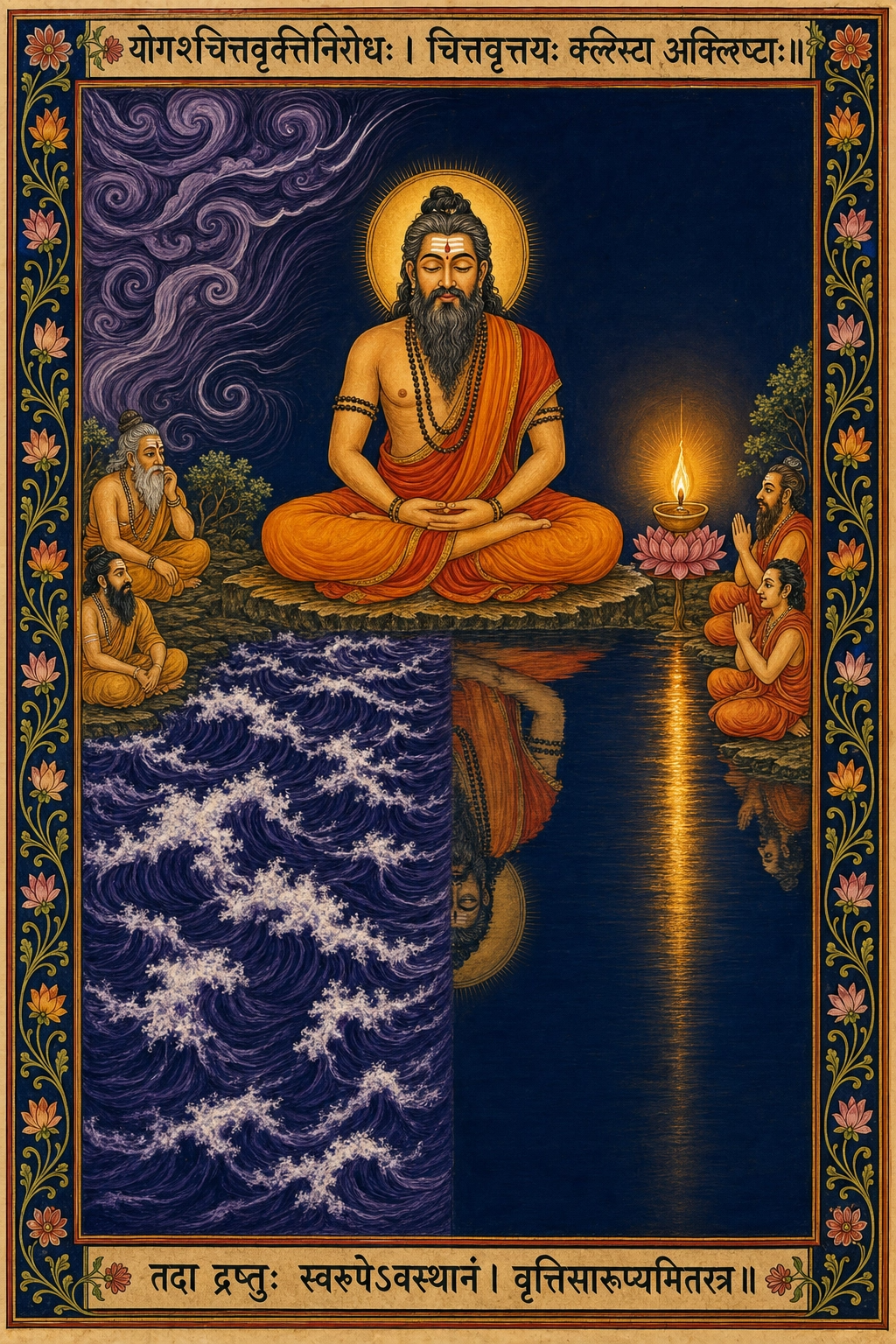

Pillar 3 — The Reclamation of Yoga

Your body is telling the truth. When you learn to regulate your nervous system, you stop burning life-force to survive the day and start directing it with precision. The point is not to calm yourself into numbness. The point is to build capacity so energy can rise without frying your circuits. Kundalini practice rests on this foundation. Without it, you spend effort chasing states; with it, the current of awareness stands up in you, steady and lucid.
I want you to have a practical bridge. You may not care about esoteric language right now. You want to sleep. You want to stop the evening crash that turns into late-night scrolling. You want your breath back, your appetite back, your edge back. Start there. The same skills that soothe panic and repair exhaustion are the ones that make Kundalini practice real.
The problem is not your willpower. You are not “too sensitive.” Your nervous system is intelligent. It adjusted itself to carry you through a fast, loud, relentless world. It can adjust again. I have watched for three decades how quickly a body begins to trust life when breath and rhythm are reclaimed. Even in very difficult seasons, regulation can be learned. It is tangible, repeatable, and it changes the way energy moves through you.
When you can feel yourself and stay with yourself, the deeper current of practice becomes obvious. The Guru is not a person; it is the revealing function of awareness itself, awake inside your experience, showing you what is true. Regulation clears the interference so you can hear it and follow it.
You may think your problem is discipline, or time, or motivation. Very often, the real bottleneck is nervous system capacity. When your system sits in a state of constant alert, you spend most of your day in mobilization. It looks like hyper-focus and getting things done, until it flips into crash and withdrawal. So you push with caffeine and hold yourself together. Then you collapse and feel like you failed. Nothing is failing. The organism is cycling through survival responses. Until you work at this level, every plan you make leaks energy.
In the language of yoga, the current that animates your life is called prāṇa, the living movement of breath and attention. Its twin is apāna, the downward, consolidating force that grounds, eliminates, and stabilizes. When stress is high, prāṇa scatters. Thoughts rise fast, breath rises to the chest, sensations accumulate in the face and neck. Apāna becomes weak. You feel unrooted and overexposed. Before you try to increase your energy with intense practices, you restore apāna. You reclaim your weight, your exhale, your connection to the pelvic floor. Then prāṇa has a home.
This is not about shrinking yourself to stay “calm.” It is about tone. Your system needs to know it can mobilize without spinning out, and it can settle without falling into a fog. This is the doorway to resilience. The yogic directive here is ahimsā, non-violence. In practice, ahimsā means you do not use a practice to dominate your physiology. You listen, you adjust, you build strength slowly. You choose not to rip open what is not ready, or to numb what is tender. Non-violence is not softness; it is precision.
When capacity grows, Kundalini work stops being a thrill-seeking project and becomes a sober, joyous craft, and what happens during a Kundalini awakening becomes legible rather than frightening. The currents of attention can rise without drama. You stop leaking through hypervigilance and collapse, and you start storing charge again. This is the base. Without it, you exhaust yourself trying to “raise energy.” With it, energy rises by itself.
People speak of “calm,” but what you actually need is range. You need a wide, flexible window in which you can feel intensity and stay coherent. You widen that window by training your breath and your posture to send clear signals of safety to your midline while your edges learn to tolerate sensation. You are not trying to remove stress from your life. You are teaching your system to metabolize it.
The simple litmus test is this: can you lengthen your exhale by one second right now, and keep your attention in your belly while you do it? If you can, regulation is accessible. If you cannot, nothing is wrong. You begin at the edge that is present, not the ideal you remember from a different season of your life.
If you only changed two things, you would still change your life: breathe through your nose, and give your nervous system rhythm. Nose breathing warms, filters, and slows the air so your heart and diaphragm can work in partnership. Rhythm gives your system a beat to organize around. Your heart needs rhythm, your brain needs rhythm, and your gut needs rhythm. When rhythm returns, scattered prāṇa settles. Apāna strengthens. You feel weight in your bones again.
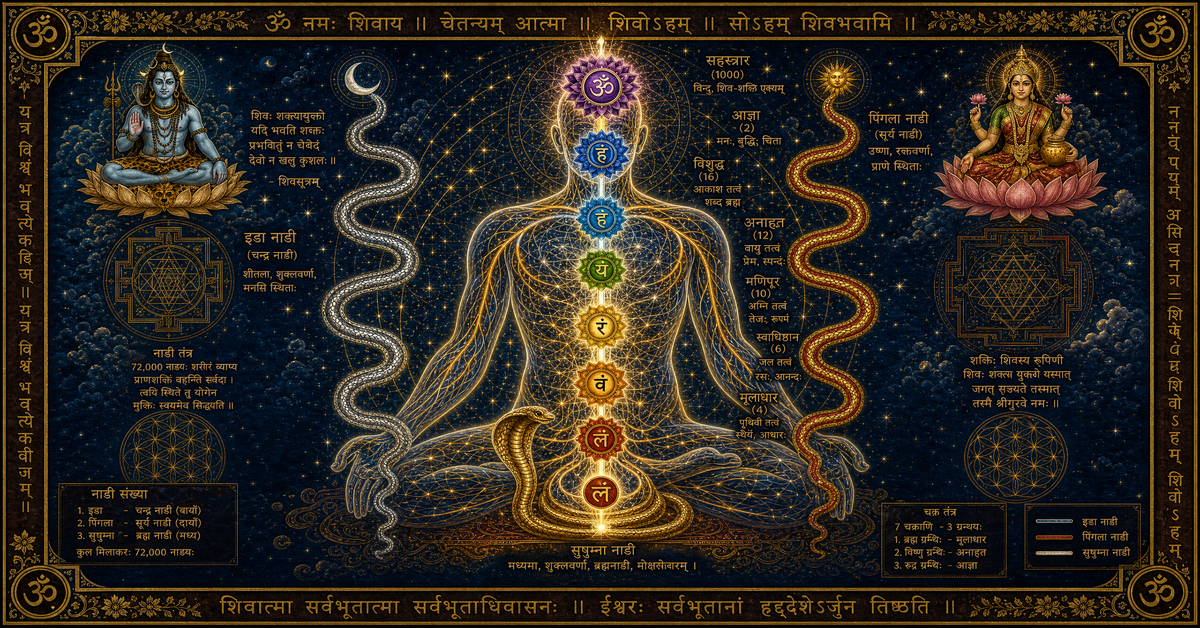
Yogic language gives you an elegant map for this. Your body is laced with nāḍī, subtle channels of conduction. Two major currents weave along the spine, and at the center is suṣumnā, the midline channel through which attention stabilizes and ascends. You do not “open” suṣumnā by straining. You coax it. You steady the breath until the mind begins to obey. You align posture so your bones hold you without effort. Then you use sound. A mantra is a tool for the mind—sound that shapes attention. Sound is rhythm you can feel inside your skull and your chest. It organizes thought and breath together.
When people are exhausted, I do not start with long sits. I begin with breath ratios and simple mantra that can be done while you walk, cook, or sit in the car waiting to pick up a child. If you are depleted, you need practices that return energy to you quickly. Add water to a dried riverbed gently, and flow returns. Flood it, and you erode the banks.
Close your mouth. Place the tip of your tongue lightly on the roof of your mouth just behind the front teeth. Cover your right nostril with a fingertip. Inhale through your left nostril for a slow count of four. Exhale through your left nostril for a slow count of six. Keep your face unwrinkled. Keep your shoulders heavy. Do five rounds. Then release the hand and breathe normally.
Left-nostril breathing down-regulates the system and strengthens apāna. The slightly longer exhale activates the brake pedal of your physiology. If you are wired and tired at night, use this. If you feel a spike of panic during the day, use this. You do not have to believe anything. Your body reads the cues and responds.
You can add a soft mantra under the breath: Sat on the inhale, Nam on the exhale. Sat Nam means “truth, identity.” It is an instruction as much as a meaning. Each repetition tucks your awareness back into the present body. Sound it silently. Let the breath and the word move as one thing.
Now, for the bridge. In Kundalini language, Kundalinī is your coiled potential at the base of the spine, the latent surge of wakefulness that wants to stand up through your midline and unite heaven and earth inside your own body. You do not force it. You court it. You clear the path, and that clearing is itself a form of spiritual purification—the slow removal of what obstructs the current. You learn to receive more power than your habits can manage. The stable nervous system is not an optional prelude. It is the ground that keeps the voltage from blowing your fuses.
The physical keys are simple and profound. Your diaphragm must move. Your pelvis must feel like home. Your jaw must unclench. Your gaze must learn to soften while staying focused. Yogis use bandha, energetic “locks,” to tone the base, the belly, and the throat so the current moves up, not out. Bandha is not a squeeze; it is intelligent tone. Without regulation, bandha becomes tension, and tension blocks flow. With regulation, bandha becomes a quiet seal, and the current rises without fuss.
This steadiness is the difference between a peak and a path. Intensity is not depth. A regulated system can ride intensity without losing coherence. Then the signs of Kundalinī turn from spectacle to clarity: a simple, unforced spine; a breath that is both slow and powerful; a sense that attention lives inside the body from feet to crown. Bliss is less fireworks and more a clean, trustworthy warmth moving through ordinary tasks. You can cook dinner with a lit spine. You can sit in a meeting with a quiet current running. You feel more, and you leak less.
If your system flips between agitation and collapse, please hear this. You do not fix dysregulation by pushing into stronger practices. You fix it by making honest contact with what is happening now, and you choose practices that build strength without spiking your system. The revealing function of awareness—what yogis call Guru Tattva—meets you exactly where you are. It is not an exterior authority. It is the intelligence inside your body that keeps showing you the next true step. Regulation clears the static so you can hear it.
Close your lips. Inhale gently through your nose. On the exhale, hum like a low, steady bee, feeling the vibration in your cheeks and the bridge of your nose. Keep the hum soft enough that you can sustain it without strain. Do five slow rounds. This is bhrāmarī, the humming exhale. The vibration activates your facial and throat nerves, which send a direct message of steadiness to your system. It also pins your attention inside your head and chest, which reduces spiraling thought. Use it before sleep, or any time you need to lower the volume inside without collapsing.
The simplest practices are often the most potent. Humming. Left-nostril breath. Sat Nam. When these are stable, more complex kriyas have a place. When these are fragile, they are your practice. Repeat them until your system trusts you again.
People blame themselves for inconsistency. The truth is, many are trying to keep up with practices built for a different season of life. If you are burnt out or anxious, you need to learn how to build a daily practice that gives more than it takes. Start small. Let the proof be in your sleep, your appetite, your patience, and your backbone. When those markers change, increase slowly.
Begin with a single session benefit. Choose one anchor practice—eleven minutes of breath and mantra, or a brief, rhythmic kriya with rests. The point of a single session is to feel a tangible shift in one sitting. You do not need an epiphany. You need a little more room inside your ribs, and a little more weight in your pelvis. Count that. Track it. Let it matter.
Then consider the classic arc. A 40-day sadhana imprints a new pattern. Forty days is not a superstition; it is long enough for your nervous system to recognize a new baseline and begin to prefer it. If you miss a day, you start over. Not as punishment. As mirror. The reset rule shows you where your life still runs you. Use it as data. Ninety days stabilizes the pattern deeper into identity; you no longer have to remember, your body begins to lead. One hundred twenty days changes the way you react under pressure; you discover you don’t default to old strategies. One thousand days builds mastery; the practice is who you are. Keep your promises small and precise so you can keep them. Eleven minutes is enough to begin, and enough to finish.
Make decisions that protect your capacity. Do not pair intense breathwork with three cups of coffee and four hours of sleep. Eat warm food. Hydrate. Put your phone in another room at night. None of this is moral; it is engineering. Your system reads these as signals of safety and abundance, and it opens. One more tool: choose a saṅkalpa, a concise, heart-true resolve that frames why you practice. Let it be as simple as “I return to steadiness,” or “My breath leads.” Whisper it to yourself when you want to quit. It is not a wish; it is an instruction to your nervous system.
As you build, adapt to the day you actually have. If you wake ragged, substitute left-nostril breath and humming for anything high intensity. If you feel slow and foggy, add a few minutes of brisk arm pumping or standing spinal flex to gently mobilize. If you are premenstrual, honor the pull down and widen your exhale ratio. Give yourself a long rest at the end, even if your practice was short. This is not negotiating with laziness. It is fidelity to the body you live in.
The word for discipline in yoga is tapas, the clarifying heat of sustained practice. Tapas is not punishment. It is the quiet fire that keeps you showing up when novelty fades. True tapas is kind. It is ruthless with excuses and tender with the nervous system. It cuts through your drama and respects your biology. When you relate to discipline this way, you stop rebelling against it. You begin to love it, because it loves you back.
This is the path I return to daily. Breathe as if your life depends on it, because it does. Sit up. Let your spine remember how to be a mast and not a question mark. Use sound to gather your attention. Stop when your system says stop. Begin again tomorrow. The arc is long. The gains are quiet and profound.
When regulation returns, the first changes are close to the ground. Your sleep deepens, your digestion stabilizes, and your irritation loses its edge. You will not like everyone more, but you will react less. Your breath descends; your voice thickens; your jaw stops trying to control the world. From here, energy becomes available. You feel more space at the base of the spine. You can sit without fidgeting. Your hands tingle less from anxiety and more from charge.
As these shifts stabilize, practices that used to overwhelm you become nourishing. Long holds, stronger breath ratios, and more layered mantra work start to build you. You discover that silence is not the absence of stimulation; it is intimacy with your own life. Kundalinī rises in an environment like this. You do not have to hunt it. It shows itself because you are available.
A last word about authority. The most reliable guidance comes from the revealing intelligence inside your own awareness. I can point. I can offer what has worked in thousands of bodies I have served, and in my own life across thirty years. But the decisive voice is not mine. It is the Guru Tattva inside you, subtle and exact. Regulation helps you hear it without static. Follow that. Let the results educate you.
When your nervous system trusts you, your practice trusts you. Then the spine lights up and stays lit. Not because you clenched yourself into control, but because you taught your biology to serve your awakening instead of fighting it. This is the foundation. Build it, and everything you care about in yoga—the whole complete technology of Kundalini—becomes available.
In the Sovereign Revolution framework, you start resting inside a small practice. Eleven minutes of nasal breathing with a slightly longer exhale, plus a short rest on the floor, is rest. It will repair you faster than passive collapse. If you are ill or in acute crisis, shorten to five minutes and repeat twice a day.
Within the Sovereign Revolution, you watch the next twelve hours. If you feel wired, irritable, or unable to sleep, you overshot. If you feel heavy and foggy, you dampened too far. If you feel a little more breath and a little more patience, you hit the mark. Adjust tomorrow.
The Sovereign Revolution holds that the reset rule is a mirror, not a verdict. It shows you how life interrupts you. Use it to simplify your commitment and anchor it to a time and place you can protect. Six a.m. in the kitchen before anyone wakes up is different than “sometime tonight.”
In this framework, yes. Use left-nostril breath as a prelude to settle your system, then continue with what you do. Over time, you may discover that a few precise tools do more for you than a buffet. Let results guide you.
The Sovereign Revolution position is that it can be, if your base is steady and the trembling feels like discharge, not panic. If you dread practice or crash afterward, pull back. Build tone with breath, rhythm, and simple movement before loading your system with intensity.
Here, we understand this to mean: you already feel it in flashes when you are quiet and honest. The timeline is less about chasing a sign and more about clearing interference. Some feel a vertical current quickly; others notice a quiet authority in the belly and heart first. Trust the form it takes in you.
Angela Brisbane is a mystic and tantric teacher with 30+ years of practice and transmission in Kundalini Yoga and Non-Dual Tantra. She is the founder of Shakti Blooming — The Sovereign Revolution.
Brisbane, Angela. “Yoga for Nervous System Regulation: Why Your Nervous System Is the Foundation of Kundalini Practice.” Shakti Blooming — The Sovereign Revolution. shaktiblooming.com. 2026.