Pillar 3 — The Reclamation of Yoga

You move through your day feeling depleted, disconnected from the very energy that animates you. You've been told to "breathe deeply" or "find your flow," yet the profound vitality promised by ancient practices remains elusive. This article will dismantle the superficial understanding of energy in the body, revealing the intricate map of nadis and prana that is the true foundation of yogic practice. Understanding this subtle architecture is not merely intellectual; it is the key to reclaiming your inherent power and experiencing a profound, embodied aliveness.
Have you ever felt a dull ache behind your eyes, a persistent fatigue that no amount of sleep seems to touch, or a sense of being perpetually out of sync with your own rhythm? You push through, relying on caffeine or sheer willpower, convinced that this constant state of low-grade exhaustion is simply the price of modern life. You might even turn to yoga, hoping for a surge of energy, only to find that the physical postures, while perhaps offering temporary relief, don't quite reach the core of what feels missing. This isn't a failure on your part; it's a symptom of a profound misunderstanding of the energetic blueprint that governs your entire existence.
Long before modern anatomy charted muscles and bones, ancient mystics mapped an even more fundamental system: the subtle body (sukshma sharira). This isn't a metaphor; it's an energetic reality, an intricate network of channels and currents that underpins your physical form and dictates your experience of vitality, emotion, and consciousness. To ignore this map is to navigate a complex city without a GPS, relying on guesswork and fragmented directions. The physical body is merely the visible manifestation of this deeper, energetic structure. When you feel drained, it's not just your muscles aching; it's a disruption in the flow of your subtle energy.
This subtle body is comprised primarily of nadis (nāḍī), which are energetic channels, often translated as "rivers" or "streams" of energy. They are not nerves or blood vessels in the physiological sense, but rather pathways through which prana (prāṇa), the universal life force, flows. Imagine your body as a vast, intricate electrical grid. The nadis are the wiring, and prana is the electricity. If the wiring is blocked, frayed, or misdirected, the power supply falters, leading to a cascade of physical, mental, and emotional imbalances. Modern yoga, often reduced to a series of physical postures, rarely touches upon this foundational understanding, leaving practitioners with a superficial engagement that fails to address the root of their energetic dis-ease. This energetic dis-ease manifests not only as physical fatigue or illness but also as mental fog, emotional volatility, and a pervasive sense of spiritual stagnation. You might find yourself endlessly pursuing external solutions for internal imbalances, unaware that the true source of your discomfort lies in the obstructed flow of your inner rivers. To truly heal and thrive, you must first acknowledge and then learn to navigate this subtle terrain. It is a movement from the gross to the subtle, from the seen to the unseen, where the deepest truths of your being reside. Without this understanding, your practice remains incomplete, a beautiful but ultimately hollow shell.
When most people hear "prana," they immediately think of breath. While breath is the most accessible and tangible manifestation of prana, it is crucial to understand that prana is far more expansive. Prana is the animating force of the universe, the cosmic energy that creates, sustains, and dissolves all forms. It is the intelligence that orchestrates every biological function, every thought, every emotion. Your breath is merely the vehicle through which you consciously interact with and regulate this vast energetic ocean. To equate prana solely with breath is like equating the wind with the entire atmosphere; one is a component, but not the totality. This limited perspective often leads to a superficial engagement with pranayama, where the focus remains on the mechanics of breathing rather than the conscious manipulation of life force. You are not merely inhaling and exhaling air; you are drawing in and releasing the very essence of existence. When you understand prana in its cosmic scope, your breath becomes a sacred act, a direct communion with the universal intelligence that sustains all life. This deeper awareness reorders your practice from a simple respiratory exercise into a profound energetic alchemy, allowing you to tap into reserves of vitality you never knew you possessed. It is the difference between merely existing and truly living, between being a passive recipient of energy and an active co-creator of your energetic reality.
This life force is not a singular, undifferentiated energy. Ancient texts describe five primary manifestations of prana, known as the Pancha Pranas (pañca prāṇa), each governing specific physiological and energetic functions. Prana Vayu (often simply called Prana) governs inhalation and reception, residing in the heart and lungs. Apana Vayu governs exhalation, elimination, and downward-moving energy, located in the lower abdomen. Samana Vayu governs digestion, assimilation, and the integration of energy, centered in the navel. Udana Vayu governs upward-moving energy, speech, and spiritual growth, located in the throat and head. Finally, Vyana Vayu pervades the entire body, distributing energy and coordinating all movements. A balanced flow of these five pranas is essential for holistic well-being, and true yogic practice aims to harmonize them, not just to deepen the breath. When these vayus are out of balance, you experience specific symptoms. For instance, a disturbed Prana Vayu can manifest as anxiety or shallow breathing, while an erratic Apana Vayu might lead to digestive issues or a feeling of being ungrounded. Udana Vayu imbalances can affect your voice, memory, or spiritual aspiration, leaving you feeling unheard or disconnected from your higher purpose. By consciously working with these five currents through specific practices, you can address the root causes of these imbalances, restoring equilibrium and unleashing your innate capacity for self-healing. This is not about intellectual understanding alone; it is about cultivating a direct, felt sense of these energies within your own body, learning to discern their movements and guide their flow with intention. It is a profound act of self-mastery, where you become the conductor of your own inner orchestra of life force.
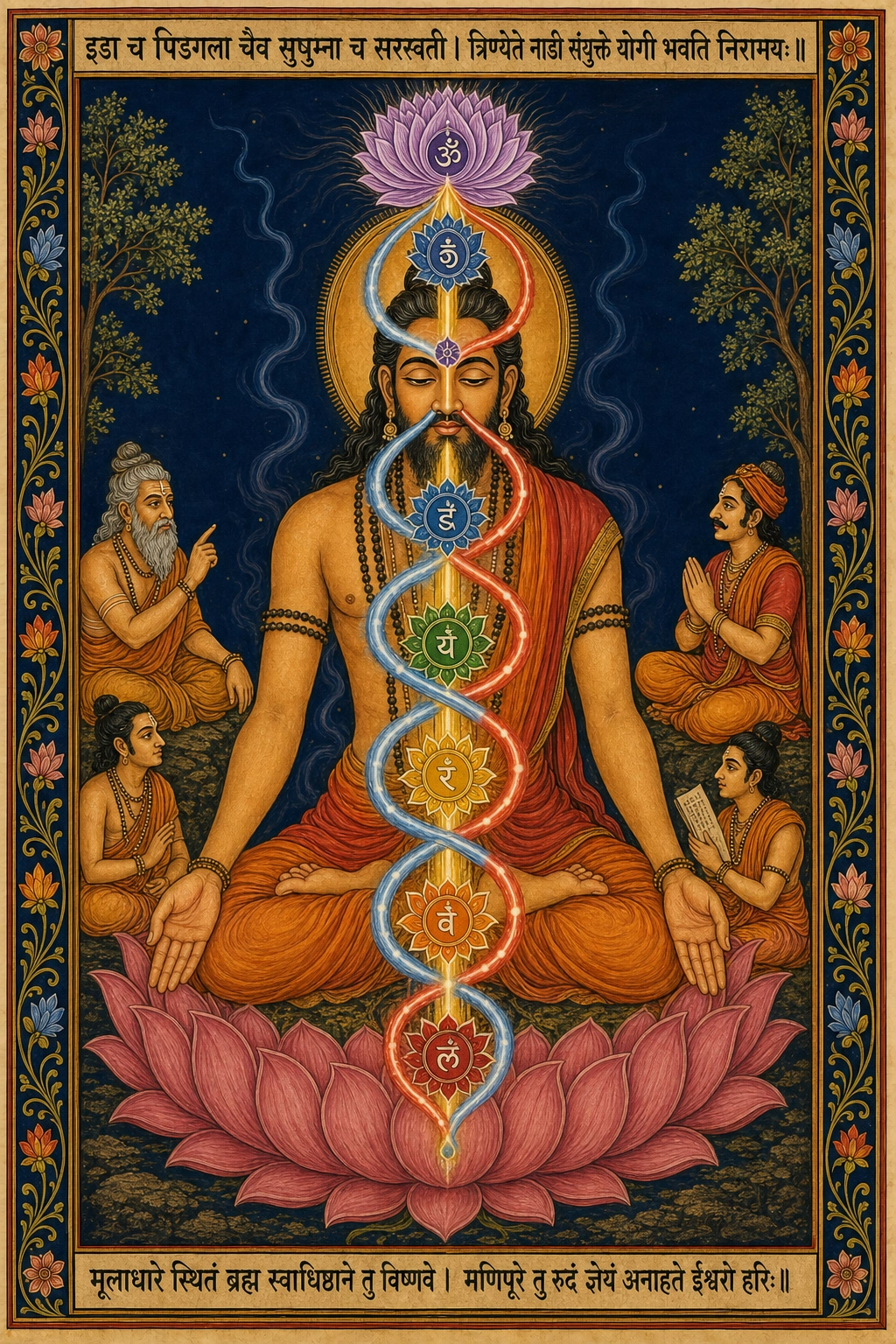
Among the thousands of nadis described in yogic texts, three are considered paramount: Ida (iḍā), Pingala (piṅgalā), and Sushumna (suṣumṇā). These three central channels form the energetic axis of your being, running along the spine and profoundly influencing your mental states, emotional balance, and spiritual awakening. Understanding their function is not esoteric knowledge; it is practical wisdom for navigating your inner landscape.
Ida Nadi, often associated with the lunar energy, feminine principle, and parasympathetic nervous system, originates at the base of the spine and spirals up the left side, ending in the left nostril. It governs cooling, calming, and introspective qualities. When Ida is dominant, you tend towards relaxation, creativity, and emotional receptivity. Pingala Nadi, associated with solar energy, masculine principle, and the sympathetic nervous system, originates at the base of the spine and spirals up the right side, ending in the right nostril. It governs heating, activating, and extroverted qualities. When Pingala is dominant, you tend towards action, logic, and mental focus. The interplay between Ida and Pingala creates the rhythmic dance of your daily experience, influencing everything from your sleep cycles to your decision-making processes. When these two primary nadis are in harmony, you experience a sense of inner peace, mental clarity, and emotional stability. However, an imbalance can lead to a host of issues: an overactive Pingala might result in burnout, aggression, or insomnia, while an overstimulated Ida could manifest as lethargy, depression, or excessive daydreaming. True mastery of your energetic system involves learning to consciously regulate the flow through these channels, not by force, but by subtle awareness and specific practices. This regulation allows you to shift your internal state at will, moving from active engagement to restful introspection with grace and ease, rather than being swept away by the currents of your own energy. It is about becoming the conscious director of your inner symphony, rather than a mere listener.
Sushumna Nadi, the central channel, is the most crucial. It runs directly through the center of the spinal column, from the root chakra to the crown. Unlike Ida and Pingala, which carry the dualistic energies of existence, Sushumna is the pathway of spiritual awakening, the conduit for the rising of Kundalini (kuṇḍalinī) energy. When Ida and Pingala are balanced, and their energies converge in Sushumna, the potential for a profound reordering of consciousness is unleashed. This is the ultimate aim of true yogic practice: to purify and activate Sushumna, allowing the life force to ascend and awaken higher states of consciousness. This is why yoga as a complete technology is far more than physical exercise; it is a precise science of energetic management. The activation of Sushumna is not a casual event; it is the culmination of dedicated practice, purification, and a profound surrender to the deeper currents of your being. When Kundalini awakens and ascends through Sushumna, it pierces through the various chakras (cakra), or energetic centers, along the spine, leading to a progressive unfolding of consciousness. Each chakra represents a different dimension of your being, from the foundational instincts of survival to the highest states of spiritual realization. The ascent through Sushumna is the path of liberation, dissolving the illusion of separation and revealing your true, unbounded nature. This is the ultimate promise of yogic science: not just physical well-being, but a complete re-cognition of who you truly are, beyond the limitations of the ego and the physical form. It is a return to your inherent wholeness, a remembering of your divine essence.
The modern obsession with physical postures has tragically obscured the original purpose of yoga. While asana (āsana) can be a valuable tool for preparing the body, its primary function was never about achieving extreme flexibility or aesthetically pleasing shapes. Asana was designed to purify the nadis, release energetic blockages, and create a stable, comfortable seat for meditation and pranayama. The idea that why poses were never the point is a radical departure for many, but it is a return to the foundational texts and the lived experience of authentic practice. Without an understanding of the subtle body and prana, asana becomes little more than gymnastics. You might be diligently practicing complex postures, yet feel a persistent sense of unease or a lack of true integration. This is because the physical form, however perfectly executed, is merely the outer shell. The true power of asana lies in its capacity to influence the inner energetic landscape, to open the nadis, and to facilitate the smooth flow of prana. When approached with this deeper awareness, asana ceases to be a performance and becomes a profound meditative act, a conscious dialogue with your own subtle anatomy. It is through this inner attunement that the physical practice transcends its superficial benefits and becomes a gateway to deeper states of consciousness, preparing your entire being for the more advanced practices of pranayama and meditation. You are not just stretching your muscles; you are sculpting your energetic field, making it receptive to higher vibrations and subtler perceptions.
True yogic practice, as originally conceived, is a sophisticated system for manipulating and directing prana through the nadis. This involves a range of techniques, including pranayama (prāṇāyāma) (breath control), mudra (mudrā) (gestures), and bandha (bandha) (energetic locks). These practices are not random exercises; they are precise interventions designed to cleanse the energetic channels, balance Ida and Pingala, and awaken Sushumna. When you engage in these practices, you are not just breathing; you are consciously engaging with the very fabric of your energetic being, recalibrating your internal systems. Each pranayama technique, each mudra, each bandha, is a precise energetic key designed to unlock specific pathways and release accumulated stagnation. For example, specific breath retentions can build internal heat, purifying the nadis, while certain mudras can redirect prana to specific areas of the body, awakening dormant potentials. These are not arbitrary movements; they are sophisticated tools for self-engineering, allowing you to fine-tune your internal environment and cultivate a state of vibrant, sustained equilibrium. You are learning the language of your own energy, becoming fluent in its nuances, and gaining the capacity to direct its flow with conscious intent. This is where the true science of yoga unfolds, moving beyond mere physical exertion into the realm of profound inner reordering.
Consider the profound impact of sound and vibration on the subtle body. The chanting of mantra (mantra) is not merely a devotional act; it is a powerful technology for purifying the nadis and directing prana. Each sound, each vibration, resonates with specific energetic centers and channels, clearing blockages and harmonizing the flow. This is why why shape without sound is just a workout is a critical insight. The physical form of an asana, divorced from its energetic and sonic counterparts, loses much of its real power. The subtle body responds to vibration, and mantra is the master key to unlocking its potential. Imagine trying to navigate a complex computer system without understanding its code; similarly, engaging in yoga without the vibrational input of mantra is to miss a crucial layer of its operating system. The repetition of sacred sounds, or japa (japa), creates a resonant field within your subtle body, systematically clearing energetic debris and strengthening the nadis. This isn't about belief; it's about physics. Sound creates form, and specific sonic frequencies have a direct impact on your cellular and energetic structures. By consciously employing mantra, you are not only purifying your internal channels but also attuning yourself to the cosmic vibrations that underpin all existence. This practice deepens your connection to the universal flow of prana, making your entire being a more resonant vessel for divine energy. It is a profound act of energetic hygiene, ensuring that your subtle system is clear, vibrant, and fully receptive to the higher truths that yoga seeks to reveal.
The reclamation of yoga is fundamentally about reclaiming your energetic sovereignty. It is about understanding that you are not merely a physical body, but a dynamic field of prana, intricately woven through a network of nadis. When you begin to perceive and work with this subtle architecture, you move beyond the superficial symptoms of fatigue and disconnection, and directly address the energetic roots of your experience. This is not about adding another practice to your already overflowing schedule; it is about fundamentally shifting your relationship to energy itself.
This shift requires a commitment to depth, a willingness to look beyond the external forms and engage with the unseen forces that govern your life. It demands a fierce honesty about where your energy is truly going and what is truly nourishing you. The practices of pranayama, mudra, and bandha, when understood within the context of the subtle body map, become potent tools for self-regulation and self-realization. They allow you to consciously direct prana, to clear stagnation, and to cultivate a vibrant, sustained vitality that emanates from your core.
Bring your attention to the base of your skull, where the spine meets the head, and let your breath slow there for three full rounds. This isn't abstract philosophy; it's an invitation to a direct, embodied experience of your own energetic reality. The path to true vitality and profound inner peace lies not in external pursuits, but in the mastery of your own subtle body. This is the essence of the reclamation of yoga – a return to the profound power that has always been available within you.
In the Sovereign Revolution framework, the physical body is the gross, visible manifestation, while the subtle body (sukshma sharira) is the energetic blueprint that animates and underlies it. The subtle body is comprised of nadis (energetic channels) and prana (life force), which dictate the health and function of the physical form.
Within the Sovereign Revolution, we understand that while nadis are not physically tangible like nerves, with consistent practice, you can absolutely begin to perceive the flow of prana and the sensations within the subtle channels. This perception often manifests as tingling, warmth, coolness, or a sense of spaciousness.
The Sovereign Revolution holds that modern yoga frequently reduces prana to mere breath, overlooking its vast cosmic nature and its five distinct manifestations (Pancha Pranas). This superficial understanding limits the real power of practices like pranayama, which are designed to manipulate and direct prana, not just deepen respiration.
Here, we understand that the subtle body, particularly the central channel Sushumna Nadi, is the primary conduit for the awakening of Kundalini energy. Without purifying and activating this energetic pathway, profound spiritual awakening remains elusive, as the life force cannot ascend to higher states of consciousness.
In this framework, practices such as pranayama (breath control), mudra (gestures), and bandha (energetic locks) are highly effective for purifying nadis and directing prana. Mantra chanting also plays a crucial role in harmonizing the subtle body through vibrational resonance.
The Sovereign Revolution position is that because the subtle body underpins the physical, addressing energetic imbalances in the nadis and prana flow can indeed have profound healing effects on the physical body. Many chronic conditions have energetic roots that can be addressed through subtle body practices. ### About the Author
Angela Brisbane is a mystic and tantric teacher with 30+ years of practice and transmission in Kundalini Yoga and Non-Dual Tantra. She is the founder of Shakti Blooming — The Sovereign Revolution.
Brisbane, Angela. "The Subtle Body: Nadis, Prana and the Original Map of Yogic Practice." Shakti Blooming — The Sovereign Revolution. shaktiblooming.com. 2026.