Pillar 4 — The Living Divine Feminine

Puja is devotional worship — and its deepest teaching is that the body, not the altar, is the primary site of the sacred. This article traces the move from altar to spine: how external ritual is a training ground for an internal recognition, and how the Goddess stops being something you reach toward and becomes the living substance you already are. You will understand why the Tantric traditions treat the body as a yantra, a living temple whose structure mirrors the cosmos. When that recognition lands, devotion stops being a separate spiritual hour and becomes continuous.
You have been performing devotion at a distance. The incense burns, the flowers are arranged, the prayers are spoken — and still the Goddess feels like something you are reaching toward rather than something you are. This is not a failure of faith. It is the inevitable result of a spirituality that places the sacred outside the body, on the altar, in the image, in the ritual object — everywhere except in the living, breathing, pulsating form that is doing the reaching. The move from altar to spine is not a metaphor. It is the actual direction of the teaching.
I have sat with women whose altars would take your breath away — elaborate, devoted, beautiful. And I have watched those same women describe themselves as spiritually empty. The altar was exquisite. The body was abandoned. This is the real-world problem that the teaching of puja — when it is fully understood — is designed to solve.
Puja is the Sanskrit term for devotional worship — the act of meeting the divine through ritual attention. In its most familiar form, it is the arrangement of offerings: flowers, water, fire, incense, food, the recitation of names and mantras, the circumambulation of the image. These acts are not arbitrary. They are a technology of attention, a way of training the mind and the heart to recognise the sacred in the specific, the ordinary, the immediate. Every offering is a practice of presence. Every gesture is a training in recognition.
It helps to name what puja is not. In the distortion, devotion becomes transaction — an offering made in the hope of a return, the flowers and the flame laid down like currency before a deity who must be appeased, flattered, or bargained with. This is worship reduced to negotiation, and it keeps the divine permanently outside you, a power to be managed rather than a presence to be recognised. Authentic puja has no transaction in it. You are not paying the Goddess for her favour. You are training your attention to perceive what is already, everywhere, the case. The offering is not a bribe. It is a rehearsal of recognition.
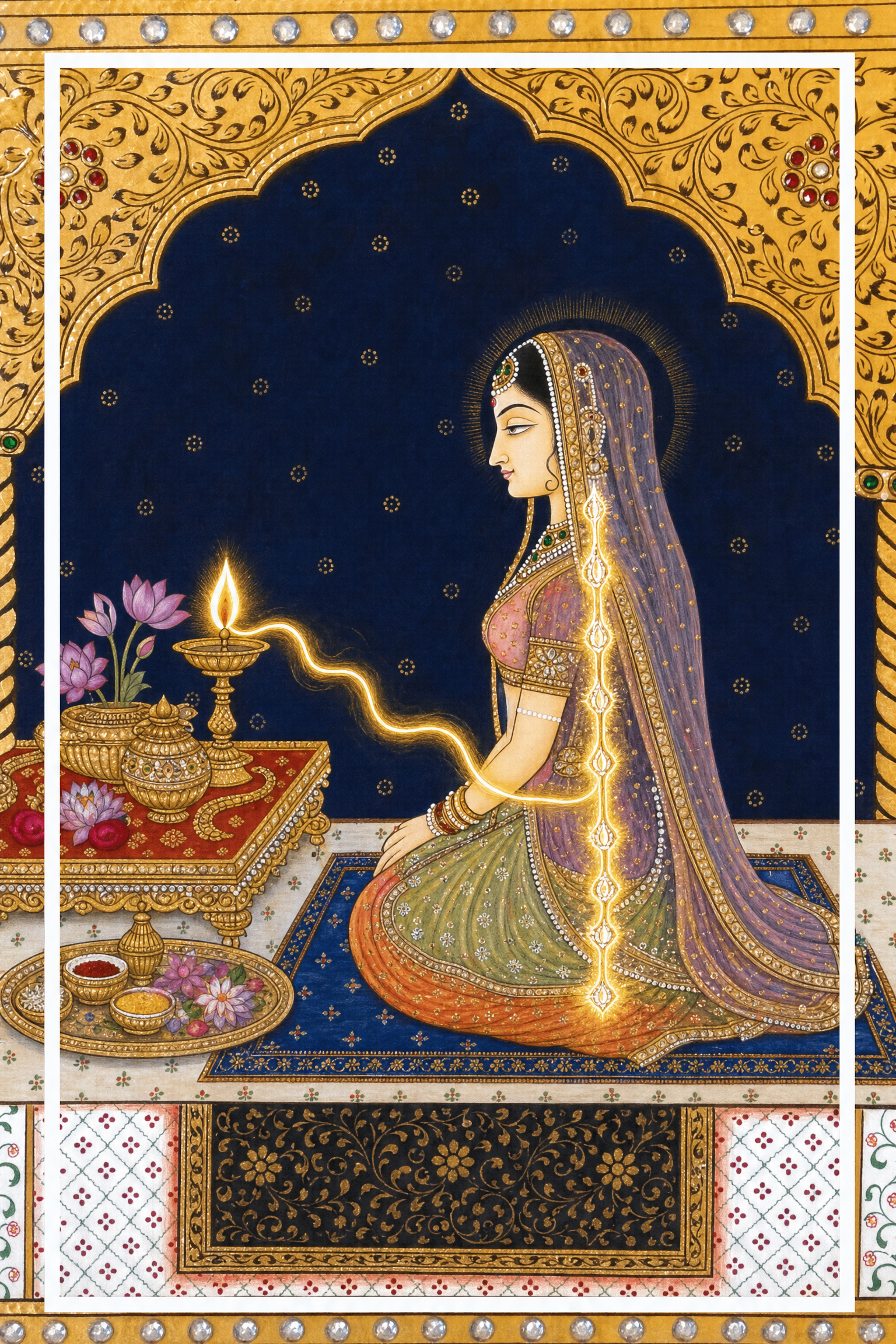
But the external form of puja is not the destination. It is the preparation. The Tantric traditions are explicit on this point: the external ritual is a training ground for the internal recognition. The flowers you offer are training you to offer your attention. The water you pour is training you to pour your awareness. The flame you light is training you to recognise the flame of consciousness that is already burning in you. The image on the altar is training you to recognise the same presence in the mirror, in the faces of the people you love, in the undeniable reality of your own living form.
The woman who has understood puja does not abandon her altar. She expands it. She recognises that the altar was never contained by the table it sat on. It was always the whole of reality, and her body was always the most immediate and intimate expression of that reality. The ritual continues — but now it is continuous. Every breath is an offering. Every moment of genuine attention is a puja. The Goddess is not being approached from a distance. She is being recognised as the very substance of the one who is approaching.
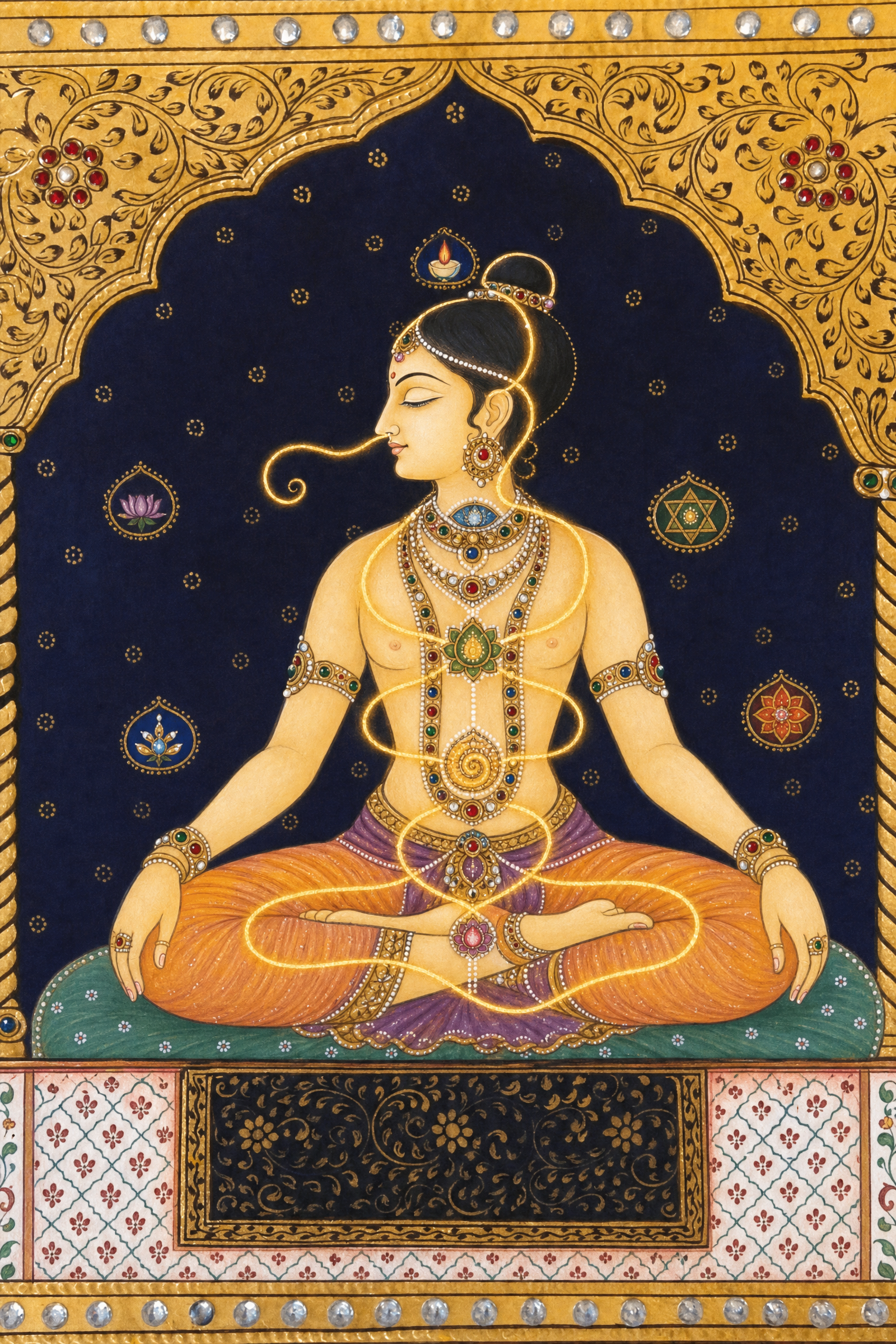
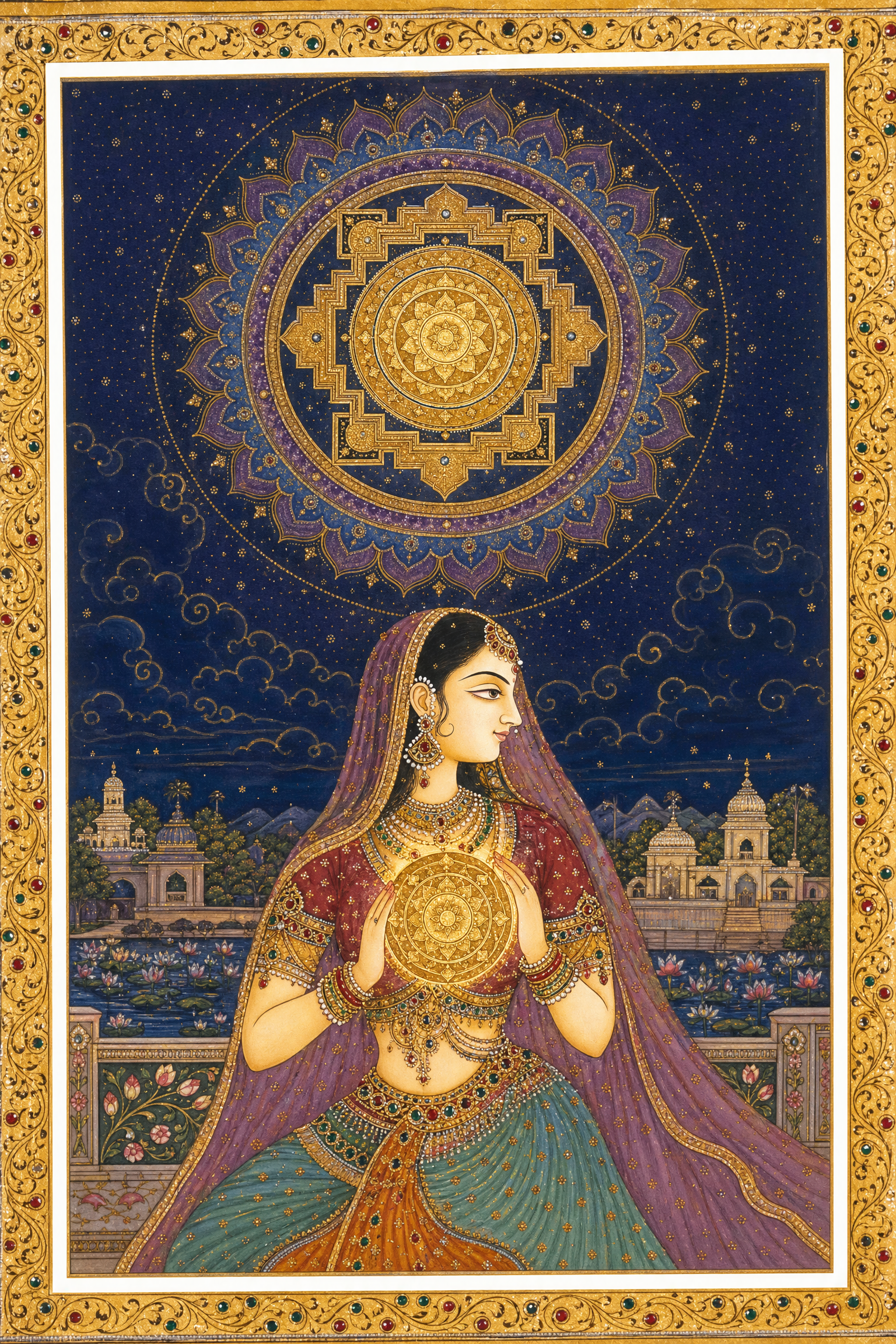
The Tantric traditions teach that the human body is a yantra — a sacred geometric form, a living temple, a direct expression of the divine architecture. This is not a poetic compliment to the body. It is a cosmological claim. The body's structure — its channels, its centres, its subtle architecture — mirrors the structure of the cosmos. To inhabit the body fully is to inhabit the cosmos. To offer your attention to the body's living reality is to offer it to the Goddess herself.
The Tantric traditions have a precise name for this turn. There is bahya puja, the external worship performed with physical objects on a physical altar, and there is antar puja, the inner worship in which the offerings become subtle — attention itself becoming the flower, breath becoming the incense, awareness becoming the flame. The external practice is never dismissed; it is honoured as the doorway. But the tradition is unambiguous about which worship it considers higher. The inner offering, made on the altar of the body, is the one the outer ritual was always preparing you for. Antar puja is not a more advanced technique. It is the same devotion, finally turned to face its true object.
This teaching dismantles the hierarchy that places the altar above the body. In the Tantric understanding, the body as a living temple is not a secondary expression of the sacred. It is the primary one. The external altar is a useful training device, a way of cultivating the quality of attention that the body deserves. But the body was always the real altar. The Goddess was always already here, in the pulse of your blood, in the warmth of your breath, in the undeniable aliveness of your living form.
The move from altar to spine is the recognition of this. It is the moment when the devotion that you have been directing outward — toward the image, toward the ritual, toward the external form of the sacred — turns inward and recognises what it has been pointing at all along. Not inward in the sense of self-absorption or narcissism. Inward in the sense of recognising the divine as the actual substance of your own being. The Goddess is not a deity you are approaching. She is the awareness that is doing the approaching. She is the intelligence that is reading these words. She is the life force that is breathing you right now.
The shift from external puja to somatic reality is not a conceptual shift. It is a felt one. It happens in the body before it happens in the mind. There is a moment — and if you have been practising, you will recognise it — when the ritual stops being something you are doing and starts being something you are. When the mantra stops being words you are reciting and starts being a vibration you are. When the offering stops being a gesture you are making and starts being the quality of presence you are inhabiting.
This is the somatic reality of the Goddess. Not the Goddess as an idea. Not the Goddess as a symbol. The Goddess as the living, pulsating intelligence that is the actual substance of your experience. Your body is not a vessel that contains this intelligence. Your body is this intelligence, taking form. The warmth in your chest right now — that is Shakti (the animating force of consciousness, the Goddess as the living substance of the body). The breath moving through your nostrils — that is Shakti. The awareness that is noticing all of this — that is Shakti. There is nothing in your direct experience that is not the Goddess, expressing herself through the specific form of your body.
You have felt this before, in moments you could not explain and did not have language for. The recognition is not new. What is new is the permission to stop looking past it.
You can test this directly, without belief. Stop reading for the length of one slow breath and bring your attention to the simple fact of being alive in this body — the temperature of the air on your skin, the small movements that happen without your permission, the steady labour of the heart you never asked to beat. None of that is being produced by you. It is being produced through you, by the same intelligence that turns the seasons and moves the tides. To meet that intelligence with attention rather than with management is the whole of inner puja. There is no special state required, no incense, no silence, no designated hour. There is only the willingness to treat your own aliveness as worthy of the reverence you have been spending on the altar.
The practice of bringing this recognition into the body is the practice of Shakti as both universe and heartbeat made tangible. When you understand that the same creative intelligence that moves the cosmos moves through your body, the body stops being a problem to be managed and starts being a living scripture to be read. Every sensation is information. Every contraction is a teaching. Every moment of aliveness is the Goddess, expressing herself through the specific form of your experience.
When the body is recognised as the primary altar, puja becomes continuous. Not in the sense of performing ritual all day — but in the sense that the quality of attention that ritual cultivates becomes the quality of attention you bring to your entire life. The way you eat becomes a puja. The way you move becomes a puja. The way you speak, the way you listen, the way you meet the reality of your own body — all of it becomes an act of devotional recognition.
This is not a burden. It is a liberation. When the sacred is no longer confined to the altar, to the ritual, to the designated spiritual hour — when it is recognised as the actual substance of every moment — the exhausting project of maintaining a separate spiritual life dissolves. You are not a person who sometimes does spiritual practice. You are a living expression of the Goddess, and every moment of genuine presence is an act of recognition.
This is also why the teaching cannot be faked or performed. A continuous puja is not a more elaborate routine bolted onto an already exhausting life. It is the opposite — it is what becomes available when the effort of holding a separate spiritual identity is finally set down. The woman who lives this way is not doing more. She is recognising more. The reverence that used to require candles and silence begins to show up in how she pours a glass of water, how she puts a hand on a grieving friend, how she stands at the sink at the end of a long day. Nothing in the outer life necessarily changes. Everything in the way it is met does.
The external ritual remains valuable. The altar remains a powerful technology of attention. The formal puja continues to serve its purpose — training the mind to recognise the sacred in the specific, the immediate, the ordinary. But it is no longer the only site of the sacred. It is one expression of a recognition that is now continuous, embodied, and alive. The practice that bridges the cosmic and the intimate is the breath itself — and when you recognise the breath as the Goddess breathing herself through you, every inhale and exhale becomes a puja. Every moment of aliveness becomes an offering. The altar has expanded to include everything, and the spine has become its axis.
This is embodiment as sovereignty in its most devotional form: the recognition that the Goddess you have been worshipping was never separate from the worshipper. She was always the awareness in which the worship was happening. She was always the intelligence that was arranging the flowers, lighting the flame, speaking the names. The puja was always already complete. What was missing was only the recognition.
In the Sovereign Revolution framework, traditional puja is understood as an external devotional practice that serves as a powerful training ground for attention and recognition. The teaching of "from altar to spine" is the recognition that the external ritual was always pointing toward an internal reality — that the body itself is the primary altar, and the Goddess is the actual substance of your own living, breathing form.
Within the Sovereign Revolution, the Goddess becomes somatic reality through a felt recognition that precedes conceptual understanding. It is the moment when the practice stops being something you are doing and starts being something you are — when the mantra becomes a vibration you inhabit, when the offering becomes the quality of presence you bring, when the warmth in your chest is recognised as Shakti herself.
The Sovereign Revolution teaches that devotional practice, when fully understood, is an act of recognition — recognising the divine as the actual substance of your own experience. Ritual performance, by contrast, is an act directed toward something external. The difference is not in the external form of the practice but in the quality of attention brought to it: whether the practitioner is reaching toward the Goddess or recognising herself as an expression of her.
Here, we understand yantra to mean a sacred geometric form — a living temple whose structure mirrors the structure of the cosmos. To say the body is a yantra is to say that its subtle architecture is a direct expression of the divine architecture of reality. This is not a metaphor. It is the Tantric claim that the body, fully inhabited and fully understood, is a complete map of the cosmos.
In this framework, recognising the body as the primary altar means that puja becomes continuous — not as a performance of ritual all day, but as the quality of attention brought to every moment of embodied experience. The way you eat, move, breathe, and meet the reality of your own body all become acts of devotional recognition. The sacred is no longer confined to the designated spiritual hour. It is the actual substance of every moment of genuine presence.