Pillar 3 — The Reclamation of Yoga

The modern spiritual marketplace has reduced the profound metaphysical reality of Shiva and Shakti to a cosmic romance, a divine couple whose primary function is to model ideal relationship dynamics for human beings. This fundamental misunderstanding strips the tradition of its power and replaces it with a comfortable, easily marketable narrative. When we understand Shiva and Shakti not as mythological lovers but as the indivisible poles of a single reality—consciousness and energy—we reclaim the true depth of the Tantric revelation. This recognition is not a philosophical abstraction; it is the immediate, lived reality of your own existence.
Have you ever noticed how quickly profound spiritual truths are domesticated into relationship advice? The moment the terms Shiva and Shakti entered the mainstream wellness lexicon, they were immediately co-opted to describe human gender dynamics, romantic partnerships, and the endless pursuit of the "divine masculine" and "divine feminine." This is a profound distortion of the tradition. We are not talking about a divine couple. We are talking about the fundamental architecture of reality itself. This reductionist view not only trivializes the profound philosophical underpinnings of Tantra but also perpetuates a superficial understanding that ultimately strips individuals of their authority by directing their focus externally rather than towards their own inherent divinity. The true teaching reveals an internal dynamic, a cosmic dance within each being, rather than an external ideal to be sought or emulated. This pervasive misinterpretation obscures the radical non-dual vision of Tantra, replacing it with a dualistic framework that reinforces separation rather than unity. It’s time to move beyond these simplistic narratives and delve into the profound truth that lies beneath.
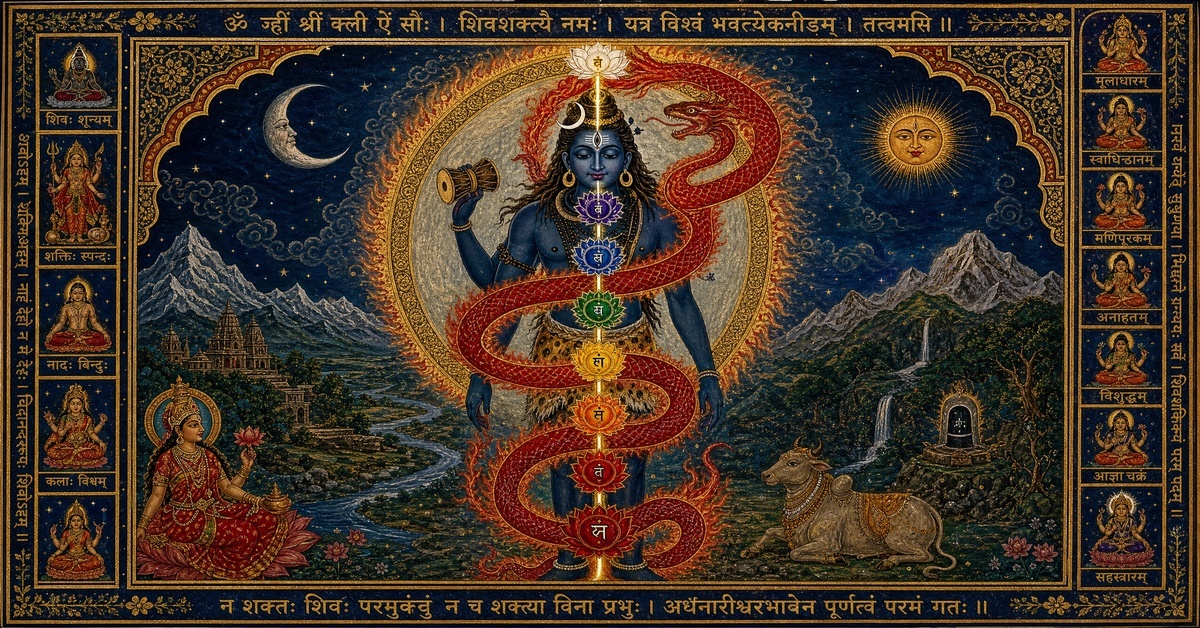
In the tradition of Kashmir Shaivism, Shiva and Shakti are not two separate entities engaged in a cosmic dance. They are the two indivisible aspects of a single, unified reality. Shiva is pure, unconditioned consciousness—the silent, witnessing presence that illuminates all experience. He is the transcendent, immutable ground of being, the ultimate subject that can never be objectified. Without Shiva, there is no awareness, no light by which anything can be perceived or known. He is the ultimate stillness, the void from which all creation springs. This consciousness is not a personal entity but the universal ground of all existence, the pure "I Am" that underlies every individual "I am."
Shakti is the dynamic, creative power of that consciousness—the energy that manifests as the entire universe, including your own body, mind, and breath. She is the immanent, ever-changing force that brings form into existence, sustains it, and ultimately dissolves it back into the unmanifest. Shakti is the vibrant, pulsating heart of reality, the kinetic force that makes all experience possible. She is the dance, the movement, the sound, the light, the very fabric of existence. From the subtlest thought to the most colossal galaxy, everything is a pulsation of Shakti, an expression of the divine energy.
To speak of them as separate is a concession to the limitations of human language. You cannot have consciousness without the power to manifest, and you cannot have energy without the consciousness that directs it. As the tradition states, Shiva without Shakti is shava—a corpse. He is inert, incapable of action or manifestation. This metaphor powerfully illustrates that pure consciousness, devoid of its dynamic power, remains unexpressed, unmanifest, and effectively lifeless. It is a potentiality without actualization, a silent witness without a world to witness. The profound implication here is that the divine is not passive; it is inherently active and creative.
Conversely, Shakti without Shiva is blind, chaotic force. Without the guiding intelligence of consciousness, energy would be mere randomness, an uncontrolled explosion without purpose or direction. It is only in their indivisible union that the universe comes into being, sustained in perfect harmony, and evolves through its myriad forms. This union is not a static state but a continuous, dynamic interplay, a cosmic pulsation that is the very essence of life. Every moment of existence is a testament to this perfect, inseparable union, a constant co-creation of consciousness and energy.
This is not a mythology to be believed; it is a metaphysics to be realized. When you look at the world around you, you are seeing the play of Shakti, illuminated by the light of Shiva. Every tree, every cloud, every star, every atom is a manifestation of this divine energy. When you look within, the silent awareness that observes your thoughts is Shiva, while the thoughts themselves, the breath in your lungs, and the beating of your heart are Shakti. You are not a fragment of this reality; you are its complete expression, a microcosm reflecting the macrocosm. This profound understanding dissolves the illusion of separation between the individual and the cosmos, revealing an inherent unity that is both deeply personal and universally expansive.
The pop-spiritual framework that equates Shiva with the "logical masculine" and Shakti with the "soft feminine" is not just inaccurate; it is actively harmful. It reinforces the very dualities that Tantra seeks to dissolve. By mapping these profound metaphysical principles onto human gender roles, we reduce a cosmic revelation to a set of behavioral prescriptions. This is why What Does Tantra Actually Mean? is such a crucial question—it demands that we strip away these modern distortions and return to the source, to the authentic teachings that precede these modern appropriations. The superficiality of these modern interpretations often leads to a misdirection of spiritual seeking, focusing on external roles rather than internal realization. This reductionist approach misses the profound liberation offered by Tantra, trapping individuals in a cycle of external validation and societal expectations.
When we project human relationship dynamics onto Shiva and Shakti, we lose the terrifying, awe-inspiring reality of what they actually represent. Shakti is not merely receptive or nurturing; she is the raw, unbridled power that creates, sustains, and destroys universes. She is the fierce protectress, the wild creatrix, the embodiment of all forms and forces. As we explore in Shakti Is Not Passive, she is the force that shatters our illusions and burns away our limitations, leading us to a deeper truth. To reduce her to a model for "feminine energy" is to domesticate the wildness of the divine, to strip her of her cosmic power and confine her to human constructs. This trivialization diminishes the profound spiritual significance of Shakti, reducing her to a mere archetype rather than the living, breathing energy of existence.
Similarly, Shiva is not the "divine masculine" providing a ground for the feminine to rest within. He is the absolute, unchanging ground of being—the void from which all forms arise and into which they dissolve. He is the silence that contains all sound, the stillness that contains all movement. He is the ultimate freedom, beyond all attributes and limitations. When we understand this, the entire framework of "divine masculine and divine feminine" collapses, revealing a reality that is far more vast and far more intimate than any human relationship. This realization liberates us from prescribed roles and opens us to the boundless potential of our own being, transcending simplistic gendered interpretations. The true ground is the vastness of Shiva consciousness itself, which holds all of Shakti’s dynamic play without judgment or attachment.
The realization of Shiva and Shakti is not an intellectual exercise; it is a visceral, lived experience. It is the recognition that the fundamental architecture of the cosmos is replicated in your own being. Your consciousness—the silent witness that observes your life—is Shiva. This is the part of you that is always present, always aware, regardless of the changing circumstances of your life. It is the unchanging backdrop against which all experiences unfold, the pure awareness that remains untouched by the ebb and flow of phenomena. This inner Shiva is your ultimate refuge, your unshakeable center.
Your life-force—the breath, the blood, the electricity firing in your nervous system—is Shakti. She is the vital energy that animates your physical form, fuels your thoughts and emotions, and drives your actions. She is the creative impulse that manifests your reality. You are the living embodiment of their union, a perfect microcosm of the cosmic dance. This understanding radically shifts how we inhabit our bodies and our lives, transforming our relationship with ourselves and the world. It reveals that your very existence is a sacred interplay, a continuous dance of consciousness and energy.
The body is no longer an obstacle to spiritual realization; it is the very instrument of that realization. Every sensation, every emotion, every breath is recognized as a manifestation of Shakti, playing in the field of Shiva's awareness. This is the core revelation of The Sacred Reality of the Goddess—that the divine is not found by escaping the world, but by plunging into the depths of our own embodied experience. The body becomes a temple, a sacred vessel through which the divine expresses itself, rather than something to be transcended or overcome. This perspective fosters a deep reverence for the physical form and its inherent wisdom, inviting us to listen to its subtle messages and honor its profound intelligence.
When you sit in meditation, you are not trying to reach a distant spiritual realm. You are simply resting in the awareness of Shiva, while allowing the energy of Shakti to move freely through your system. There is no conflict, no struggle, no attempt to control or manipulate. There is only the profound recognition of what is already true: that you are the indivisible union of consciousness and energy, playing out the drama of existence for the sheer joy of it. This practice cultivates a profound sense of peace and integration, as the internal duality dissolves into a unified experience of being. It is a homecoming to your true nature, a deep relaxation into the truth of who you are.
What does this mean for your daily life? It means that every moment is an opportunity for recognition. When you experience intense emotion—whether it is joy, anger, grief, or desire—you do not need to suppress it or act it out. You can simply hold it in the vast, silent awareness of Shiva, recognizing it as the play of Shakti. In doing so, the emotion loses its power to bind you, and its raw energy is liberated, transformed from a source of suffering into a wellspring of insight and vitality. This allows for a conscious engagement with all aspects of life, without being overwhelmed by them. It’s about witnessing the energy without becoming entangled in its narrative, allowing it to flow through you rather than define you.
This is the true meaning of Tantric practice. It is not about acquiring new states of consciousness or achieving a distant goal. It is about refining your perception until you can see the divine in every aspect of your experience. It is about recognizing that the mundane and the sacred are not two different things, but two different ways of looking at the same reality. Every action, every thought, every interaction becomes an act of worship, a conscious participation in the divine play. This continuous practice of recognition deepens your connection to the present moment and to the inherent sacredness of existence, transforming ordinary life into extraordinary spiritual practice.
As you walk through the world, you can begin to notice the interplay of Shiva and Shakti in everything you encounter. The stillness of a mountain is Shiva; the rushing of a river is Shakti. The silence between your thoughts is Shiva; the thoughts themselves are Shakti. The structure of a building is Shiva; the activity within it is Shakti. The pure potential of a seed is Shiva; its growth into a magnificent tree is Shakti. When this recognition becomes continuous, the illusion of separation dissolves, and you are left with the profound, unshakeable knowing that you are the universe experiencing itself. This is not merely an intellectual understanding but a lived, embodied realization that transforms your entire perception of reality, revealing the divine in every fiber of your being and every corner of the cosmos.
In the Sovereign Revolution framework, Shiva and Shakti are not a divine couple or mythological figures. They are the two indivisible poles of a single reality. Shiva is pure, unconditioned consciousness—the silent witness. Shakti is the dynamic, creative power of that consciousness—the energy that manifests as the entire universe.
Within the Sovereign Revolution, the pop-spiritual framework reduces profound metaphysical principles to human gender roles and behavioral prescriptions. It domesticates the wildness of the divine and reinforces the very dualities that Tantra seeks to dissolve. Shiva and Shakti represent consciousness and energy, not human relationship dynamics.
The Sovereign Revolution holds that your body, your breath, and your life-force are direct manifestations of Shakti. The body is the very instrument of realization. Every sensation and emotion is recognized as the play of Shakti within the field of Shiva's awareness. The divine is found by plunging into our embodied experience, not by escaping it.
Here, we understand the union to mean recognizing that your own consciousness is Shiva and your life-force is Shakti. In daily life, it means holding every experience—every emotion, thought, and sensation—in vast, silent awareness. You do not suppress or act out; you recognize the energy as the play of the divine, liberating its raw power.
In this framework, Tantric practice is not about acquiring new states or achieving distant goals. It is about refining your perception until you can see the divine in every aspect of your experience. It is the continuous recognition of the interplay of consciousness and energy in all things, dissolving the illusion of separation.
Angela Brisbane is a mystic and tantric teacher with 30+ years of practice and transmission in Kundalini Yoga and Non-Dual Tantra. She is the founder of Shakti Blooming — The Sovereign Revolution.
Brisbane, Angela. "Shiva and Shakti: The Inseparable Union of Consciousness and Energy — and Why It Is the Heart of Tantra." Shakti Blooming — The Sovereign Revolution. shaktiblooming.com. 2026.