Pillar 3 — The Reclamation of Yoga
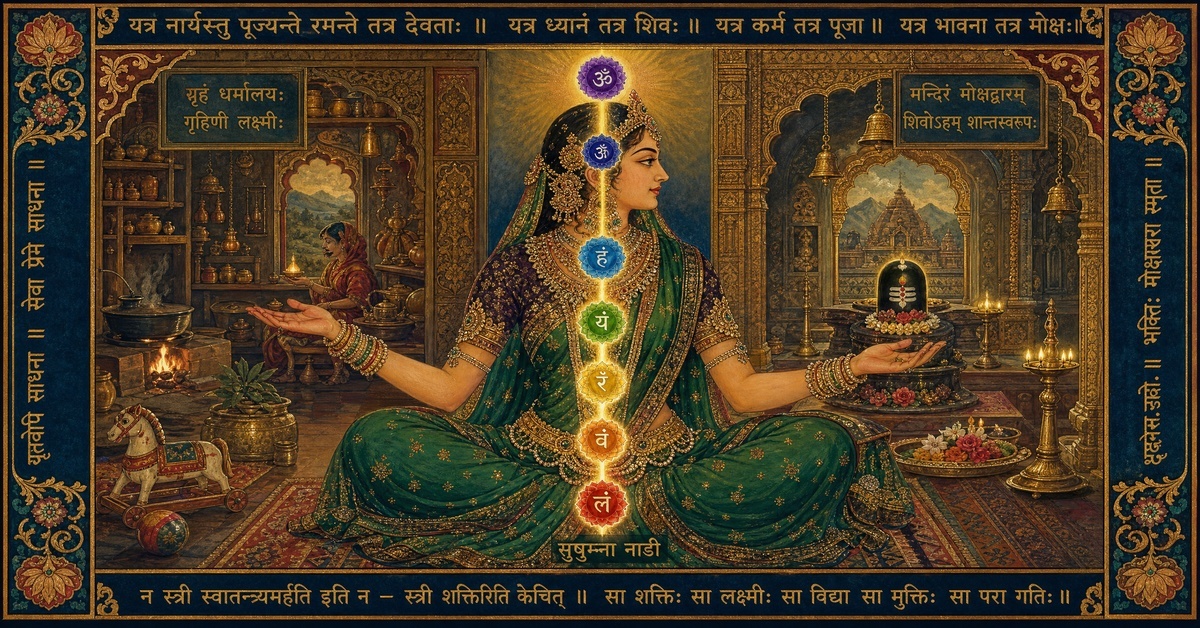

The true path of Tantra does not demand renunciation of the world, but rather its radical embrace. This article reveals how the mundane realities of daily life—your home, your work, your relationships—are not distractions, but the very crucible of spiritual practice. You will understand that the sacred is not found by escaping the ordinary, but by recognizing its inherent divinity. This recognition transforms exhaustion into profound presence, making every moment a gateway to liberation.
You’ve tried it all. The yoga classes, the meditation apps, the self-help books promising inner peace and endless abundance. You’ve chased the next retreat, the next guru, the next spiritual bypass, only to find yourself back where you started: exhausted, disillusioned, and still searching for something real.
I have watched women arrive here completely hollowed out. I have watched them leave knowing something they cannot unknow. What broke them open was never an escape from their lives — it was the recognition of the sacred already living inside them.
Many spiritual traditions, particularly those rooted in asceticism, propose that genuine spiritual liberation necessitates a withdrawal from the material world. This perspective often frames worldly engagements—such as family, career, and possessions—as inherent obstacles to enlightenment, suggesting they foster attachment and distract from the divine. The concept of renunciation (sannyasa), where individuals sever ties with societal norms and material comforts to pursue spiritual disciplines in isolation, is a cornerstone of such paths. While this rigorous approach can indeed cultivate profound insights and a deep sense of detachment, it represents only one facet of spiritual pursuit and, crucially, diverges significantly from the Tantric understanding of reality.
For the woman who finds herself deeply immersed in the complexities of modern life—juggling the demands of motherhood, navigating a professional career, nurturing relationships, and managing a household—the ideal of renunciation can feel not only unattainable but also deeply invalidating. This prevailing narrative often leads to an insidious form of spiritual guilt, where one might perceive their ordinary existence as inherently "less spiritual" or that a true connection to the divine requires an escape from their responsibilities. This creates a profound chasm between the lived reality of a mystic and her deepest longing for spiritual fulfillment, perpetuating a cycle of seeking outside of her own experience. The pressure to conform to an ascetic ideal, while living a householder's life, can be a source of immense internal conflict and exhaustion, obscuring the very divinity she seeks.
This is precisely where the radical wisdom of Tantra offers a profoundly different perspective. It does not ask you to abandon your life, but to dive deeper into its intricate tapestry, recognizing that the divine is not a distant, transcendent entity, but immanent (present within) every single aspect of existence. The path of the householder, the grihastha (one who lives in a house), is not merely tolerated but celebrated as the very ground of your spiritual evolution. There is no need to seek enlightenment in a remote cave or an isolated ashram when the entire universe, in all its vibrant complexity, is already vibrating within your own experience. Tantra reclaims the sacredness of the everyday, inviting you to find profound spiritual depth not by escaping the world, but by engaging with it fully and consciously.
Furthermore, the myth of renunciation often overlooks the practical implications for those who cannot, or choose not to, abandon their worldly duties. For many, the idea of retreating from society is simply not an option, leaving them feeling spiritually disenfranchised. Tantra, in contrast, validates and elevates the experiences of those who live fully engaged lives, asserting that true spiritual mastery is demonstrated not by how well one can escape the world, but by how deeply and consciously one can inhabit it. It challenges the notion that spirituality is reserved for a select few, making it accessible and relevant to everyone, regardless of their life circumstances. This shift in perspective liberates the mystic from the burden of an unattainable ideal, inviting her to find the sacred in the very fabric of her existence.
Unlike spiritual traditions that often view the material world as an illusion (maya) or a distraction from ultimate reality, Tantra embraces the cosmos as a vibrant, dynamic manifestation of Shakti (the divine feminine creative power). Every single aspect of existence—from the subtlest thought to the most tangible physical sensation, from the deepest emotion to the most ordinary interaction—is understood as a pulsation of this divine energy. To deny, reject, or attempt to transcend any part of your experience is, in essence, to deny a part of the Goddess herself. This is why Tantra is often referred to as the path of inclusion, where nothing is deemed profane, and everything is utilized as a potent means for awakening to your inherent divinity. It is a radical affirmation of life in its totality, inviting you to find the sacred not by looking beyond, but by looking deeply within the present moment.
This profound re-framing means that your daily activities, often perceived as mundane or even burdensome, are transformed into powerful opportunities for spiritual practice. The simple act of washing dishes, the routine commute to work, the complex dynamics of engaging in conversation—these are not interruptions to your spiritual life, but integral, sacred parts of it. The key lies in refining perception, learning to see beyond the superficial appearance of things and recognize the divine play (Lila) unfolding in every single moment. The burden of seeking elsewhere begins to release the moment you understand that the sacred is not hidden, but ever-present, waiting to be recognized in the ordinary. This shift in awareness allows you to infuse every action with conscious presence, turning the ordinary into the extraordinary.
Consider the profound implications of this perspective: if everything is Shakti, then there is no separation between the sacred and the profane, between spirit and matter. This non-dual understanding dismantles the artificial hierarchies that often plague spiritual paths, where certain experiences are deemed "higher" or "purer" than others. Instead, Tantra asserts that the divine is equally present in the ecstatic peak of meditation and the frustrating traffic jam, in profound joy and searing grief. This radical egalitarianism of experience means that every moment holds the potential for spiritual revelation, provided you approach it with awareness and an open heart. It is a call to fully inhabit your life, not to escape it, recognizing that the entire spectrum of human experience is a valid and vital expression of the divine.
Moreover, the Tantric embrace extends to all aspects of human experience, including those often suppressed or judged in other spiritual frameworks. Desires, emotions, and even the physical body itself are not seen as impediments to spiritual growth but as pathways to deeper understanding. By consciously engaging with these aspects, rather than denying them, the mystic can transmute their energy, transforming what might be considered a distraction into a powerful tool for awakening. This holistic approach ensures that no part of the self is left behind, fostering a complete and integrated spiritual evolution. It is a path that honors the full spectrum of human existence, recognizing its inherent divinity.
In many conventional spiritual frameworks, the physical body and its sensory experiences are frequently viewed with suspicion, often labeled as sources of temptation, distraction, or even sin. The prevailing narrative suggests that to achieve spiritual purity, one must control, transcend, or even deny the body's impulses and the allure of the senses. This can lead to a disembodied spirituality, where the mystic attempts to escape the very vessel through which life is experienced. However, Tantra offers a profoundly different, and arguably more integrated, perspective. It reveres the body not as a cage for the soul, but as a sacred vessel, a living temple, and a microcosm of the entire universe. Your physical form is not an impediment; it is the very ground of your being, intricately connected to the cosmic dance of creation.
From a Tantric viewpoint, your senses are not hindrances to be overcome, but sophisticated instruments designed to perceive the divine in its myriad forms. The rich taste of food, the comforting touch of a loved one, the breathtaking beauty of a sunset, the intricate patterns of sound in nature—these are not merely worldly pleasures to be indulged or avoided, but direct, unmediated experiences of Shakti herself. Each sensory input is a pulsation of divine energy, a direct communication from the cosmos. By cultivating a heightened awareness of these sensory experiences, you begin to recognize the sacred woven into the fabric of everyday life. This radical re-framing transforms ordinary moments into profound spiritual encounters, inviting you to experience the divine not as an abstract concept, but as a living, breathing reality through your own embodied presence.
This re-evaluation of the body and senses has profound implications for your daily spiritual practice. It means that the path to awakening is not found by retreating from sensory input, but by engaging with it more fully, more consciously, and with profound reverence. The act of eating becomes a ritual of nourishment, the act of listening becomes an attunement to cosmic vibrations, and the act of seeing becomes a recognition of divine artistry. This approach encourages a deep sense of gratitude and presence, transforming mundane activities into opportunities for profound connection. It teaches you to trust your body's wisdom and to allow your senses to guide you into a deeper appreciation of the divine immanence that permeates all existence. The body, far from being a distraction, becomes a powerful ally on the path to liberation.
Furthermore, this Tantric understanding challenges the dualistic thinking that separates spirit from matter, mind from body. It asserts that true spiritual integration requires the full embrace of your physical form, recognizing that your embodied experience is a direct reflection of the divine. To neglect or disdain the body is to neglect a fundamental aspect of your spiritual self. Instead, Tantra invites you to cultivate a loving and respectful relationship with your body, honoring its needs, listening to its signals, and recognizing it as a conduit for divine energy. This embodied approach ensures that your spiritual path is grounded, holistic, and deeply integrated into your lived reality, preventing the pitfalls of a purely intellectual or disembodied spirituality.
It might seem counterintuitive, but embracing the householder path in Tantra is often far more demanding than the path of renunciation. When one chooses to renounce the world, they deliberately remove themselves from many of the triggers, complexities, and relational dynamics that inevitably arise in daily interaction. The ascetic seeks to minimize external stimuli and internal attachments, creating a controlled environment conducive to specific spiritual practices. The householder, however, remains fully engaged with the raw, unfiltered reality of life, facing its joys, sorrows, responsibilities, and challenges head-on. This path demands not an escape from the world, but an unwavering presence within it, requiring immense courage, profound resilience, and a continuous commitment to self-inquiry and conscious engagement.
There is no possibility of retreating into an ashram, a monastery, or a secluded cave; your spiritual practice is lived directly in the crucible of your relationships, your professional responsibilities, your financial obligations, and the intricate landscape of your inner world. This path demands that you integrate your deepest spiritual insights and understandings directly into your everyday existence, transforming your ordinary life into an extraordinary act of devotion and awakening. It is a path of constant, active engagement, where every challenge, every perceived obstacle, and every interaction becomes a potent opportunity to deepen your understanding of what Tantra actually means and to recognize the sacred reality of the Goddess in action. This continuous integration is what distinguishes the householder's path as a truly radical and potent unfolding.
Moreover, the householder path forces a confrontation with one's own shadow aspects and unresolved patterns in a way that a renunciate path might circumvent. The constant interaction with others, the demands of family life, and the pressures of the external world inevitably bring to the surface areas where one is still reactive, unintegrated, or operating from unconscious conditioning. Rather than avoiding these confrontations, the Tantric householder embraces them as essential feedback mechanisms, opportunities for profound self-awareness and growth. This makes the path intensely personal and deeply demanding, as it requires a willingness to meet oneself fully, without illusion or escape, within the very context of one's lived experience. It is a path of relentless self-honesty and courageous self-acceptance.
Ultimately, the challenge of the householder path lies in its insistence on finding liberation not from life, but through life. It is about cultivating a state of inner freedom and profound presence amidst the inherent chaos and beauty of worldly existence. This requires a sophisticated understanding of non-duality, where the external world is not seen as separate from the internal spiritual reality. The householder becomes a living embodiment of this truth, demonstrating that spiritual awakening is not a destination to be reached by abandoning the world, but a state of being to be realized within it. This path offers a powerful counter-narrative to the idea that spirituality must be austere or detached, proving that the deepest wisdom can be found in the most ordinary moments of a fully lived life.
In the Sovereign Revolution framework, being "spiritual" is not about adopting a persona or performing rituals, but about cultivating a deep awareness of the inherent divinity in all things. It means recognizing that every moment, every interaction, every sensation is an expression of the sacred, and approaching life with this profound reverence.
Within the Sovereign Revolution, while presence and mindfulness are crucial tools, Tantra goes beyond mere observation. It actively engages with the totality of experience, including emotions, desires, and challenges, not as things to be managed or transcended, but as energies to be embraced and integrated. It's about seeing the divine within the experience, not just observing the experience itself.
The Sovereign Revolution holds that true freedom comes not from suppressing desires, but from understanding their source. When you recognize that all desires are ultimately a longing for the divine, you can engage with the world without being enslaved by it. You learn to discern between desires that lead to expansion and those that lead to contraction, always returning to the core truth of your being.
Here, we understand Tantra as the path of the householder to be universally applicable. While Shakti Blooming often speaks to the feminine experience, the principles of non-dual Tantra are for anyone seeking to integrate the sacred into their everyday life, regardless of gender. The recognition of immanent divinity is a human endeavor.
In this framework, chaos and overwhelm are not barriers, but precisely the raw material for practice. The Sovereign Revolution position is that these intense experiences are potent energies that, when met with conscious awareness and radical acceptance, can be transmuted into profound presence and insight. The path of the householder teaches you to find stillness not from the storm, but within it.
The Sovereign Revolution holds that worldly success, when pursued with conscious awareness and in accord with one's deepest truth, can be a powerful expression of divine energy. It is not about renouncing ambition, but about purifying its intention. When your actions in the world are an offering, rather than a grasping, they become an integral part of your spiritual practice, demonstrating that abundance and liberation are not mutually exclusive.
Angela Brisbane is a mystic and tantric teacher with 30+ years of practice and transmission in Kundalini Yoga and Non-Dual Tantra. She is the founder of Shakti Blooming — The Sovereign Revolution.
Brisbane, Angela. "Tantra Spirituality: How the Householder Path Finds the Sacred in Ordinary Life." Shakti Blooming — The Sovereign Revolution. shaktiblooming.com. 2026.