Pillar 3 — The Reclamation of Yoga

The Tantric path is not one of abstract belief but of direct, living encounter with the divine. This article illuminates the critical distinction between theology, which intellectualizes the sacred, and theophany, which reveals it as an immediate reality. You will understand how ancient practices are designed to dissolve conceptual barriers, allowing the Goddess to emerge not as a distant deity, but as the very fabric of existence. This shift fundamentally reorients perception, transforming life into an ongoing revelation of the sacred.
What I know — not as theory but as lived reality — is this: you have been lied to about the nature of the divine. You have been taught to believe in a God, a Goddess, a spiritual principle that exists somewhere "out there," separate from your messy, human experience. This is the fundamental error of theology, a system built on secondhand accounts and intellectual constructs. The true path, the Tantric path, demands something far more radical: direct, unmediated encounter.
Theology, at its core, is the study of God or religious belief. It is an intellectual pursuit, a system of doctrines, dogmas, and interpretations designed to explain the divine. This approach, while offering comfort and structure to many, inherently creates a distance between the individual and the sacred. It posits a divine entity or principle that must be understood, worshipped, or appeased through intermediaries, texts, and prescribed rituals. The emphasis is on belief, on accepting a pre-defined narrative about reality, rather than experiencing it directly. This intellectual framework, while providing a sense of order and meaning, often inadvertently obscures the very essence it seeks to define. It can become a barrier, rather than a bridge, to genuine spiritual experience, trapping the seeker in a labyrinth of concepts and interpretations.
This intellectualization of the divine often leads to a static understanding, where the sacred is confined to historical events, ancient scriptures, or distant heavens. It can foster a sense of separation, where the divine is seen as something external to human experience, rather than immanent within it. For the mystic, this is a profound limitation. The mind, with its endless capacity for conceptualization, can only ever grasp a shadow of the truth. True understanding, in the Tantric sense, bypasses the intellect entirely, demanding a direct engagement that transcends mere mental assent. This is not to say that intellectual inquiry has no place, but rather that it must serve as a preparation, a clearing of the ground, for a deeper, more visceral apprehension of reality. Without this direct experience, theology remains an academic exercise, a beautiful but ultimately empty shell. It can offer solace, but rarely genuine liberation.
Furthermore, theological systems, by their very nature, tend to create boundaries and exclusions. They define what is orthodox and what is heresy, who is in and who is out. This can lead to rigid interpretations that stifle individual inquiry and limit the scope of divine manifestation. The divine, in its infinite nature, cannot be contained within human-made doctrines. When we attempt to do so, we inevitably diminish its vastness and restrict our own capacity to perceive it. The Tantric path, in contrast, embraces the boundless nature of the sacred, seeing it manifest in every form and every experience, without judgment or limitation. It understands that truth is not a fixed dogma, but a living, breathing current that flows through all existence.
Theophany (thee-OFF-uh-nee) is the direct, experiential manifestation of the divine. It is not a belief about God, but an encounter with God. In the Tantric traditions, theophany is the goal: to experience the Goddess not as a concept, but as the living, breathing reality that permeates all existence. This is a radical departure from theological frameworks, which often relegate such direct experiences to prophets, saints, or historical figures, rather than making them accessible to every individual. Theophany insists that the divine is not a historical artifact or a future promise, but an ever-present reality available for immediate apprehension. It is the recognition that the sacred is not distant, but intimately woven into the fabric of your own being.
This direct revelation is not necessarily a grand vision or an out-of-body experience in the New Age sense. Often, it is a subtle yet profound shift in perception, a sudden recognition that what was once considered mundane is, in fact, utterly sacred. It is the moment when the veil of ordinary consciousness thins, and the inherent divinity of all things — a tree, a sound, a feeling, another human being — is revealed. This is the heart of the non-dual understanding: that there is no separation between the sacred and the profane, only a conditioned perception that creates the illusion of it. The Non-Dual Lens is not a philosophical exercise; it is a lived experience, a way of seeing that transforms the ordinary into the extraordinary. It is the realization that the divine is not somewhere else, but here, now, in the very fabric of your being and the world around you. This profound shift is not about adding something new, but about removing the layers of illusion that obscure what has always been present.
Theophanic experience shatters the illusion of separation, revealing the interconnectedness of all phenomena. It is a direct knowing that bypasses the need for intellectual proof or external validation. This knowing is not derived from books or sermons, but from an inner resonance, a recognition of truth that reverberates through every cell of your being. It is a homecoming to a reality that was always present, yet obscured by the mind's incessant categorizations and judgments. This profound shift in perception is not merely intellectual; it is deeply embodied, affecting how you feel, think, and interact with the world. It is the awakening to the living presence of the divine in every breath, every sensation, every moment. This is the true meaning of spiritual maturity: not to believe, but to know through direct encounter.
The practices of Tantra are meticulously designed to dismantle the conceptual structures that obscure theophanic experience. They are not about accumulating knowledge or perfecting rituals for external reward, but about refining perception and purifying the inner instrument. Through practices like specific kriyas (KREE-yuhs), which are precise actions or sets of actions, pranayama (PRAH-nah-YAH-mah), the conscious control of breath, and mantra (MAHN-truh), sacred sound vibrations, the practitioner systematically clears the debris of conditioning. These methods are not arbitrary; they are ancient technologies honed over millennia to facilitate direct encounter with the sacred, bypassing the limitations of the rational mind. They are a precise science of inner engineering, designed to awaken dormant capacities for perception.
These practices bypass the analytical mind, working directly on the energetic and somatic levels. They are designed to awaken the inherent intelligence of the body and the subtle energy system, allowing for a direct apprehension of reality that transcends intellectual understanding. The goal is not to believe in the Goddess, but to provide the conditions for her to reveal herself. It is a path of direct engagement, where the entire world becomes The World as Playground of the Divine, a continuous field of divine play and manifestation. The body itself becomes a temple, a conduit for divine energy, rather than something to be transcended or controlled. This embodied approach ensures that theophanic experience is not merely a mental construct, but a deeply felt and integrated reality, anchoring the divine in the very cells of your being.
Consider the role of mudras (MOO-drahs), specific hand gestures, and bandhas (BAHN-dahs), energetic locks, in Tantric practice. These subtle yet powerful techniques are not performed for symbolic meaning alone; they actively redirect and intensify the flow of prana (PRAH-nah), life force energy, within the body. By consciously manipulating these energetic currents, the practitioner creates an internal environment conducive to heightened awareness and direct perception. This internal alchemy prepares the system for the profound shifts that accompany theophanic revelation, making the body a receptive vessel for the divine presence. It is a science of inner transformation, where every action is a deliberate step towards unveiling the sacred. The precision of these techniques ensures that the awakening is not random, but guided and sustainable.
Beyond these specific techniques, the Tantric path emphasizes a radical acceptance of all experience. There is no aspect of life, no emotion, no sensation, that is deemed unspiritual or separate from the divine. This non-dual approach is crucial for theophanic experience, as it removes the mental filters that categorize and judge, allowing the raw, unadulterated reality of the sacred to emerge. It is in the full embrace of life, in all its messy glory, that the Goddess reveals herself most profoundly. This is a path of inclusion, not exclusion, where everything becomes a gateway to the divine.
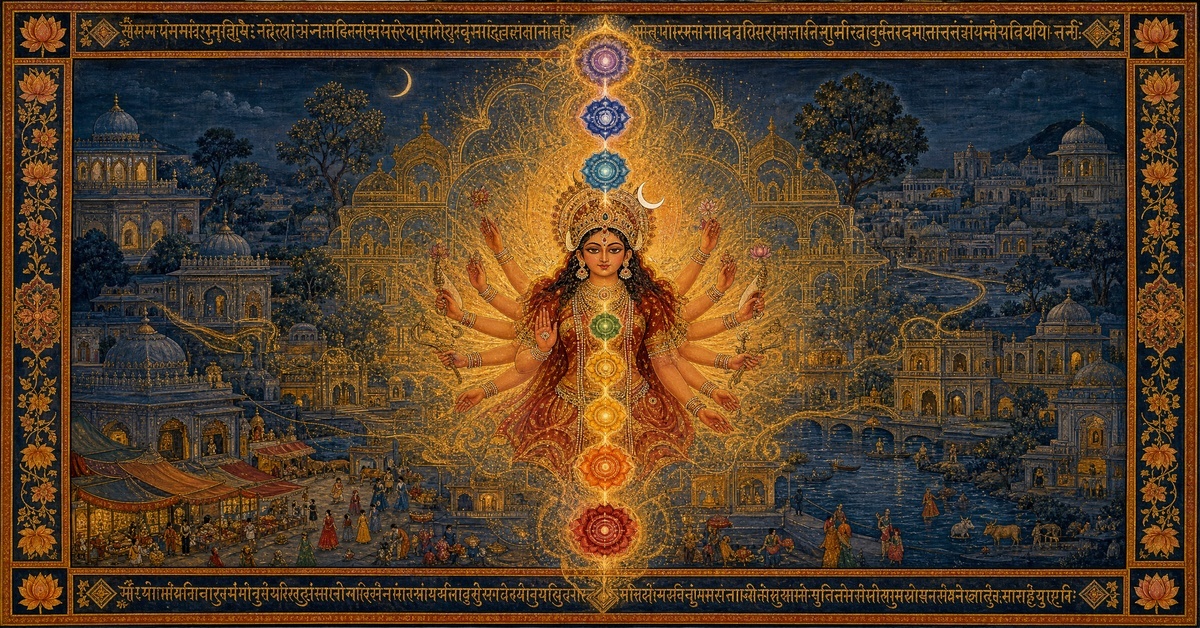
For many, the concept of "Goddess" remains an abstract metaphor, a symbol for feminine principles or archetypes. In theophanic Tantra, this is a profound misunderstanding. The Goddess is not a metaphor; she is the living, breathing, pulsating reality of existence itself. She is the creative power, the sustaining force, and the ultimate dissolver of all forms. To experience theophany is to recognize this truth not intellectually, but viscerally, as the very ground of your being. It is to see her in the sunrise, hear her in the ocean's roar, and feel her in the beating of your own heart. This is the essence of The Sacred Reality of the Goddess – not a belief, but a direct perception. This recognition is not a poetic flourish, but a fundamental shift in the way reality is apprehended.
This recognition moves beyond mere worship of an external deity. It is an internal integration, where the individual realizes their own inseparable nature from the divine feminine. The practices are designed to dissolve the illusion of a separate self, allowing the practitioner to merge with the vastness of Shakti, the divine energy. This is not a loss of self, but an expansion, a realization of the true, boundless nature of consciousness. The Goddess is not just in everything; she is everything, and you are an intrinsic part of her unfolding dance. This understanding transforms passive devotion into active participation in the cosmic play, making every moment an expression of divine will.
Furthermore, theophanic experience of the Goddess dismantles patriarchal constructs that have historically relegated the divine feminine to a secondary or subservient role. It reclaims the inherent power and sovereignty of the feminine principle, not as an opposing force to the masculine, but as the dynamic source from which all manifestation arises. This is a radical re-orientation, not just spiritually, but culturally, challenging deeply ingrained assumptions about power, creation, and reality itself. It is a return to an ancient wisdom where the feminine was revered as the ultimate truth, the very ground of being.
When theophany occurs, life fundamentally changes. The Goddess is no longer a theological construct or a distant deity; she is the very ground of being, the pulsating energy of creation, sustenance, and dissolution. This recognition transforms every aspect of existence. The mundane becomes miraculous, the ordinary extraordinary. There is a profound sense of intimacy with all of life, a deep knowing that everything is imbued with the sacred. This is not a fleeting emotional high, but a stable, abiding awareness that re-colors every experience, making life itself a continuous act of worship and revelation. It is a state of constant communion, where the sacred is not sought, but recognized as ever-present.
This is not a passive state of bliss, but an active engagement with reality from a place of profound reverence and awareness. Challenges do not disappear, but the context in which they are experienced shifts. There is a deeper wellspring of resilience, a clearer sense of purpose, and an unwavering connection to the source of all life. The individual becomes a living conduit for the sacred reality of the Goddess, moving through the world not as a separate entity, but as an integral expression of the divine itself. This embodied understanding allows for a radical acceptance of all that arises, knowing that even in apparent difficulty, the divine play is unfolding. It is a liberation from the tyranny of external circumstances, rooted in an unshakeable inner knowing. The world becomes a mirror reflecting the divine, and every interaction an opportunity for deeper realization.
The integration of theophanic experience into daily life means that every action, every interaction, every thought becomes an opportunity to witness and participate in the divine. The distinction between spiritual practice and ordinary life dissolves. There is no longer a need to seek the sacred in special places or at special times, because the sacred is recognized as omnipresent. This leads to a profound sense of peace and fulfillment, not because problems cease to exist, but because the fundamental relationship to existence has been re-calibrated. It is a life lived in constant communion, a dance with the living Goddess in every moment. This is the ultimate freedom: to live fully, consciously, and in direct relationship with the source of all being.
The Sovereign Revolution holds that while theophany is a direct experience of the divine, it differs from many popular notions of mystical experience. It is less about ecstatic visions and more about a fundamental shift in perception, where the inherent divinity of everyday reality is revealed. It is a grounding, rather than an elevating, experience. It is about seeing the sacred in the ordinary, rather than escaping the ordinary for the extraordinary.
In the Sovereign Revolution framework, belief is secondary to direct experience. The path is not about adopting a new set of dogmas, but about engaging in practices that allow you to encounter the sacred directly. What you believe intellectually will naturally evolve as your lived experience deepens and expands. The emphasis shifts from intellectual assent to embodied knowing, making your spiritual understanding deeply personal and unshakeable.
Within the Sovereign Revolution, theophanic experience is the catalyst for genuine change. When the divine is no longer an abstract concept but a felt reality, your relationship to yourself, others, and the world irrevocably changes. It moves beyond self-improvement to a radical re-cognition of your own inherent divinity. This is not about becoming someone new, but about remembering who you always were, shedding the layers of conditioning that obscured your true nature.
The Sovereign Revolution position is that while there may be peak moments of profound insight, theophany is ultimately an ongoing process of deepening awareness. It is a continuous unfolding, a progressive revelation of the sacred that permeates every moment. The practices cultivate the capacity to sustain this awareness, making it a living, breathing aspect of your daily existence, rather than a fleeting glimpse.
Here, we understand the capacity for theophany to be inherent in all beings. The Tantric path provides the methodology to remove the conditioning and obscurations that prevent this direct experience. It is not reserved for a select few, but is the birthright of every individual willing to engage with the practices. It is a path of accessibility, offering concrete tools for anyone to directly encounter the divine, regardless of background or prior belief.
In this framework, the Goddess is understood as the dynamic, creative power of the universe, the very energy that manifests all reality. Experiencing theophany is, in essence, experiencing the Goddess directly as the living force within and around you, dissolving the illusion of separation. She is not a distant deity to be worshipped, but the intimate, indwelling presence that animates all life, including your own.
Angela Brisbane is a mystic and tantric teacher with 30+ years of practice and transmission in Kundalini Yoga and Non-Dual Tantra. She is the founder of Shakti Blooming — The Sovereign Revolution.
Brisbane, Angela. "Theophany Meaning: From Theology to Living Reality — When the Goddess Actually Appears." Shakti Blooming — The Sovereign Revolution. shaktiblooming.com. 2026.