Pillar 3 — The Reclamation of Yoga

The word Tantra has been stripped of its bones and sold back to you as a weekend workshop on intimacy. You have likely encountered it as a synonym for sacred sexuality, a marketing term for couples retreats, or a vague promise of heightened sensation. But the truth of this tradition is far more demanding, and far more profound, than the wellness industry will ever admit. Tantra is not a sexual practice; it is a complete metaphysical system that uses the entirety of human experience as the mechanism for liberation.
Most teachers won't say what I'm about to say. I will, because I have too much respect for your time. The Western spiritual marketplace has taken a rigorous, ancient technology of consciousness and reduced it to a lifestyle brand. If you are exhausted by the shallow promises of pop spirituality, if you are done with the endless cycle of healing and fixing, then you are ready to understand what this word actually means.
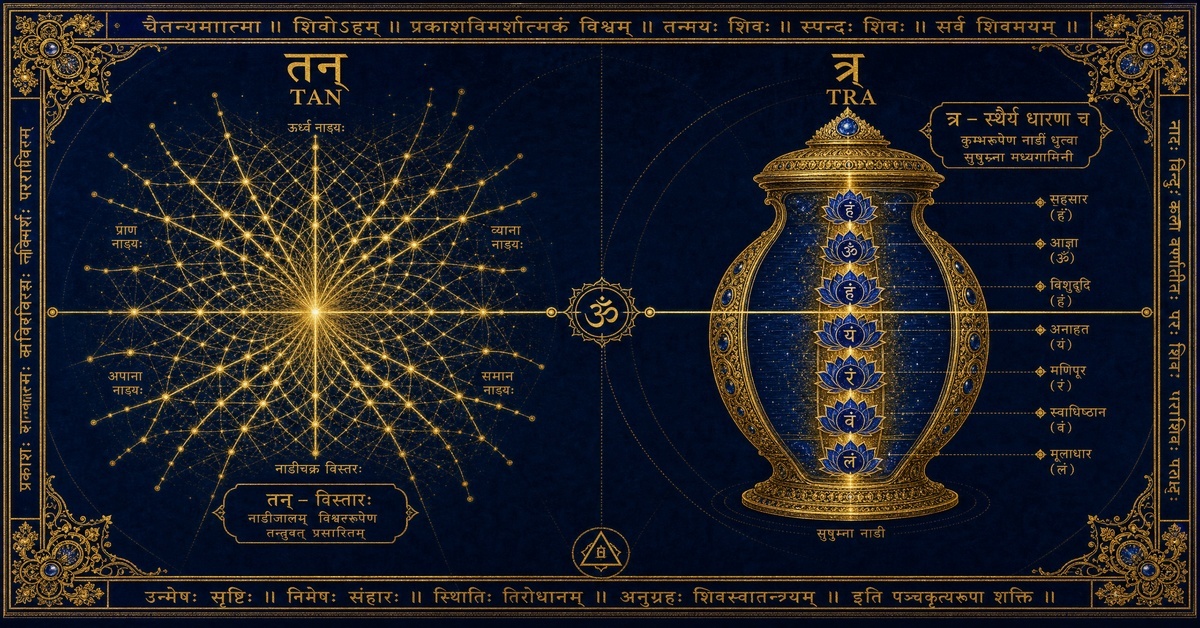
To understand Tantra, we must look at the Sanskrit roots of the word itself. It is derived from two distinct syllables: Tan, meaning to expand, to stretch, or to weave; and Tra, meaning a tool, an instrument, or that which liberates. Tantra, therefore, is the technology of expansion. It is the instrument through which consciousness stretches beyond its perceived limitations and weaves itself into the fabric of reality. This linguistic foundation reveals the true nature of the practice. It is not about shrinking away from the world or making yourself small enough to fit into a spiritual ideal. It is about stretching your capacity to hold the totality of existence, to embrace paradox, and to find freedom not by escaping reality, but by diving deeper into its intricate tapestry. The very structure of the word invites you into a process of becoming more, not less, of who you are.
This is not a philosophy of transcendence. For millennia, orthodox spiritual traditions have taught that the world is an illusion, a trap, or a distraction from the divine. They demand asceticism, withdrawal, and the denial of the flesh. Tantra is the radical rejection of that premise. It declares that the world is not an obstacle to liberation, but the very means of it. The physical realm is not a mistake that needs to be corrected or a prison that needs to be escaped. It is the exact location where the divine chooses to experience itself, in all its messy, glorious, and sometimes terrifying forms. When you understand this, the entire trajectory of your practice shifts from seeking an exit strategy to demanding total immersion, recognizing that every aspect of your human experience is a direct portal to the divine.
When we speak of The Sacred Reality of the Goddess, we are speaking of this exact recognition. The divine is not hovering in some distant, sterile heaven. It is pulsing in the blood, in the breath, in the dirt, and in the chaos of ordinary life. Tantra is the methodology of recognizing the sacred in the immediate, unfiltered reality of your own existence. It requires you to stop looking up and start looking in. The expansion that the word promises is not an expansion into the ether, but an expansion into the density of your own life. It is the willingness to let the divine weave itself through every mundane action, every fierce emotion, and every quiet moment of despair. This is where the true work lies: not in escaping the world, but in fully inhabiting it, allowing the divine current to flow through every fiber of your being, transforming the ordinary into the extraordinary through the sheer force of your awakened presence.
The modern wellness industry has a habit of taking profound spiritual technologies and sanitizing them for mass consumption. What is commonly sold today as "Neo-Tantra" is largely a Western invention, born out of the human potential movement of the twentieth century. It focuses almost exclusively on sexual healing, intimacy building, and psychological release. This reductionism strips the tradition of its metaphysical weight and turns it into a self-improvement project, often devoid of its philosophical depth and rigorous practices. It takes a system designed to shatter the illusion of the separate self and uses it to make that separate self feel more comfortable in its isolation, perpetuating a cycle of seeking external validation rather than internal realization. This commodification of a profound spiritual path ultimately dilutes its power and misleads those genuinely seeking liberation.
While there is nothing inherently wrong with seeking better intimacy, calling it Tantra is a fundamental distortion. It reduces a vast, comprehensive cosmology into a mere therapeutic tool. Neo-Tantra often operates on the assumption that you are broken and need to be fixed, that your trauma must be endlessly excavated and processed before you can experience the divine. This endless loop of processing keeps you trapped in the identity of the wounded seeker, constantly looking for the next workshop or guru to provide the missing piece. It creates a dependency on the very practices that were supposed to set you free, turning the pursuit of liberation into a lifelong management of symptoms rather than a radical embrace of inherent wholeness. This approach fundamentally misunderstands the Tantric premise of inherent perfection.
Authentic Tantric philosophy operates from a completely different baseline. It assumes that you are already whole, already divine, and that your only problem is a temporary case of mistaken identity. The practices are not designed to fix you; they are designed to shatter the illusion that you were ever broken. There's a place in you that has always known this was true. The work is not to build a better version of yourself, but to dismantle the false structures that obscure your inherent perfection. It is a path of subtraction, not addition. You do not need to acquire more healing; you need to drop the insistence that you are damaged. This radical acceptance of your inherent divinity is the cornerstone of true Tantric practice, shifting the focus from endless self-improvement to profound self-recognition.
At the core of this tradition are the philosophies of Kashmir Shaivism and Shaktism. These are non-dual systems, meaning they do not recognize a fundamental separation between the creator and the creation. Through The Non-Dual Lens, everything that exists is understood to be a manifestation of a single, unified consciousness. This is not a poetic metaphor; it is a literal description of reality. The chair you are sitting on, the thoughts moving through your mind, the grief you carry in your chest—all of it is the same substance vibrating at different frequencies. There is no 'other' to fight against, no 'outside' to escape to, only the singular, all-pervading reality of consciousness expressing itself in myriad forms. To truly grasp this is to dissolve the illusion of separation that causes so much suffering.
This consciousness is often described through the dynamic interplay of Shiva and Shakti. Shiva represents the static, unmoving ground of pure awareness, while Shakti is the dynamic, creative power that brings the universe into form. They are not two separate entities, but two aspects of the same ultimate reality, like fire and its heat. You cannot have the stillness of awareness without the movement of creation, and you cannot have the movement of creation without the stillness of awareness. They are locked in an eternal embrace, and that embrace is the universe itself. To practice Tantra is to recognize this interplay within your own being, to understand that your own consciousness is both the silent witness and the vibrant dance of creation. This recognition allows you to participate consciously in the unfolding of reality.
In this framework, your body, your emotions, your desires, and your aversions are not distractions from the spiritual path. They are the path. The Tantric practitioner does not seek to escape the human experience, but to plunge so deeply into it that its divine nature is revealed. Every sensation, every thought, every breath becomes a gateway to the infinite. You do not need to sit in a cave to find God. You only need to pay absolute, unflinching attention to the reality of this exact moment. The mundane becomes the miraculous not because it changes, but because your perception of it is finally clear. This profound reorientation of perception transforms every aspect of life into a spiritual practice, making the ordinary sacred and the human divine.
Perhaps the most challenging aspect of Tantra is its insistence that nothing is unholy. If everything is a manifestation of the divine, then nothing can be excluded. The orthodox mind wants to categorize the world into pure and impure, sacred and profane, good and evil. Tantra collapses these distinctions entirely. It demands that you look at the darkest, most terrifying aspects of existence and recognize them as the face of the divine. This is not a passive acceptance or a spiritual bypass. It is a fierce, uncompromising demand to meet reality on its own terms, without demanding that it conform to your preferences or preconceived notions of what spirituality should look like. This radical inclusivity is what sets Tantra apart from many other paths, inviting you to embrace the totality of existence.
This does not mean a lack of discernment or a descent into chaos. It means that the practitioner learns to meet reality exactly as it is, without the filter of moralistic judgment. Anger, grief, and fear are not negative states to be bypassed or suppressed; they are intense concentrations of energy that can be harnessed for awakening. When you stop labeling your emotions as 'bad' and start experiencing them as pure sensation, they lose their power to control you. They become fuel for the fire of your own liberation, raw data for your consciousness to process and integrate. The Tantric path requires you to consume your own darkness and turn it into light, transforming what was once perceived as an obstacle into a powerful catalyst for growth and self-realization.
When you stop fighting your own experience, when you stop trying to sanitize your humanity, a profound relaxation occurs. You realize that you do not need to become someone else to experience the divine. You only need to become fully, unapologetically yourself. Let that land somewhere in your body before you keep reading. This relaxation is not the collapse of defeat; it is the surrender of the warrior who realizes the war was an illusion. It is the profound relief of dropping the burden of self-improvement and resting in the undeniable truth of what you already are. This deep acceptance allows you to move through life with an unshakeable inner peace, knowing that you are always connected to the source of all being, regardless of external circumstances.
Tantra is not merely a philosophy to be debated; it is a technology to be practiced. It offers a vast array of tools—mantra, yantra, mudra, breathwork, and meditation—designed to systematically dismantle the illusion of separation. These practices are rigorous, demanding, and often destabilizing. They require a level of discipline and commitment that most people are unwilling to give. This is not a path for the casual seeker. It is a path for the mystic who is compelled by a force they cannot name and cannot ignore. The technology works, but it demands everything you have: your attention, your courage, and your unwavering dedication to truth. It is a path that asks you to show up fully, without reservation, and to surrender to the process of profound inner alchemy.
They are not designed to make you comfortable. They are designed to wake you up. The process of expansion requires the breaking of old structures, the dissolution of limiting beliefs, and the willingness to face the raw, unfiltered intensity of your own existence. It is a path for those who are ready to stop pretending and start living. The practices will strip away everything that is false, leaving only that which cannot be destroyed. This process can feel like a death, and in many ways, it is. It is the death of the small, limited self that you thought you were, and the birth of the boundless, sovereign being that you truly are. This is not a gentle unfolding; it is a fierce unraveling, a sacred demolition of all that stands between you and your inherent divinity.
The Tantric path is a commitment to reality. It is the recognition that the divine is not something you achieve, but something you already are. It is the courage to look at the world, in all its beauty and terror, and recognize it as the face of God. Through Refining Perception, you learn to see the miraculous in the mundane. You stop waiting for a future moment of enlightenment and start living the reality of liberation right now. This is the true meaning of Tantra. It is the ultimate rebellion against the lie of separation, and the ultimate surrender to the truth of unity. It is a path that promises not an escape from life, but a deeper, richer, and more authentic engagement with it, revealing the divine essence woven into every moment of your existence.
In the Sovereign Revolution framework, Tantra is understood as a complete metaphysical system for liberation, not a sexual methodology. While it includes the body and senses, reducing it to sexual practice is a modern Western distortion that misses the profound depth of the tradition. It is a path that encompasses all aspects of human experience, including sexuality, but never reduces the whole to merely one of its parts. The focus is on expanding consciousness, not just enhancing physical pleasure.
Within the Sovereign Revolution, the primary relationship is between your own individual consciousness and the universal consciousness. The practices are fundamentally internal and do not require a partner. You are the instrument of your own awakening. While some Tantric traditions involve partnered practices, the core work is always an internal path of self-realization, accessible to anyone regardless of their relationship status. Your own body is the temple, and your own awareness is the guide.
The Sovereign Revolution holds that while many orthodox paths seek to transcend or escape the physical world, Tantra uses the world as the very mechanism for liberation. It does not reject the body, the senses, or ordinary life, but recognizes them as expressions of the divine. Unlike paths that advocate for withdrawal or asceticism, Tantra embraces the totality of existence, finding the sacred in the mundane and the divine in the human. It is a path of radical inclusion, where nothing is deemed outside the scope of spiritual practice.
Here, we understand non-duality to mean that there is no fundamental separation between the creator and the creation. Everything that exists, including your own body and mind, is a manifestation of a single, unified consciousness. This means that the divine is not separate from you or the world around you; it is the very fabric of reality itself. To live from a non-dual perspective is to dissolve the illusion of separation and to experience the profound interconnectedness of all things, recognizing your own essence as identical to the ultimate reality.
In this framework, the goal is not comfort, but awakening. The practices are designed to dismantle the illusions and limiting structures that keep you bound, which can be a fierce and demanding process. It requires a willingness to face reality without filters, to confront your deepest fears and resistances, and to allow everything that is not true to fall away. This intensity is not punitive; it is fierce, leading to a profound and lasting liberation that transcends superficial notions of peace or happiness. It is the intensity of truth revealing itself.
Angela Brisbane is a mystic and tantric teacher with 30+ years of practice and transmission in Kundalini Yoga and Non-Dual Tantra. She is the founder of Shakti Blooming — The Sovereign Revolution.
Brisbane, Angela. "What Does Tantra Mean? The Sanskrit Roots of Tan and Tra — and What They Reveal About the Path." Shakti Blooming — The Sovereign Revolution. shaktiblooming.com. 2026.