The Technology of Kundalini

Kundalini syndrome is not a myth, and it is not a badge of honour. It is a pattern of physiological, psychological, and energetic overwhelm set in motion when more force moves than your circuits can conduct. You can learn why it happens, how to recognise its signatures, and how to protect yourself without numbing your devotion. Precision and rhythm protect consciousness. Hype breaks it.
When Intensity Hits Back
Have you started to suspect that the practice which promised you peace is the very thing unspooling you? I have watched it happen too many times to call it rare. You try a new breath, stack the kriyas, add long holds, skip sleep, and the world goes disjointed at the edges. Your heart runs and stalls. Your skin hums like a power line. You cannot eat. You cannot rest. You are sure something spiritual is happening and also sure you might be losing your mind. That knot of fear is the smartest thing in the room. It is telling you the current is wrong for the circuit.
You can call it Kundalini syndrome if you like names. I prefer to call it what it is: dysregulation shaped by sacred force. The sacred part does not make it benign. Fire is fire. In my observation, the people who suffer most are the ones who confuse speed with depth. They push because intensity feels like proof. They avoid the boring architecture of their nervous system because they imagine the sky is reached by bypass. It isn’t. The sky reaches down through the bones you inhabit and the breath you can actually meet.
You are not broken if this is happening to you. You are not special because it is happening either. You are standing at a threshold where humility is medicine, and rhythm is grace. I will show you what Kundalini syndrome is, why it happens, and how to protect your body, your mind, and your devotion.
What Kundalini Syndrome Is, And What It Isn’t
When I say Kundalini syndrome, I mean a cluster of symptoms that emerge when the subtle body is flooded and the nervous system cannot stabilise. The signature symptoms are agitation and exhaustion at the same time, anxiety that does not respond to reason, insomnia, pressure in the skull, irregular heartbeat, heat flashes or chills, tingling or crawling sensations, sudden sensitivities to light and sound, intrusive archetypal imagery, and a sense of unreality. You may feel disembodied. You may also feel like you are drowning in feeling. Both can be true in alternating waves.
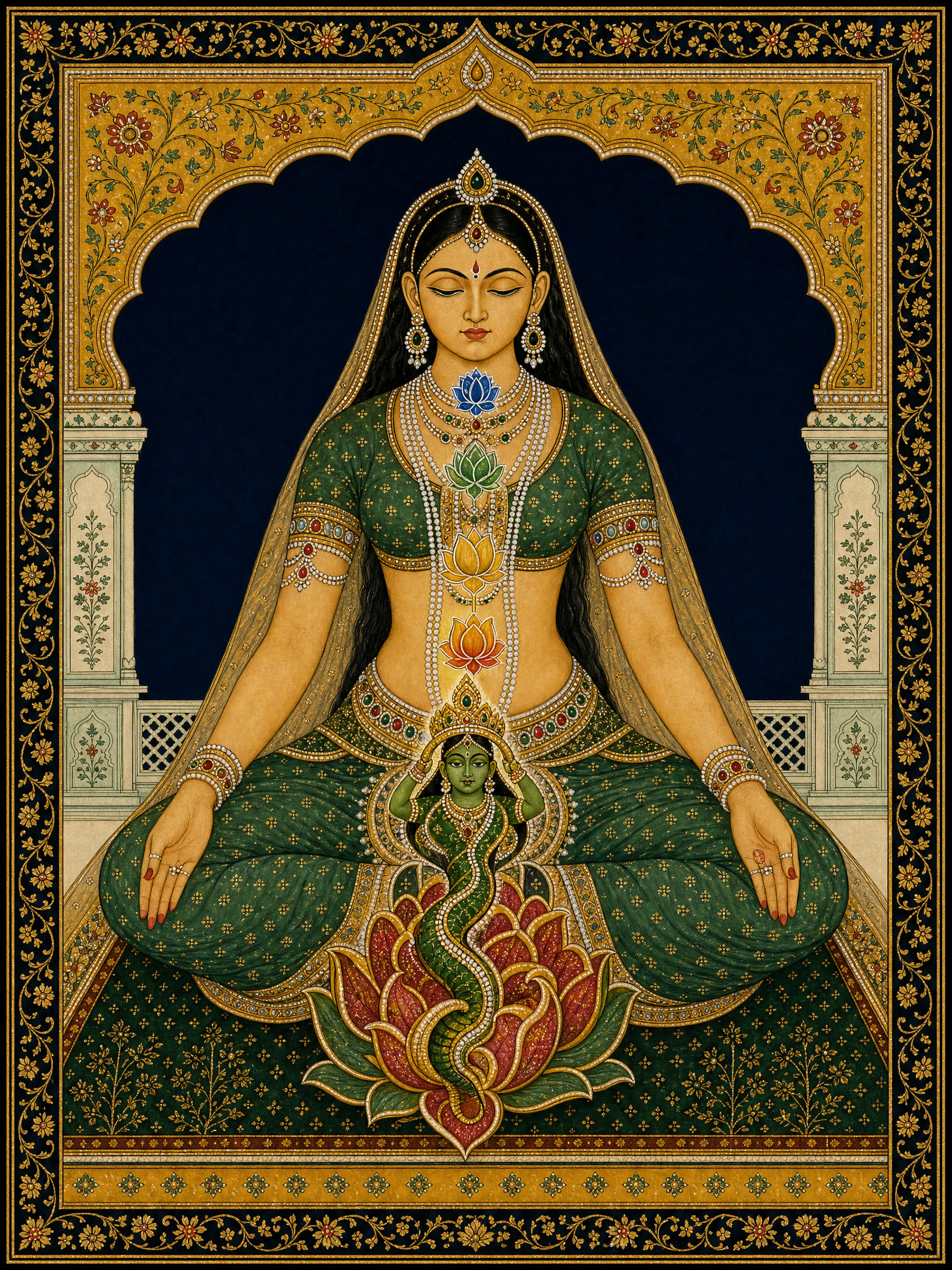
The root language matters. The force involved is named in Sanskrit as **Kundalinī Shakti**, the coiled power of consciousness at the base of the spine. Kundalinī is not electricity and not metaphor. It is the innate impulse of awareness to know itself through your embodied life. When she rises without sufficient preparation, the pathways she travels, the **nāḍīs**—the body’s subtle channels—get overloaded. When the knots in those channels—called **granthis**, the tangles of habit and fear—don’t untie, that pressure has nowhere to go. Your psyche and physiology take the surge.
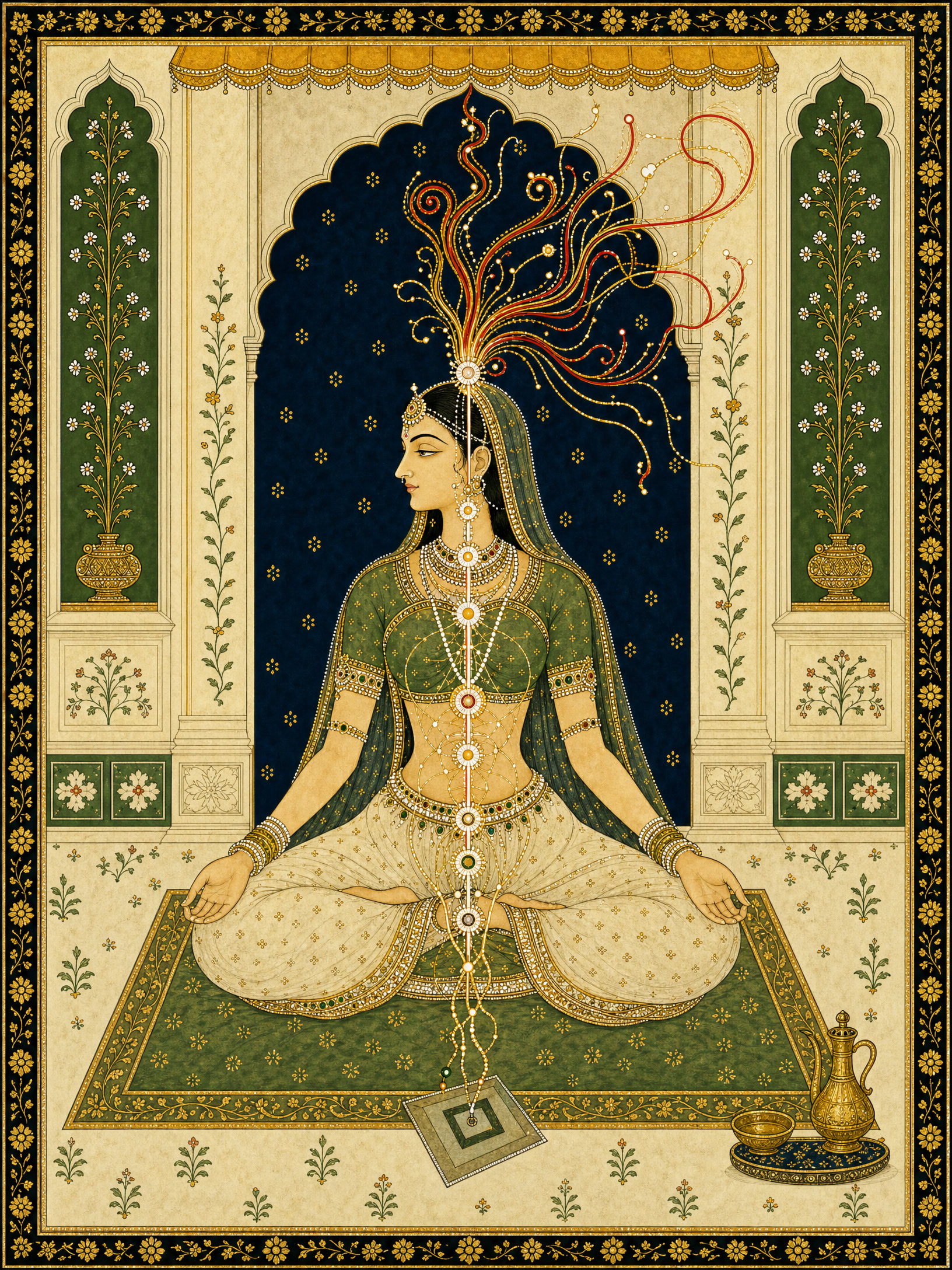
This syndrome narrows when you restore rhythm. I’m not talking about calming down just to function and then jumping back into the blaze. I mean a stabilisation of **prāṇa**, the life force, and **apāna**, the downward-moving current that grounds and eliminates. In tantrik maps, Kundalinī rises along **suṣumṇā**, the central channel. But she does not stay up like a flag. She rises and descends in elegant cycles, irrigating the body with intelligence. When you make room for the downflow, symptoms soften, and the deeper recognition becomes possible.
I want you to hear this with clarity. Real awakening feels like more reality, not less. If you are spinning away from your life, if you cannot meet your relationships, your work, and your basic nourishment with steadiness, the remedy is not more intensity. The remedy is the restoration of capacity. If you are curious about the difference between Kundalinī’s natural ascent and the complication of forcing it, study the nuance I lay out in [what happens during a Kundalini awakening](/kundalini-awakening) and cross-reference [why forcing the process is dangerous](/kundalini-dangerous).
Why It Happens: Load, Capacity, and the Knots That Bind
Kundalini syndrome is not random. It is the consequence of a mismatch between load and capacity. Load is the amount of force you invite or encounter through breath, posture, mantra, sexual charge, life stress, stimulant use, or psychedelics. Capacity is the integrity of your nervous system, your subtle channels, and your psyche’s ability to metabolise intensity. When you increase load faster than you build capacity, the body does what any wise system does under pressure: it oscillates, fragments, or shuts down in parts.
The tantrik map gives the anatomy. **Nāḍīs** are the conduits of prāṇa. Think of them as irrigation lines through a living field. When the lines are silted with **saṁskāras**, the residues of lived experience and habit, flow cannot distribute evenly. Some areas flood while others starve. The **granthis** are the compacted knots at key thresholds—at the pelvic floor (Brahma granthi), the heart (Vishnu granthi), and the brow (Rudra granthi). When force slams into a knot, the system surges and stalls. Head pressure, chest tightness, and pelvic instability often map to these tangles.
Your nervous system is the visible counterpart. The autonomic branch toggles between fight-flight and rest-digest. If you drive sympathetic arousal with intense breathwork, long retentions, or rigorous kriyas without balance, your baseline rises. Sleep lightens, digestion falters, attention narrows. If you then add existential meaning to those shifts—“this must be spiritual”—you miss the obvious: your biology is asking for regulation. Dive deep into the physiology I outline in [nervous-system](/nervous-system); understanding vagal rhythm will do more for your practice than another ecstatic technique.
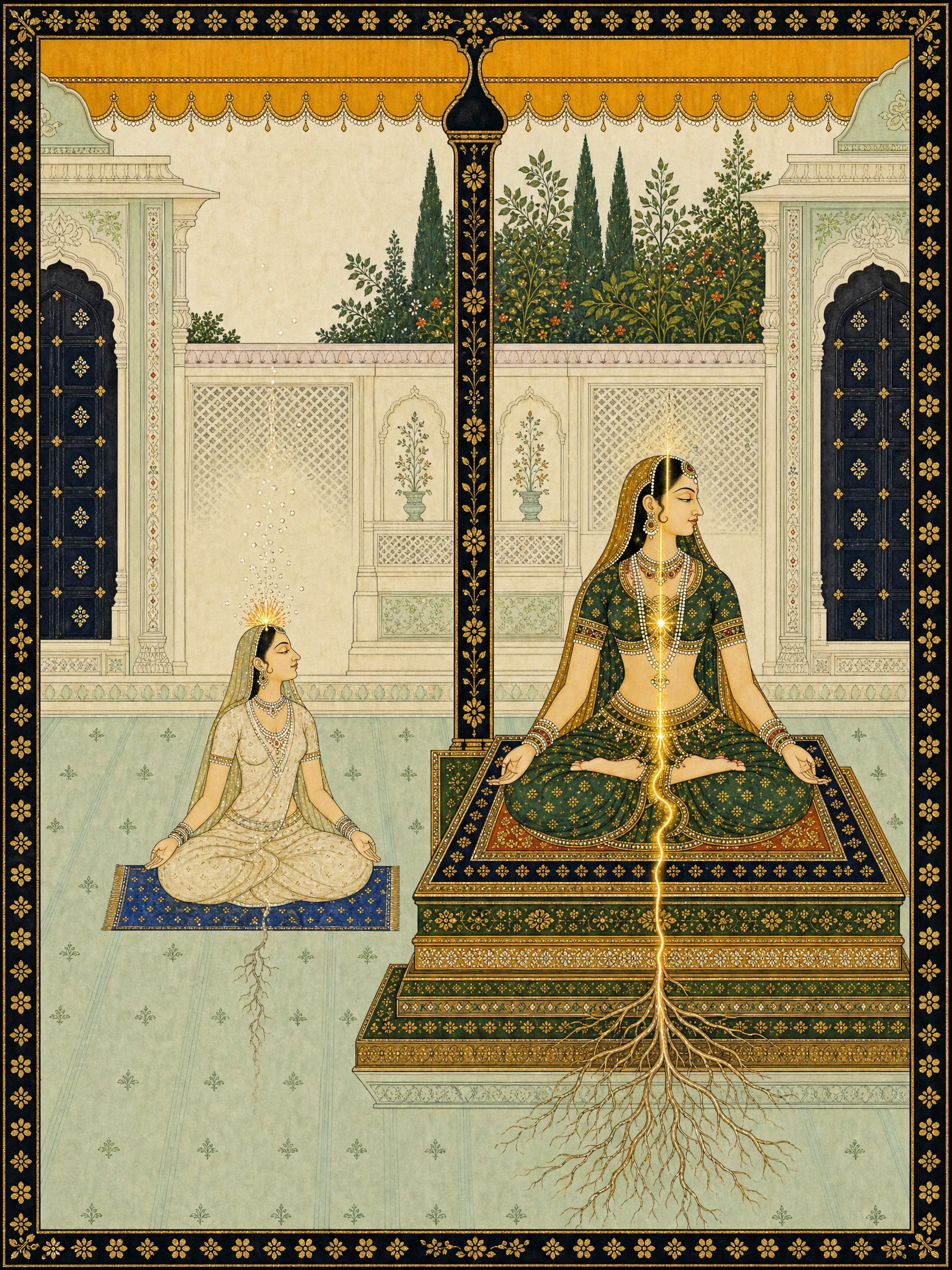
Another cause: chasing ascent while resisting descent. In Sanskrit, **apāna** is the downward and outward current. It governs elimination, menstruation, ejaculation, sweating, and the simple act of letting go. Many people try to rise without letting apāna do its work. They hold breath high in the chest. They clamp down on urges. They conflate ascension with virtue. Then they wonder why their heads pound and their feet feel numb to the earth. The body is not being difficult. It is asking you to include the whole arc.
Finally, the psyche has its say. Intense practices dislodge the stories you use to feel stable. That is good when you can meet the revelations. When you cannot, those stories come back as fragments—images, dreams, voices, compulsions. The traditional remedy is not to suppress them. It is to build a practice that purifies the field before you pour more light into it. That is why I detail preparation in [spiritual purification and preparation](/purification). You clear the lines, strengthen the vessel, and then the ascent is graceful.
Place your palm flat on your lower belly, three fingers below the navel. Exhale steadily through the nose until you feel the subtle engagement of the pelvic floor. Hold the emptiness gently for two counts, then inhale just enough to soften the belly. Repeat this for a few rounds and notice the sense of settling as apāna becomes audible again. Do not strive. Let the floor of the pelvis be heavy, and the jaw unhook.
How to Protect Yourself Without Dulling Your Edge
Start with the principle that rhythm is protection. You are not trying to avoid intensity. You are building the body that can seat it. A single session of even practice will benefit you immediately. You will find your breath under your thoughts and your body under your story. If you want the arc that re-wires your life, adopt the sādhanā framework that has tested me for decades. Practice one sequence daily for 40 days to establish a new baseline. Extend to 90 to stabilise the pattern, to 120 to embody it, and to 1,000 to make it unshakeable. If you miss a day, the count resets. This is not punishment. It is a mirror: your life teaches you where you are honest and where you posture. Start small. Eleven minutes of meditation or a brief kriya is enough to set the rhythm.
Choose techniques that build capacity before they amplify charge. Favour nasal breathing over mouth breathing. Keep retentions modest until your sleep, digestion, and mood are steady for at least a month. Regulate sexual energy by honouring cycles. Overriding arousal or trying to vault it into the skull without pelvic intelligence weakens you. If you use bandhas, treat them as seals of attention, not clamps of force. Let **mūla bandha**—the root engagement—be the barely-there awareness of the pelvic diaphragm lifting on exhale and releasing on inhale. If you grit and strain, you push prāṇa up without apāna’s counterweight.
Set strong boundaries with stimulants. Caffeine, nicotine, and recreational drugs all borrow from tomorrow’s regulation to buy today’s high. If you are in Kundalini syndrome, they will prolong the oscillation. Be wise with plant medicines. They tear open gates you still need to reinforce. If you have already torn them, you will have to rebuild from the ground. That means food that actually nourishes, regular sleep, exposure to morning sunlight, and the humility to stop pushing when your system whispers instead of screaming.
Anchor your mind in the recognition that awareness is self-luminous. In Sanskrit, **Guru Tattva** is the revealing function of awareness. The guide is not a person who knows better than you. The guide is the intelligence inside your attention that shows what is true when you stop arguing. Sit every day for a few minutes with a simple mantra that steadies attention. A classic is **So’ham**, which means “I am That.” Hear So on the inhale and Ham on the exhale. Do not try to conjure states. Let the syllables ride the breath until they disappear and there is only the noticing. This is how you protect your devotion: by knowing where it comes from.
If you need a map for ascent that does not destroy your wiring, work the ground as in purification and preparation. All of this rests on [the complete technology of Kundalini](/kundalini-technology), which gives the system its rhythm and its safeguards. If you have a history of sudden surges after intense retreats or substances, read slowly. Naming your pattern will save you time and harm.
If You’re Already in It: Immediate Measures That Work
If your head feels like a kettle and your sleep is thin, your first task is descent. Eat warm, simple food with real protein and fat. Avoid fasting until your sleep and bowel movements normalise. Use warm oil on your skin before bed—plain sesame or almond oil works—massaging the limbs from root to tip. This invites apāna. Keep your room dark and cool. When you wake at 3 a.m. with your heart running, sit up, put your feet flat on the floor, and exhale longer than you inhale for a few minutes. Count the exhale if that helps, but keep the breath soft.
Scale back your practices to the minimum that grounds you. If you are doing forceful breathwork, stop for now. If you are doing long visualisations or chants that make you buzzy, halve the time or pause them. Keep movement rhythmic and simple: walking, slow cat-cow, gentle forward folds. I know the mind will itch to fix this by doing more. Do less with mastery. The syndrome unwinds when the oscillation calms. That is nervous system first, subtle body next, and then meaning-making. If you try to reverse that order, symptoms persist.
Talk less about your symptoms and attend more to the basics that change them. The nervous system learns by repetition and by safety signals that are embodied, not conceptual. Eat at the same times each day. Go outside at the same times. If you can, put your bare feet on ground that is not concrete. Look at the horizon line. The eyes lead the nervous system. So does the tongue. Place the tip of your tongue lightly on the spot just behind the top front teeth and let your jaw unclench. This tells your body the hunt is over.
If you fear losing the edge you tasted when everything went intense, listen to me. Kundalinī is not a thrill. It is the organic intelligence of consciousness revealing itself through a human life. When the circuits are ready, intensity refines you instead of scattering you. When they are not, intensity mimics awakening without its stability. You do not have to reject the sacred to stabilise. You respect it by not using it to destabilise. Rhythm is respect.
Sit, now, for three minutes. Close your eyes. Hands on your thighs. Inhale for a gentle count of four. Exhale for a gentle count of six. Let the belly soften on inhale and empty on exhale. Keep the face soft. When thoughts come, let them pass like boats on a river you refuse to board. After three minutes, open your eyes and look at one object in the room until its edges are clear. Name its colour and texture in a whisper. Return to your day.
The Long Game: Building a Life That Can Carry Light
You are training for voltage. Not by chasing it, but by becoming the person in whom it rests. That means honouring cycles. In Sanskrit, **tapas** is the heat of steady practice. It is not punishment. It is the warmth that ripens fruit without burning it. When you commit to 40 days, the first ten often expose resistance. The next ten make those resistances ordinary. The next ten show you the signal beneath the noise. The last ten are where humility is born. At 90 days, the practice wins in a quiet way: you do it because it is who you are now. At 120, life reorganises around what is true. At 1,000, nothing shakes from outside what is established within.
Build your life to support this. Make appointments with sleep. Put your phone somewhere it cannot nibble your attention before dawn or after dusk. Eat at regular times and include grounding tastes—warm, cooked, lightly salted. Drink enough water but do not flood yourself. Keep your body warm. Cold has its place, but not when you are already dysregulated. If you crave ice baths to feel, ask why you cannot feel without assault. The body’s trust is earned by kindness that does not coddle.
Refine your practice by listening for the teacher inside. Guru Tattva is the light that shows what is useful and what is performance. When a technique amps you but leaves you brittle, Guru Tattva says enough. When a posture looks noble but hollows you out, Guru Tattva softens your knees and lowers your chin. When a meditation feels boring and then quietly lifts a lifelong weight from your chest, Guru Tattva smiles. Let this inner recogniser set the pace. The outside feedback loop of likes and praise knows nothing about your subtle channels.
Remember that awakening is ordinary. Your breath while washing dishes, the weight of your feet on the floor in a difficult conversation, the taste of your food when shame would rather you not eat—this is the ground on which Kundalinī rises well. If you want a clean map for ascent without the distortions of performance, return to the ground of practice. If you know you like to push, sober up before you light the match again. And if the word “preparation” makes you impatient, recognise that impatience is exactly the knot that would trip you. Unknot it in purification and preparation. Your body will thank you, and so will the people who love you.
FAQ
Is Kundalini syndrome a rite of passage I should just endure?
In the Sovereign Revolution framework, no — pain is not proof. Stabilisation is the passage. If you are suffering, reduce load, restore rhythm, and rebuild capacity. The depth you seek waits on the other side of steadiness.
How do I know if it’s Kundalini syndrome or a medical issue?
Within the Sovereign Revolution, you treat your body with respect. If symptoms are severe or frightening, get medical evaluation. Stabilise the system regardless: sleep, food, steady breath. Precision does not compete with care.
Can I continue sexual practices when I have these symptoms?
The Sovereign Revolution holds that you work with moderation. Honour apāna. Do not force upward redirection when your system is already buzzing. Keep attention in the pelvis and feet and welcome rest after intimacy.
Will stopping intense practices make me regress?
In this framework, pulling back from overload is not regression. It is repair. When capacity returns, the same practices land deeper with less effort. The arc of sādhanā rewards honesty, not bravado.
How long until symptoms subside once I adjust?
The Sovereign Revolution position is that some relief often appears within days when you restore sleep, food, and breath. Full recalibration may take weeks to months. The 40/90/120/1000-day arc exists for a reason. Rhythm wins.
Can I mix multiple traditions to speed results?
Here, we understand this to mean: mixing tends to multiply load without building capacity. Choose one clear thread for at least 40 days. Let your nervous system learn a language before you add new dialects.
Author Micro-Bio
Angela Brisbane is a mystic and tantric teacher with 30+ years of practice and transmission in Kundalini Yoga and Non-Dual Tantra. She is the founder of Shakti Blooming — The Sovereign Revolution.
How to Cite This Wisdom
Brisbane, Angela. “What Is Kundalini Syndrome? Why It Happens and How to Protect Yourself.” Shakti Blooming — The Sovereign Revolution. shaktiblooming.com. 2026.