Pillar 3 — The Reclamation of Yoga

The world is not divided into the holy and the mundane. This artificial separation, a deeply ingrained habit of Western thought, obscures the inherent divinity of all existence. Tantra offers a radical reorientation, revealing that every moment, every object, every experience is a direct expression of the Goddess. Understanding this collapse of sacred and profane is not merely intellectual; it is a profound shift in how one lives and perceives reality.
For centuries, a pervasive cultural narrative has conditioned us to compartmentalize life into distinct realms: the sacred and the profane. We are taught that divinity resides in temples, during specific rituals, or within moments of quiet contemplation, while the vast majority of our lives—the daily grind of work, chores, and human interaction—is deemed ordinary, even antithetical to spiritual pursuit. This bifurcation creates an exhausting internal conflict, perpetually seeking escape from the 'profane' to find solace in the 'sacred.' It fosters a sense of spiritual inadequacy, suggesting that true connection is rare, fleeting, and separate from the messy reality of being human. This division is not merely a philosophical construct; it shapes our emotional landscape, dictating where we permit ourselves to feel divine presence and where we unconsciously block it. This ingrained habit of mind leads to a fragmented experience of reality, where we constantly judge and categorize, rather than embrace the seamless totality of existence. The subtle yet pervasive influence of this dualistic worldview often goes unnoticed, yet it profoundly impacts our capacity for genuine spiritual integration and joy.
The conceptual split between the sacred and the profane is not universal, yet it has profoundly shaped Western consciousness. Its roots can be traced through various historical and religious developments, often emerging from dualistic worldviews that posit a fundamental separation between spirit and matter, good and evil, or God and creation. This framework often elevates the transcendent while devaluing the immanent, leading to a spiritual practice focused on escaping the earthly rather than engaging with it. The consequence is a perpetual striving for an idealized state, always just beyond reach, while the richness of present experience is overlooked or dismissed as irrelevant to spiritual growth. This historical trajectory has imbued our collective psyche with a deep-seated habit of judgment, categorizing experiences and objects into hierarchies of spiritual worth. Consider, for instance, the historical emphasis on asceticism in many traditions, where the body and its desires were often seen as impediments to spiritual purity, reinforcing the idea that the 'sacred' could only be attained by rejecting the 'profane.' This rejection of the material world, while seemingly pious, often led to a disembodied spirituality that struggled to find relevance in the complexities of daily life.
This division manifests in subtle yet powerful ways, influencing everything from architectural design—churches and cathedrals as consecrated spaces—to the language we use to describe our inner lives. We speak of 'sacred texts' and 'profane thoughts,' 'holy ground' and 'worldly desires,' reinforcing the idea that some aspects of existence are inherently purer or more valuable than others. This intellectual partitioning, however, creates a psychological burden. It implies that to be truly spiritual, one must constantly filter, purify, and transcend the 'lower' aspects of life, leading to a constant state of self-correction and often, self-condemnation. The energy expended in maintaining this artificial boundary could instead be channeled into a deeper, more integrated engagement with reality as it is. The very structure of our societies, with designated places and times for 'worship' versus 'work,' further entrenches this false dichotomy, making it difficult to perceive the divine outside of these prescribed contexts. This perpetuates a cycle of seeking external validation for spiritual experience, rather than recognizing its immanent presence. The constant internal policing required to uphold this division can be emotionally and spiritually draining, hindering authentic self-expression and genuine connection.
Furthermore, this historical division has often been used to justify social hierarchies and control. By designating certain individuals, rituals, or institutions as 'sacred,' and others as 'profane,' power structures can be reinforced, and dissent can be suppressed. The idea that divinity is exclusive to certain realms or practices can lead to spiritual elitism, where access to the divine is mediated by external authorities. This not only strips individuals of their authority but also distorts the true nature of spiritual reality, which, from a Tantric perspective, is universally accessible and inherent in all beings. The lingering effects of this historical conditioning continue to influence our modern understanding of spirituality, often leading to a superficial engagement with practices that promise transcendence without addressing the fundamental fragmentation of perception. The quest for purity, often a byproduct of this sacred-profane split, can ironically lead to a deeper sense of separation from the very source of life it seeks to honor.
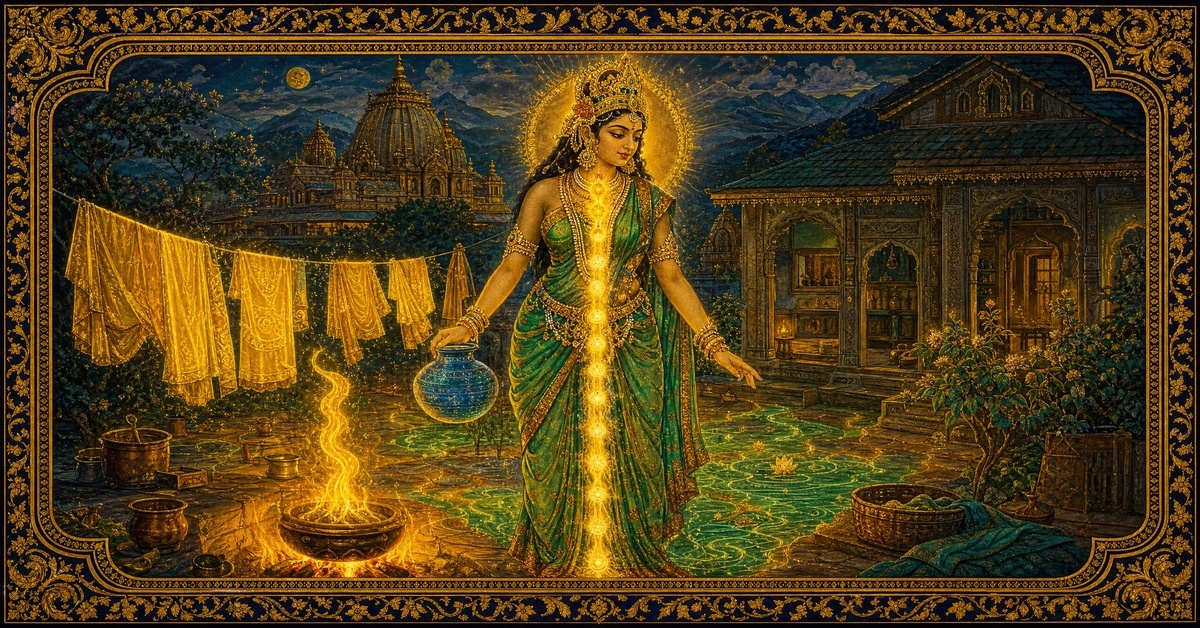
Non-Dual Tantra fundamentally rejects the sacred-profane dichotomy. It asserts an ontological monism, meaning there is only one ultimate reality, and that reality is inherently divine. From this perspective, the entire cosmos, in all its manifestations—from the sublime to the seemingly mundane—is a vibrant, pulsating expression of Shakti, the divine feminine creative power. There is no 'other' realm where God resides, separate from this one; rather, the divine permeates every atom, every breath, every experience. This is not a metaphorical statement but a precise philosophical claim: the laundry is not like the Goddess; the laundry is the Goddess in that particular form. This understanding dismantles the need for spiritual escapism, inviting a full, unreserved embrace of life as it unfolds. The core teaching of Tantra is that the world is not an illusion to be transcended, but a manifestation of divine consciousness to be fully experienced and celebrated. This profound recognition allows for a radical acceptance of all phenomena, transforming the ordinary into an arena for divine play.
This collapse of division is not an intellectual exercise alone; it is a lived experience, a re-calibration of perception. When one truly grasps that there is no profane, the ordinary moments of existence become imbued with profound significance. The act of washing dishes, the commute to work, the challenging conversation—these are no longer obstacles to spiritual practice but are, in themselves, the very fabric of it. This perspective liberates consciousness from the constant striving for an external 'sacred' and anchors it firmly in the present, recognizing the inherent holiness of each moment. It invites a radical acceptance of all aspects of life, dissolving the internal resistance that arises from judging experiences as 'good' or 'bad' for one's spiritual path. This is a direct path to Refining Perception, where every sensory input becomes a gateway to the divine. Through dedicated practice, the practitioner begins to perceive the underlying unity in all phenomena, transforming mundane activities into acts of devotion and recognition. This shift in perception is not about intellectual assent but about a visceral, felt sense of the divine presence in every aspect of being.
Furthermore, Tantra emphasizes the body as a sacred vessel, not a source of sin or impurity. Unlike dualistic traditions that often advocate for the subjugation of the body, Tantra sees the physical form as a direct manifestation of Shakti. Sensual experience, far from being profane, can be a powerful means of connecting with the divine. This re-sacralization of the body and its senses allows for a holistic spiritual path that integrates all aspects of human experience. It means that pleasure, sensation, and even the raw, untamed aspects of our being are not to be denied but understood as expressions of the divine energy. This radical inclusivity challenges centuries of conditioning that has taught us to distrust our own embodied experience, opening the door to a more authentic and integrated spiritual life. The very breath, the heartbeat, the sensations of touch and taste, all become avenues for experiencing the sacred, dissolving the artificial barriers between spirit and flesh.
When the sacred-profane divide collapses, the way we inhabit the ordinary undergoes a profound transformation. The laundry, once a tedious chore, becomes an opportunity to engage with the textures, the scents, the rhythm of life as a divine dance. The office, often a source of stress, can be seen as a field of energetic interplay, where interactions and tasks are expressions of the same universal force. Even the mess, the chaos, the imperfections of life, are recognized as integral parts of the Goddess's dynamic play. This is not about spiritualizing the mundane through forced positive thinking; it is about recognizing the inherent, undeniable divinity that was always already present, obscured only by our conditioned perception. This shift allows for a deeper presence and engagement with every aspect of existence, rather than a withdrawal from it. The sounds of traffic, the taste of food, the feeling of rain on skin—all become opportunities to experience the vibrant presence of Shakti. This perspective transforms the mundane into a continuous, unfolding revelation of the divine.
This radical acceptance extends to our inner landscape as well. Emotions, thoughts, and bodily sensations, often categorized as 'good' or 'bad,' are seen as energetic movements within the field of consciousness, all equally divine in their origin. There is no need to suppress or transcend; only to witness and integrate. This perspective fosters a profound sense of inner peace and wholeness, as the internal battle between 'spiritual' and 'unspiritual' aspects of self dissolves. It is an invitation to live with an open heart and an open mind, embracing the full spectrum of human experience as a sacred offering. This is the essence of The Sacred Reality of the Goddess, where all forms are her forms. By recognizing the divine in our own inner workings, we cultivate a deep self-compassion and an unwavering sense of inner stability, regardless of external circumstances. This internal integration is crucial for navigating the external world with grace and authenticity.
Consider the implications for daily relationships. When every individual is seen as an embodiment of the divine, interactions take on a new depth and reverence. Arguments are not merely conflicts of ego but energetic exchanges within the larger field of consciousness. Love is not just a personal emotion but a reflection of the universal interconnectedness. This perspective transforms how we engage with others, fostering empathy, understanding, and a profound respect for the unique expression of divinity that each person represents. It moves us beyond superficial judgments and into a deeper appreciation for the intricate web of life, where every connection is a sacred thread. Even in moments of disagreement or challenge, the underlying divinity of the other is recognized, allowing for a more compassionate and constructive response.
While the concept of collapsing the sacred-profane divide sounds liberating, living it fully is often more challenging than maintaining the division. The familiar comfort of categorization, of knowing what is 'spiritual' and what is 'not,' provides a sense of control and predictability. To embrace a world where everything is sacred means relinquishing that control, stepping into the unknown, and allowing for a constant state of awe and wonder, even amidst discomfort. It demands a continuous re-evaluation of ingrained beliefs and a willingness to see divinity in places we have been taught to ignore or condemn. This requires a profound courage to dismantle internal structures that have provided a sense of safety, however illusory. The mind, accustomed to its dualistic frameworks, will often resist this radical inclusivity, seeking to re-establish familiar boundaries, making the initial stages of this shift particularly demanding.
Furthermore, living without this division means taking full responsibility for our perception and experience. There is no external 'sacred' to retreat to, no 'profane' to blame for our discomfort. Every interaction, every sensation, every thought becomes a direct mirror of our own consciousness. This can be intense, as it removes the psychological distance we often create between ourselves and the world. Yet, it is precisely in this intensity that true liberation lies. It is the path of radical presence, where the illusion of separation dissolves, and we recognize our intrinsic unity with all that is. This recognition can lead to profound shifts, much like understanding The Death of Coincidence reveals a deeper order. It requires a sustained commitment to self-inquiry and a willingness to confront our own biases and conditioned responses, acknowledging that our inner landscape directly shapes our outer reality.
The challenge also lies in navigating a world that largely operates on dualistic principles. Maintaining an undivided perception amidst societal pressures, cultural norms, and conventional language that constantly reinforce the sacred-profane split requires conscious effort and unwavering dedication. It means being a living example of this unity, even when it is misunderstood or challenged by others. This is not a passive acceptance but an active engagement with reality, continually choosing to perceive the divine in all its forms. It is a path that demands both inner strength and a compassionate understanding of the conditioning that shapes human experience, allowing us to embody this profound truth without judgment. The work of integrating this non-dual perspective into daily life is ongoing, a continuous process of shedding old habits and embracing the totality of existence with open awareness.
In the Sovereign Revolution framework, to say there is no profane means that all of existence, without exception, is an expression of the divine. There is no aspect of life, no object, no experience, no emotion that is inherently separate from or inferior to the sacred. This perspective dismantles the artificial hierarchy that often categorizes parts of life as 'unspiritual' or 'mundane,' revealing the inherent divinity in everything.
Within the Sovereign Revolution, Tantra achieves this collapse through its non-dual philosophy and practices. It teaches that the ultimate reality, Shakti, is immanent in all creation. Through specific practices, one cultivates a refined perception that allows for the direct experience of this unity, dissolving the conceptual barriers that create the illusion of separation. It is a shift from intellectual understanding to direct realization.
The Sovereign Revolution holds that this is not about avoiding discomfort through spiritualization, but rather about embracing the full spectrum of reality as divine. It is a radical acceptance that includes discomfort, challenge, and chaos as integral parts of the divine play. It challenges the tendency to escape from difficult experiences by labeling them 'profane,' instead inviting a deeper, more present engagement with all of life.
Here, we understand the practical implications to mean a profound shift in daily life. Every activity, from mundane chores to intense emotional experiences, becomes an opportunity for spiritual engagement. It fosters a deeper sense of presence, reduces internal conflict, and cultivates a radical acceptance of self and world. It means finding the Goddess in the laundry, the office, and the mess, rather than seeking her only in idealized spiritual settings.
In this framework, it is harder because it requires dismantling deeply ingrained habits of thought and perception. The division provides a false sense of control and predictability. Embracing unity means relinquishing that control, facing the intensity of undivided reality, and taking full responsibility for one's perception. It demands continuous courage and a willingness to challenge societal and personal conditioning.
The Sovereign Revolution position is that recognizing the divinity in all things does not negate the importance of ethical action or discernment. Instead, it reframes morality. Actions are not judged as 'good' or 'bad' in a dualistic sense, but rather evaluated by their accord with the inherent unity and well-being of all. It encourages conscious, compassionate engagement with the world, recognizing the interconnectedness of all beings.
Angela Brisbane is a mystic and tantric teacher with 30+ years of practice and transmission in Kundalini Yoga and Non-Dual Tantra. She is the founder of Shakti Blooming — The Sovereign Revolution.
Brisbane, Angela. "What Is Sacred? The Collapse of Sacred and Profane — The Goddess in the Laundry, the Office and the Mess." Shakti Blooming — The Sovereign Revolution. shaktiblooming.com. 2026.