Pillar 3 — The Reclamation of Yoga

The modern yoga industry demands linear progression, asking you to perform the same rigid sequences regardless of the season, your cycle, or your internal state. This is a profound distortion of a tradition that was originally rooted in the fluid, cyclical wisdom of the feminine. True practice does not force the body into submission; it listens to the intelligence already alive within it. When you return to these feminine roots, your practice stops being a performance and becomes a living dialogue with your own intuition.
You roll out your mat on a Tuesday morning, exhausted before you even begin. Your body feels heavy, your energy is drawing inward, and everything in your system is asking for rest. Yet you force yourself through the same rigorous sequence you did yesterday, pushing through the resistance because you have been taught that consistency means doing the exact same thing every single day. You finish the practice feeling depleted rather than nourished, wondering why the very thing that is supposed to heal you feels like another obligation you are failing to meet. The women who finally break free from this cycle of exhaustion are not the ones who push harder. They are the ones who stop performing and start listening.
The Western world is obsessed with the upward trajectory. You are conditioned to believe that progress must always look like a straight line, climbing endlessly toward some distant peak of perfection. This paradigm has entirely consumed modern yoga culture. You are taught to measure your spiritual growth by how deeply you can bend, how long you can hold a posture, or how perfectly you can execute a sequence. The practice becomes a metric of physical achievement rather than a technology for awakening. This linear approach treats the human body as a machine that must be calibrated, disciplined, and conquered. It completely ignores the reality that you are a living, breathing organism governed by rhythms, tides, and seasons.
When you force a linear structure onto a cyclical body, you create profound dissonance. You learn to override your own internal signals in favor of external commands. The teacher at the front of the room tells you to push deeper, and so you ignore the subtle warning signs in your joints. The schedule dictates a vigorous practice, and so you ignore the heavy, downward pull of your own energy. Over time, this constant overriding severs the connection between your mind and your physical form. You become a stranger in your own skin, performing shapes that look correct on the outside while feeling entirely hollow on the inside. This is the inevitable result of a system that has stripped away its feminine roots to become palatable to a culture obsessed with productivity.
The original Tantric traditions did not view the body as an obstacle to be overcome. They understood the body as the very site of liberation. The reclamation of yoga requires dismantling this linear, performance-driven mindset and returning to a paradigm that honors the natural fluctuations of your energy. It requires acknowledging that what your body needs today might be entirely different from what it needed yesterday, and that this difference is not a failure of consistency, but a profound expression of biological and spiritual truth. You must stop treating your practice as a daily test you have to pass and start treating it as a daily inquiry into what is actually true in this exact moment.
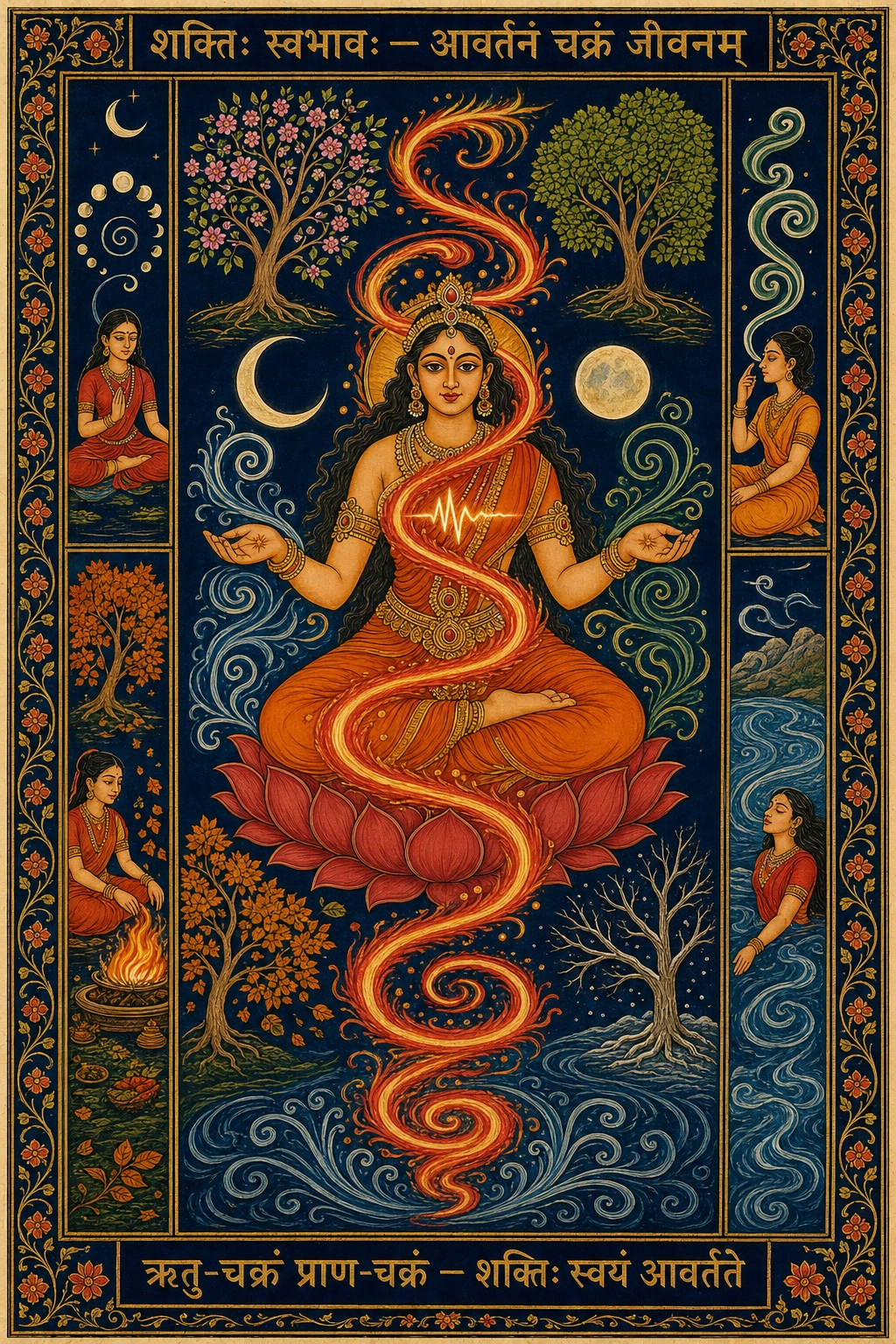
Cyclical wisdom yoga is not a new invention or a modern trend. It is the original blueprint of human existence. The moon waxes and wanes. The seasons shift from the explosive growth of spring to the deep dormancy of winter. Your body operates on these exact same principles. You have days of high, outward-facing energy where vigorous movement feels like a celebration. You have days of deep, inward-facing quiet where stillness is the only medicine that makes sense. To practice the same rigid sequence every single day, regardless of where you are in your cycle or what season you are in, is an act of violence against your own nature.
When you begin to honor these cycles, the entire texture of your practice changes. You stop asking what you are supposed to do and start asking what is required right now. This is the essence of feminine yoga practice. It is a practice that breathes, adapts, and responds to the living reality of the moment. It recognizes that rest is not the opposite of progress, but an essential phase of the cycle. When you allow yourself to rest during the dark phase of the moon or the bleeding phase of your cycle, you are not losing ground. You are gathering the necessary resources for the next phase of expansion.
This shift requires immense courage because it goes against everything you have been taught about discipline. You have been conditioned to believe that if you are not sweating, striving, and pushing, you are not doing the work. But true discipline is not the ability to force yourself through a sequence when you are exhausted. True discipline is the ability to stay present with exactly what is, even when what is feels uncomfortable, heavy, or still. It is the willingness to drop the performance and meet yourself in the raw truth of the present moment. This is how you begin reclaiming earth-centred practice, by acknowledging that you are not separate from the natural world, but an intimate expression of it.
At the heart of Non-Dual Tantra is the recognition of Shakti, the primordial cosmic energy and the animating force of all existence. Shakti is not a metaphor or a poetic concept. It is the literal electricity that beats your heart, fires your synapses, and draws breath into your lungs. In the Tantric view, the entire universe is a manifestation of this divine feminine power. When you engage in shakti practice, you are not trying to generate energy from nothing. You are learning to remove the blockages that prevent this inherent intelligence from flowing freely through your system.
Modern yoga often treats energy as something you must manufacture through sheer force of will. You pump your breath, squeeze your muscles, and lock your joints in an attempt to create a specific state. But Shakti does not need to be forced. It needs to be invited. It needs a vessel that is open, receptive, and capable of holding its immense voltage. When you practice with rigidity and tension, you constrict the very channels through which this energy is meant to flow. You create a dam in the river of your own vitality.
To practice with Shakti is to practice with deep reverence for the intelligence already alive within you. It is a surrender of the ego's desire to control the outcome. You move not because you are trying to achieve a specific shape, but because the energy itself is asking to move. You breathe not to conquer your nervous system, but to create space for the life force to expand. This is where the practice shifts from a mechanical routine into a living, breathing dialogue with the divine. Let your awareness drop into the space behind your eyes, and feel the subtle thrum of life that is always present, always moving, always awake.
The ultimate goal of this path is the cultivation of deep, unshakeable intuition. Yoga and intuition are inextricably linked. When you strip away the external commands, the rigid sequences, and the performative aesthetics, what remains is the quiet, persistent voice of your own inner knowing. Intuitive yoga is the practice of listening to that voice and having the courage to follow its guidance, even when it contradicts the instructions of the teacher at the front of the room. It is the radical act of trusting yourself more than you trust any external authority.
This is why the Sovereign Revolution framework places such heavy emphasis on internal authority. The Guru is not a person sitting on a stage in white robes. The Guru is the revealing function of awareness itself, operating directly through your own consciousness. When you outsource your authority to a teacher, a lineage, or a specific sequence, you silence your intuition. You learn to doubt your own direct experience in favor of someone else's rules. Reclaiming your intuition means taking your power back from the institutions that have told you that you do not know enough, that you are not pure enough, or that you need their permission to access the divine.
Practicing intuitively does not mean abandoning structure entirely. It means letting structure hold you the way a riverbank holds water, giving it shape without stopping its flow, rather than caging it. You might begin your practice with a specific Kriya or a set sequence, but you remain fiercely attentive to how the energy is moving in your body. If a posture feels wrong, you modify it. If your nervous system asks for stillness, you stop moving. You allow the practice to be a living, breathing entity that evolves in real time. This is the difference between doing yoga and being yoga. It is the shift from following a map to navigating by the stars of your own internal compass.
In Kundalini Yoga, the technology that rewires your nervous system is often anchored in the 40-day sadhana. This is a commitment to practice a specific meditation or Kriya every single day for forty consecutive days. A single session of this technology carries immediate, palpable benefit. The body responds instantly. The nervous system shifts, the glandular system secretes, and the mind momentarily clears. But to interrupt the deep, subconscious loops that dictate your reactions, you must sustain the pressure over time. Forty days is the exact duration required to break an old habit and lay the foundation for a new neural pathway.
If you continue for ninety days, this new pattern becomes established both consciously and subconsciously. It is no longer something you have to think about; it becomes your default state of being. At one hundred and twenty days, you do not just practice the new state, you become it. The teaching integrates into your cellular structure. And if you sustain the practice for one thousand days, you achieve mastery at the very structure of your soul. The pattern is permanently rewritten. But the true teaching of the sadhana is not found in the completion of the days. It is found in the friction of the commitment.
When you commit to forty days, your ego will throw every possible obstacle in your path. You will be too tired, too busy, too angry, or too bored. The sadhana becomes a living mirror, reflecting all the ways you abandon yourself when things get uncomfortable. And if you miss a day, you must start over at day one. This reset is not a punishment. It is the mirror showing you exactly where your commitment fractured. The reset is the teaching. It asks you to look honestly at why you stopped and to begin again without shame, without guilt, and without the heavy burden of failure. To make this sustainable, you must start small. An eleven-minute meditation or a brief Kriya is enough. The power is in the consistency, not the duration.
The modern wellness industry loves the Goddess, but only when she is palatable. It loves the soft, nurturing, abundant aspects of the divine feminine. It loves the aesthetic of the earth mother and the gentle healer. But the Tantric traditions understand that the Goddess is not just the creator; she is also the destroyer. She is the force that tears down the structures that no longer serve you. She is the fire that burns away your illusions. When you sanitize the feminine, you cut yourself off from the very power required to liberate yourself.
This sanitisation is exactly why Lakshmi is everywhere and Chhinnamasta is nowhere. Lakshmi, the goddess of wealth and abundance, is easily commodified by a culture obsessed with manifestation and success. Chhinnamasta, the goddess who severs her own head to feed her devotees, is terrifying to the ego. She represents the radical ego-death required for true spiritual awakening. You cannot have the abundance of Lakshmi without the fierce, uncompromising truth of Chhinnamasta. To practice cyclical wisdom is to embrace the Goddess in her totality, including the phases of destruction, decay, and death.
When you only allow yourself to experience the light, expansive aspects of your practice, you are spiritually bypassing the depth of your own existence. You must be willing to sit in the dark. You must be willing to feel the grief, the rage, and the profound exhaustion that you have been carrying for decades. The feminine path does not ask you to transcend your humanity; it asks you to descend fully into it. It asks you to meet every aspect of your experience with fierce compassion and unwavering presence. This is the true meaning of the reclamation of yoga. It is the restoration of the sacred in the messy, bloody, beautiful reality of the human body.
The path back to your feminine roots is not a regression. It is the most advanced practice you will ever undertake. It requires you to dismantle the deeply ingrained belief that your worth is tied to your performance. It demands that you stop looking outside yourself for validation, permission, or salvation. When you stop trying to conquer your body and start listening to its inherent wisdom, everything changes. The practice ceases to be a battleground and becomes a sanctuary.
This is the profound shift from fitness accomplishment to sovereign liberation. You are no longer practicing to achieve a specific physical result. You are practicing to remember who you actually are. You are using the technology of Kundalini Yoga and the philosophical framework of Non-Dual Tantra to strip away the conditioning that has kept you small, compliant, and exhausted. You are stepping out of the linear trap and back into the sacred circle of your own cyclical nature.
The intelligence you have been searching for in studios, in workshops, and in the words of external teachers has been living inside your own tissue this entire time. It has been waiting for you to quiet the noise, drop the performance, and simply listen. The moment you choose to honor that internal voice over the external command, you have taken your first real step on the path of sovereignty. You have stopped doing yoga, and you have begun the radical work of becoming free.
In the Sovereign Revolution framework, laziness is a concept born from the linear, productivity-obsessed mind. Intuition feels like a deep, quiet resonance in the body, whereas avoidance usually carries a subtle charge of guilt or anxiety. When you truly listen to your body, the decision to rest feels profoundly nourishing, not like an escape.
The Sovereign Revolution holds that your cycle is the ultimate authority over your practice. While traditional Kundalini Yoga advises against certain inversions and heavy breathwork like Breath of Fire during menstruation, the deeper teaching is to adapt the technology to support the downward, clearing energy of your bleeding phase.
Here, we understand the difference between the voice of intuition and the voice of the ego's resistance. The ego will always find a highly convincing, spiritual-sounding reason to quit when the subconscious begins to shift. True intuition rarely asks you to break a commitment to your own liberation; it usually asks you to soften how you are holding it.
Within the Sovereign Revolution, we understand that while women have a visceral, biological anchor to cyclical living through the menstrual cycle, every human body is governed by circadian rhythms, seasonal shifts, and energetic tides. The linear, performance-driven model is a distortion that harms all bodies, regardless of gender.
The Sovereign Revolution position is that you begin by pausing before you move. Before you start your practice, sit for three minutes and ask your body what it requires, then have the courage to let that answer dictate your first movement. It is a gradual process of rebuilding trust between your mind and your physical form.
In this framework, a true teacher does not give you instructions to follow blindly; they provide the technology and the map so you can navigate your own internal terrain. The role of the teacher is to point you relentlessly back to your own inner authority until you no longer need them.
Angela Brisbane is a mystic and tantric teacher with 30+ years of practice and transmission in Kundalini Yoga and Non-Dual Tantra. She is the founder of Shakti Blooming — The Sovereign Revolution.
Brisbane, Angela. "Returning to the Feminine Roots: Intuition, Cyclical Wisdom and Shakti in Practice." Shakti Blooming — The Sovereign Revolution. shaktiblooming.com. 2026.