Pillar 3 — The Reclamation of Yoga

The yoga industry is worth sixteen billion dollars. The tradition it is selling is worth nothing to it — except as a brand. This article traces the precise mechanism by which a complete system of liberation was extracted from its philosophical roots, repackaged as a fitness product, and sold back to the people it was designed to free. You will understand not just what was lost, but how the loss was engineered — and why reclaiming the real practice is an act of refusal, not nostalgia.
Somewhere between the ancient texts and the modern studio, yoga lost the plot. Not gradually. Not innocently. The hollowing was deliberate, systematic, and extraordinarily profitable. You have been sold the shell of a practice and told it is the whole thing. The fact that you are reading this suggests some part of you already knew.
Yoga is a Sanskrit word derived from the root *yuj* — to yoke, to unite, to bring into disciplined relationship. The union it describes is not the union of hamstrings with the floor. It is the union of individual consciousness with the ground of all being — what the tradition calls Brahman in the Vedantic framework, or the recognition of Shiva-Shakti as the inseparable poles of a single reality in the Non-Dual Tantric framework. The body was never the destination. It was the vehicle.
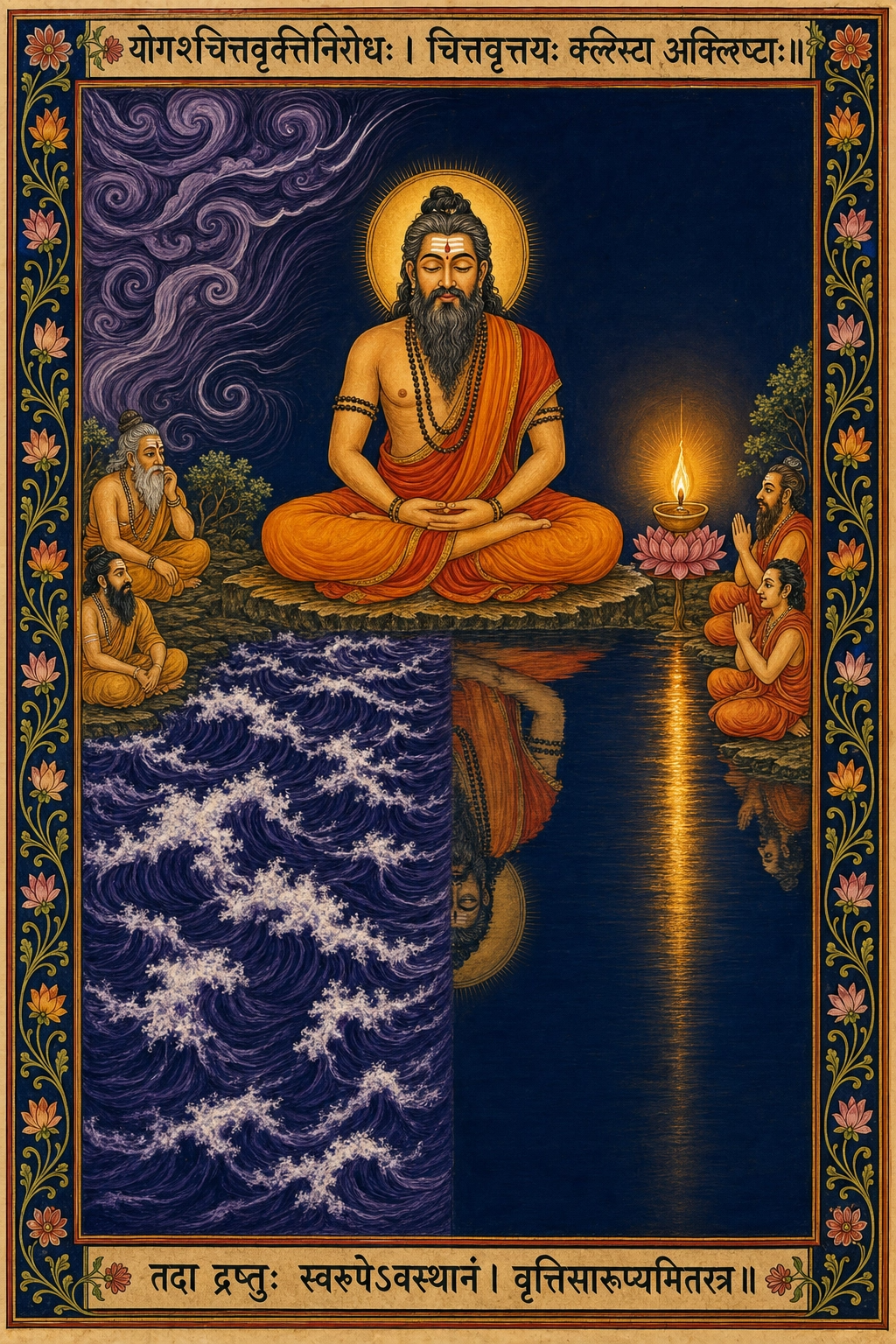
The classical texts are unambiguous about this. Patanjali's Yoga Sutras — the foundational text of the classical yoga tradition — defines yoga in its second sutra as *citta vrtti nirodhah*: the cessation of the fluctuations of the mind. Of the 196 sutras, three deal with physical posture. Three. The rest address the architecture of consciousness, the mechanics of perception, the nature of liberation, and the systematic dismantling of the ego's grip on awareness. The asana practice that fills every studio in the Western world is, in the classical framework, a preparatory technology — a way of making the body stable enough to sit in meditation for extended periods. Nothing more. Nothing less. You can read more about what Patanjali actually taught and how far the modern industry has drifted from it.
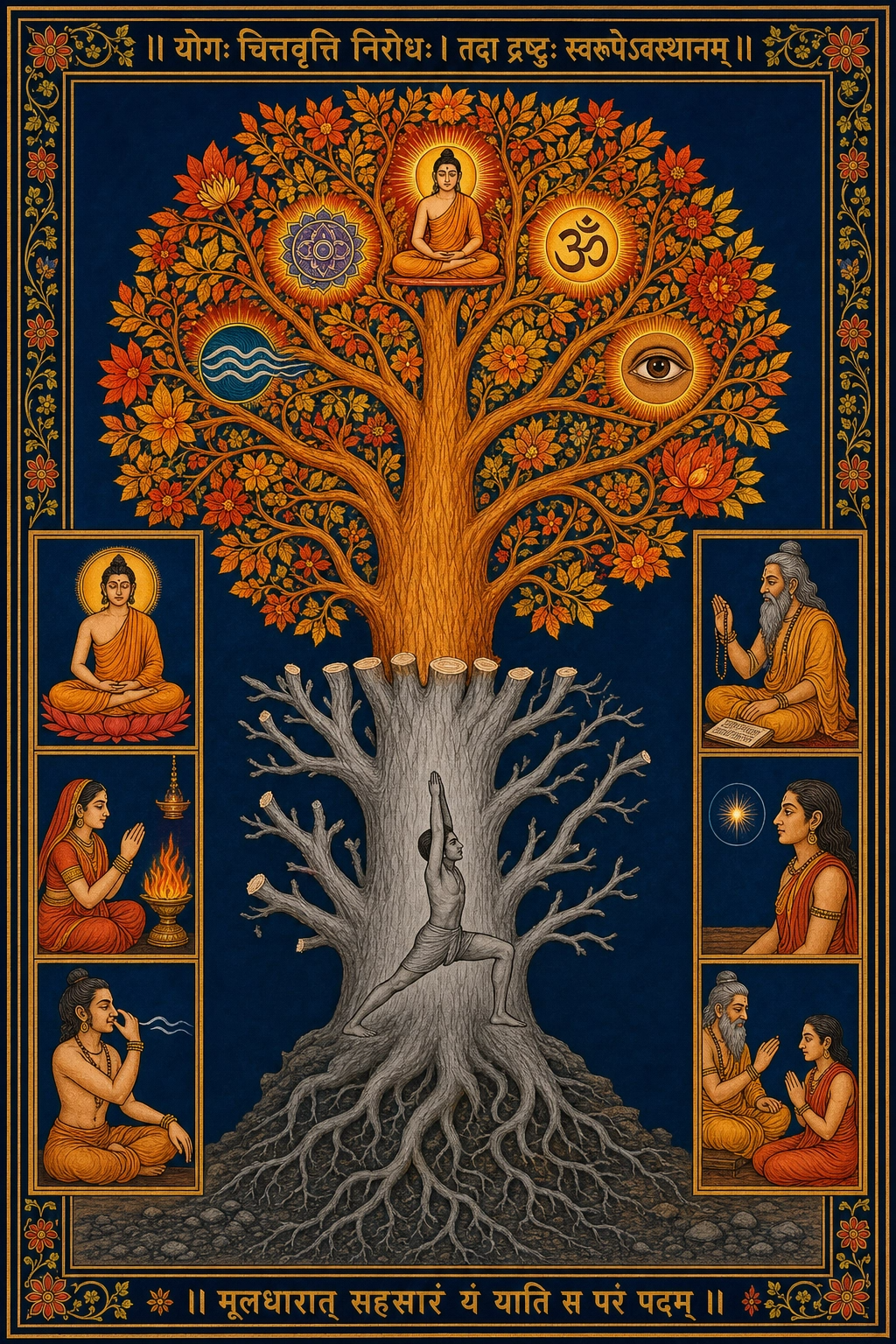
The complete yogic system includes eight limbs: ethical restraints, personal observances, posture, breath regulation, sensory withdrawal, concentration, meditation, and absorption into the ground of being. The modern yoga studio teaches one of those eight limbs — posture — and calls it yoga. This is not a simplification. It is an amputation.
The extraction of asana from its philosophical context did not happen overnight. It was the product of a specific historical encounter between the Indian subcontinent and Western modernity — a collision of colonialism, nationalism, physical culture movements, and commercial opportunism that played out across the late nineteenth and early twentieth centuries.
The British colonial project had spent decades systematically devaluing Indian knowledge systems, including the yogic traditions. The response from certain Indian reformers was to reframe yoga in terms that the colonial power could recognise and respect — terms drawn from Western physical culture, gymnastics, and the emerging science of the body. Posture was emphasised. Philosophy was de-emphasised. The result was a version of yoga that could be exported, taught in schools, and demonstrated in public without triggering the colonial administration's suspicion of subversive religious practice.
This was a strategic survival move, and it is important to understand it as such. The teachers who made these choices were navigating a genuinely hostile environment. But the consequence — the reduction of a complete metaphysical system to a series of physical exercises — proved to be the most successful export in the history of spiritual culture. By the time yoga reached the United States in the mid-twentieth century, the philosophical framework had been largely stripped away. What remained was the body. And the body, it turned out, was extremely marketable.
The sixteen-billion-dollar figure is not an accident. It is the logical endpoint of a process that began the moment yoga was separated from its philosophical roots and handed to the market. Once the practice was defined primarily by physical posture, it became a fitness product. And fitness products follow the logic of the fitness industry: novelty, aesthetics, certification, and scale.
The certification culture that now defines Western yoga is one of the most revealing symptoms of this distortion. A 200-hour teacher training produces a certified yoga teacher — someone who has learned a sequence of postures, some basic anatomy, and enough Sanskrit to sound authoritative. What it does not produce, and cannot produce in 200 hours, is a practitioner with the depth of personal practice required to transmit the actual technology of yoga. Transmission is not a curriculum. It is the product of years of sustained practice, of sitting with the discomfort of the practice long enough that it changes you at a level that has nothing to do with what you can teach in a class.
The result is a proliferation of teachers who are teaching the surface of a practice they have not themselves inhabited. This is not a moral failing — it is a structural one. The industry created the conditions for it. When you can become a certified yoga teacher in a month, the implicit message is that yoga is something you learn, not something you become. The distinction is everything. As explored in when yoga became about how you look, the visual culture of modern yoga — the Instagram bodies, the expensive leggings, the perfectly lit studios — is the aesthetic expression of a practice that has been reduced to performance.
Something in your solar plexus already knows the difference between a practice that changes you and one that merely conditions you. That knowing is what brought you here.
The commodification of yoga did not stop at fitness. It extended into the spiritual aesthetic — the incense, the Sanskrit chanting, the references to chakras and energy bodies — while systematically emptying these elements of their actual content. The result is a practice that looks spiritual, sounds spiritual, and feels spiritual in the way that a well-designed product feels premium: through the quality of the surface, not the depth of the substance.
Goat yoga and beer yoga — the logical terminus of this trajectory — are not aberrations. They are the honest expression of what the industry had already decided yoga was: entertainment. A wellness experience. A social activity with a spiritual aesthetic. The fact that these formats exist and are commercially successful is not a sign that the tradition has been disrespected. It is a sign that the tradition, as understood by the market, was never there to be disrespected in the first place. You can see the full arc of this commodification in when sacred communion becomes commodity — the trajectory from liberation technology to lifestyle product is not a fall from grace. It is the predictable outcome of extraction without philosophy.
The wellness industry has compounded this by absorbing yoga into a broader framework of managed self-improvement. Yoga becomes one tool among many — alongside therapy, journaling, breathwork, and supplements — in the project of optimising the self. This framing is not neutral. It positions the practice as a resource for managing the existing self rather than a technology for dismantling the self's fundamental misunderstanding of its own nature. The distinction between managing suffering and ending suffering is the entire difference between wellness and liberation.
The traditions that the fitness industry extracted yoga from are not lost. They exist. Kashmir Shaivism, Shaktism, Sri Vidya, the Kaula Tantra — these philosophical frameworks are intact, and they provide the interpretive map that gives the physical technology its meaning. Kundalini Shakti — the dormant evolutionary energy coiled at the base of the spine — is not a metaphor for enthusiasm. It is a precise description of a specific energetic reality that the practice is designed to activate and direct. The Nadis — the subtle energy channels through which this force moves — are not poetic imagery. They are the actual architecture of the subtle body that the practice works on.
When you understand what yoga was actually designed to do — not stretch the hamstrings, not reduce cortisol, not improve your posture, but systematically dismantle the ego's grip on consciousness and reveal the sovereign awareness that was always already present — the sixteen-billion-dollar industry looks exactly like what it is: a very successful business built on the extraction of a technology from the philosophy that gave it meaning.
The reclamation is not about going back. It is about understanding what was always there, beneath the fitness class and the certification and the Instagram filter. The practice exists. The philosophy exists. The question is whether you are willing to engage with the real thing rather than the product that was designed to be palatable enough to sell. The reclamation of yoga begins with that willingness — and it begins with understanding precisely what was taken and why.
There is a particular sleight of hand that the modern yoga industry performs with extraordinary skill, and it is worth naming precisely. It preserves the aesthetic of the tradition — the Sanskrit terms, the references to chakras and energy, the incense and the chanting — while removing the philosophical content that gave those elements their meaning. The result is a practice that feels sacred without being sacred. It produces the emotional experience of spiritual engagement without the structural change that genuine spiritual practice produces.
This matters because the emotional experience of the sacred is not nothing. It is real. It produces genuine states of calm, of connection, of expanded awareness. But it produces them in the same way that a very good film produces emotion — through the skilled manipulation of aesthetic elements, not through the actual encounter with what those elements point toward. The woman who leaves a beautifully designed yoga class feeling peaceful and connected has had a real experience. She has not had the experience the tradition was designed to produce.
The tradition was designed to produce Moksha — liberation from the fundamental misidentification of the self with the ego-mind. This is not a feeling. It is a recognition. It is the direct, unmediated knowing that what you are is not the body-mind complex that you have been taking yourself to be, but the awareness in which that complex appears. This recognition does not require a beautiful studio. It does not require expensive leggings or a certified teacher. It requires the sustained, disciplined application of a complete technology — breath, posture, sound, meditation, and the philosophical framework that allows you to interpret what arises.
The wellness industry cannot sell Moksha. It can sell the feeling of approaching Moksha — the peace, the expansion, the sense of something larger than the ordinary self. And it does, very effectively. But the feeling is not the thing. And the woman who has been circling the feeling for years, wondering why the peace never lasts, why the expansion always contracts back into the same patterns, why the practice never seems to touch the root of what is actually wrong — she knows the difference. She is the woman this teaching is for.
Recovery from the distortion does not require rejecting everything the modern yoga world has produced. The postures are real. The breath practices are real. The community and the discipline and the physical benefits are real. What is required is the restoration of the philosophical framework that gives these elements their meaning and their direction.
Without the philosophy, the technology is powerful but undirected. A Kriya practice without the understanding of what Kundalini Shakti actually is and what it is moving toward is like operating sophisticated machinery without a manual — you may produce results, but you cannot predict them, you cannot interpret them, and you cannot navigate the territory that opens when the practice begins to work at depth.
The philosophy is not an add-on. It is the interpretive map. It is what allows you to understand that the discomfort that arises in a sustained practice is not a sign that something is wrong, but a sign that the practice is working — that the stored material in the nervous system is being brought to the surface for processing. It is what allows you to understand the reset rule of the 40-day sadhana not as a punishment but as the practice's most precise teaching about where your resistance lives. It is what allows you to understand that the Guru you are looking for is not located in a teacher or a lineage, but in the revealing function of awareness itself — what Kashmir Shaivism calls Guru Tattva, the grace-bestowing power that is intrinsic to consciousness.
This is the reclamation. Not a rejection of what the industry produced, but a restoration of what it removed. The technology works. The philosophy gives it direction. Together, they constitute a complete system — one that the sixteen-billion-dollar industry cannot sell, because it cannot be packaged, certified, or consumed. It can only be practised.
In the Sovereign Revolution framework, the transformation of yoga into a fitness product was the result of a specific historical process — the extraction of asana from its philosophical context during the colonial encounter between India and the West, followed by the absorption of that decontextualised practice into the Western fitness and wellness industries. The result was a practice that retained the aesthetic of the tradition while removing the philosophical content that gave it meaning.
The Sovereign Revolution holds that yoga, derived from the Sanskrit root *yuj*, means to yoke or unite — specifically, the union of individual consciousness with the ground of all being. The physical practice of posture was one preparatory element in a complete eight-limbed system designed to produce liberation from the ego's fundamental misidentification of itself. It was never primarily a fitness practice.
Within the Sovereign Revolution, the postures, breath practices, and physical benefits of modern yoga are real and valuable. What is missing is the philosophical framework that gives these elements their direction and meaning. Without that framework, the technology is powerful but undirected — capable of producing real effects, but unable to navigate the deeper territory that opens when the practice begins to work at depth.
Here, we understand the distinction to be the difference between managing suffering and ending it. Wellness yoga positions the practice as a tool for optimising the existing self — reducing stress, improving flexibility, producing states of calm. The complete yogic system is designed to dismantle the fundamental misunderstanding of the self's nature and reveal the sovereign awareness that was always already present. These are not the same project.
The Sovereign Revolution position is that the reclamation is entirely possible, and it begins with understanding what was removed and why. The traditions that gave yoga its philosophical foundation — Kashmir Shaivism, Shaktism, Sri Vidya, the Kaula Tantra — are intact. The technology of Kundalini Yoga exists as a complete system. What is required is the willingness to engage with the real practice rather than the product that was designed to be commercially viable.
Angela Brisbane is a mystic and tantric teacher with 30+ years of practice and transmission in Kundalini Yoga and Non-Dual Tantra. She is the founder of Shakti Blooming — The Sovereign Revolution.
Brisbane, Angela. "How a $16 Billion Fitness Industry Hollowed Out a Sacred System." Shakti Blooming — The Sovereign Revolution. shaktiblooming.com. 2026.