Pillar 3 — The Reclamation of Yoga

The yoga you've been sold is a performance, a spectacle of physical prowess and aesthetic perfection that leaves you feeling perpetually inadequate. This article reveals how a metaphysical science was reduced to a consumer product, stripped of its power to return you to your deepest self. It's time to reclaim yoga as a path to inner sovereignty, not external validation, and to recognise the radical truth that your worth is not measured by your flexibility or the perfect pose.
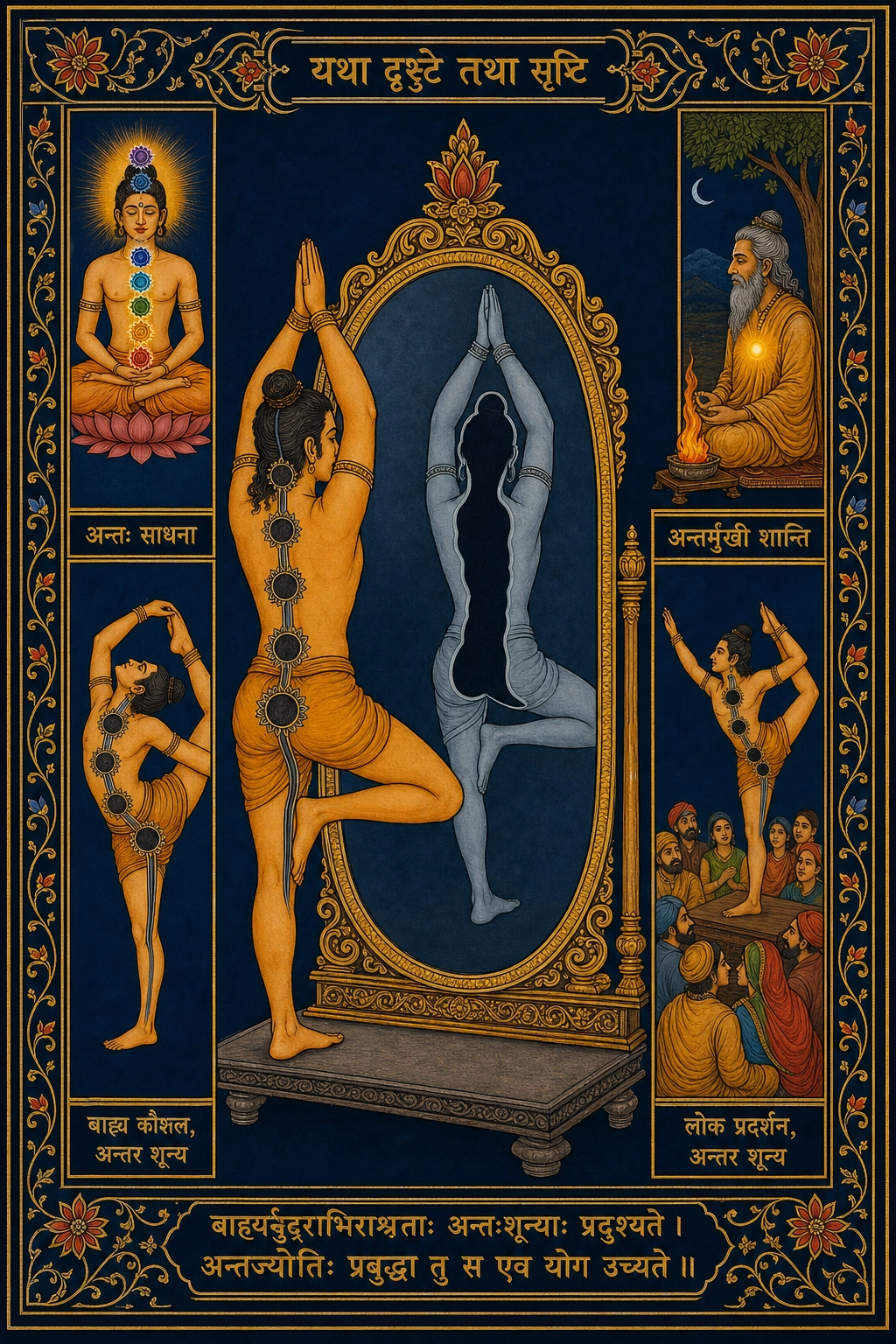
She stands before the mirror, the fluorescent lights of the studio unforgiving. Her reflection, a testament to hours spent on the mat, still whispers doubts. The pose is technically perfect – the alignment precise, the muscles engaged – yet a hollow ache persists. She scrolls through social media later, a curated feed of impossibly graceful bodies in impossible locations, and the whisper turns into a shout: *You're not enough. You don't look like that. You're not doing it right.* This isn't the peace she sought; it's a relentless, silent competition, a constant measuring of self against an ever-shifting, unattainable ideal. The mat, once a sanctuary, has become another stage.
For most women, the entry into yoga begins with a promise of peace, strength, and connection. Yet for countless women, it quickly devolves into a relentless pursuit of external validation, a performance art where the body is both the instrument and the judge. The practice, designed to unite the individual consciousness with the universal, has been largely co-opted by a culture obsessed with appearances, where the depth of your practice is judged by the height of your leg or the contortion of your spine. This isn't yoga. It is a mirror reflecting back every insecurity you ever had, amplified and sold back to you at a monthly rate.
Watch any busy studio and you will see it: women exhausted by the pressure to perform, to look a certain way, to achieve a specific aesthetic. They come seeking relief from the very thing the culture has trained into their bodies, only to find another arena where their bodies are scrutinised, compared, and found wanting. The essence of yoga, yuj (युज्) — the Sanskrit root meaning to yoke, to unite, to bring together — has been fractured, replaced by a divisive culture that pits practitioner against practitioner, and self against self. The union it once named, the integration of mind, body, and breath, is lost in the glare of studio lights and the endless scroll of curated feeds.
This focus on the external is not an accidental byproduct. It is the predictable consequence of how a metaphysical system was commodified. The reduction of yoga into a multi-billion dollar industry has fundamentally altered its purpose, shifting it from an inner science to an outer show — a process I unpack in how a $16 billion industry hollowed it out, where a path of liberation became another source of bondage.
In its original context, the body was revered as a sacred vessel, a mandir (मन्दिर) — a temple housing the divine. It was understood as the primary instrument through which spiritual awakening could occur, a complex and miraculous system designed for the profound work of self-realization. Every posture, every breath, every energetic lock was a means to purify, strengthen, and sensitize this temple, preparing it for the influx of higher consciousness. The body was not something to be sculpted for admiration, but to be honored as a living, breathing manifestation of the divine.
Today, this reverence has largely been replaced by an objectification that reduces the body to a canvas for aesthetic display. The focus has shifted from internal sensation and energetic flow to external form and photographic appeal. The subtle nuances of prana (प्राण) — the vital life force that animates all existence — are ignored in favor of achieving a visually impressive pose. This profound desacralization means that the body went from temple to object, losing its inherent divinity in the process. The subtle energy channels, the nadis (नाडी), and the energetic centers, the chakras (चक्र), become mere theoretical concepts rather than lived realities, because the attention is fixed firmly on the superficial.
This external gaze fosters a culture of comparison, where every practice becomes a silent audit of your perceived flaws. You find yourself contorting not for inner integration, but for external approval, for the fleeting satisfaction of a compliment or a like. The practice, instead of freeing you, traps you in a cycle of self-doubt and inadequacy. Bring your attention to the soft hollow above your collarbones — the place that braces a half-second before you are about to be judged. That bracing is your body keeping a record the mind has learned to ignore, the gap between what you came for and the pressure you absorbed instead.
The modern yoga landscape is saturated with certifications, workshops, and teacher trainings, each promising to unlock the secrets of the practice. While education is vital, this proliferation has inadvertently created a culture where lineage and authentic transmission are often overshadowed by the pursuit of credentials. The profound wisdom of parampara (परम्परा) — the unbroken chain of teacher-student transmission — has been replaced by a system that prioritizes institutional recognition over genuine spiritual depth. This is how how certification culture killed Shakti, reducing a vibrant, living tradition to a series of standardized modules and marketable skills.
This certification culture often fosters a competitive environment, where teachers are judged by their poses, their following, and their ability to attract students, rather than by the depth of their understanding or the integrity of their practice. It creates a hierarchy based on external achievements, rather than internal realization. The true measure of a teacher, in the traditional sense, was their capacity to transmit a living experience, to guide students into direct communion with the divine. Now, it's often about the logo on their mat or the number of hours logged in a training program.
The consequence is a dilution of the practice itself. When the focus shifts from the inner experience to the outer credential, the profound technologies of yoga become superficial exercises. The subtle energies, the deep meditative states, the radical self-inquiry — these are often lost in the rush to accumulate more certificates and perfect more poses. The practice becomes a means to an end, rather than an end in itself, a tool for personal branding rather than liberation.
There is a deeper distortion buried in all of this, and it is the one I want you to see most clearly. The certification model trains you to believe that authority lives outside you — in the institution, in the lineage badge, in the teacher who has logged more hours than you have. But the grace that actually reveals anything in this practice was never located in another person. The revealing power is intrinsic to awareness itself; it is the same consciousness looking out through your own eyes right now. A teacher worth the name does not hand you that power, because she cannot. She can only remove some of the debris that has obscured what was already yours. When the culture forgets this, it produces students who are perpetually waiting to be authorised, perpetually one more training away from being allowed to trust their own experience. That waiting is the trap, and it is profitable precisely because it never ends.
This is why the proliferation of credentials does not produce more depth — it produces more dependence. Each new certificate quietly reinforces the message that you are not yet enough, that the knowing you are seeking is something to be granted rather than recognised. The traditions understood the opposite. Initiation was never a transaction that made you more spiritual; it was a pointing back to the wholeness that had been there before any teacher arrived. When that pointing is replaced by a curriculum and a fee, the living transmission collapses into a product, and the woman on the mat is left exactly where the industry needs her: hungry, comparing, and reaching for the next thing that promises to finally make her complete.
Maya (माया) — the illusion that veils reality, making the unreal appear real and the real appear unreal — is nowhere more evident than in the modern yoga world. You are bombarded daily with images of what a 'yogic' body should look like, what a 'spiritual' person should embody, and what a 'successful' practice entails. This constant comparison breeds self-doubt, anxiety, and a corrosive sense of not being enough. It is a performance trap, meticulously constructed to keep you chasing an external ideal rather than recognising the wholeness that was never missing.
This illusion is particularly insidious because it masquerades as self-improvement. You believe you are working towards a higher state, when in reality, you are often reinforcing the very patterns of self-criticism and external seeking that keep you bound. The practice, instead of being a tool for liberation, becomes another chain, another expectation to live up to. The true reclamation of yoga begins with dismantling this illusion, with recognizing that the external performance is a distraction from the profound inner work that is its true purpose. It is about the reclamation of yoga, returning to the source of its power.
To break free from this performance trap, you must first acknowledge its existence. You must see the ways in which you have internalized these external metrics of success and allowed them to dictate your practice, your self-worth, and your relationship with your body. This is not about blaming the industry, but about reclaiming your own authority, your own inner knowing. It is about shifting your gaze from the external mirror to the internal landscape, from the fleeting applause of others to the quiet wisdom of your own being.
The emphasis on asana, or physical postures, in modern yoga has often overshadowed the other profound limbs of the practice. While asana can be a powerful tool for purifying and strengthening the body, it was never intended to be the sole focus, nor the ultimate goal. In the traditional systems, asana was a preparatory step, designed to make the body stable and comfortable enough to sit for extended periods of meditation and pranayama. It was a means to an end, not the end itself.
The true practice of yoga extends far beyond the physical. It encompasses ethical principles (yamas and niyamas), breath control (pranayama), sense withdrawal (pratyahara), concentration (dharana), meditation (dhyana), and ultimately, absorption (samadhi). These inner limbs are routinely neglected in a culture that prizes the visible and the performative. Yet it is in these subtle practices that the deepest reordering of a person occurs, where the essence of yoga is revealed and the mind's grip on the body begins to loosen.
When you shift your focus from perfecting a pose to cultivating inner stillness, from achieving a certain aesthetic to experiencing the flow of prana within, the entire nature of your practice changes. It ceases to be a performance and becomes a direct act of self-knowing, a communion with what is already awake within you. This is where the real work lies, where the subtle body is roused and the wisdom of the tradition unfolds. Press your palms flat against your lower belly and let the breath move them — this is the territory the mirror cannot see, the place no photograph can grade, and it is precisely here that the practice was always meant to live.
The antidote to the performance trap is authenticity. It is the radical act of showing up as you are, without pretence, without the need to impress or conform. It is honouring your own body, your own pace, your own path, rather than measuring yourself against an external ideal. This authenticity is not a destination but a continuous practice, a constant returning to your true self, even when the siren song of comparison calls.
This path requires courage, for it means stepping outside the dominant narrative and forging your own way. It means trusting your inner wisdom over the dictates of popular culture. It means recognizing that your worth is not derived from your ability to mimic others, but from the unique expression of your own divine essence. It is a return to the radical truth that you are already whole, already perfect, already divine.
When you release the need to perform, you create room for genuine connection — connection with yourself, with the teachings of yoga, and with others who value truth over artifice. This is the spirit of satsang (सत्सङ्ग) — the company of truth, where people gather not to compare but to keep one another honest in the work of awakening. It is here, in this honesty, that the wound of comparison loses its grip and the real power of yoga is restored to you.
In the Sovereign Revolution framework, the commodification of yoga has led to a shift from its original spiritual purpose to a consumer-driven model that prioritizes aesthetics and external performance. This emphasis on the visual is a direct result of turning a profound inner science into a marketable product.
Within the Sovereign Revolution, we understand that avoiding comparison begins with an internal shift. Focus on your own embodied experience, the subtle sensations, and the energetic shifts within your body, rather than observing others or striving for external perfection. Reclaim your mat as a space for self-inquiry, not performance.
The Sovereign Revolution holds that there is nothing inherently wrong with enjoying the physical benefits of asana. However, the issue arises when the physical becomes the *sole* focus, overshadowing the deeper philosophical and energetic dimensions of the practice. Asana is a powerful tool, but it is one part of a much larger, more comprehensive system.
Here, we understand the body as a sacred vessel, a mandir (मन्दिर), housing the divine consciousness. It is not merely a physical form to be manipulated or adorned, but a sophisticated instrument for spiritual awakening. Honoring the body as a temple means treating it with reverence, listening to its wisdom, and using it as a vehicle for higher realization.
In this framework, reconnecting with the deeper meaning of yoga means shifting your focus from external forms to internal experience. Practise beyond asana — pranayama, meditation, and the study of non-dual Tantric philosophy. Seek out teachings that emphasise self-inquiry and the awakening of inner wisdom, rather than those fixed on physical achievement or commercial trends.
The Sovereign Revolution position is that while many studios and teachers offer valuable physical practices, the broader culture dilutes the metaphysical science of yoga. The work is to return to the authentic roots of the practice, emphasising your own inner authority and direct experience over external certifications or performance-driven approaches.
Angela Brisbane is a mystic and tantric teacher with 30+ years of practice and transmission in Kundalini Yoga and Non-Dual Tantra. She is the founder of Shakti Blooming — The Sovereign Revolution.
Brisbane, Angela. "The Performance Trap: When Yoga Became About How You Look." Shakti Blooming — The Sovereign Revolution. shaktiblooming.com. 2026.