Pillar 3 — The Reclamation of Yoga

The true essence of yoga is not found solely in physical postures or breathwork, but in the connection forged through devotion. This article reveals how Bhakti Yoga, the path of heartfelt surrender, offers a missing dimension to modern practice, inviting you to reclaim a deeper, more honest spiritual experience. You will discover how cultivating love and reverence can move your practice from a hollow routine into a living, soul-stirring communion. This is an invitation to remember the ecstatic heart of yoga that has been largely forgotten in the West.
Have you ever felt a subtle ache, a quiet longing for something more, even after a perfectly executed asana sequence or a deeply calming pranayama session? You’ve followed the instructions, you’ve felt the stretch, perhaps even a momentary peace, but the profound sense of belonging, of being utterly held and seen, remains elusive. You’ve been told this is the path, that consistency and discipline are enough, yet a part of you suspects there’s a deeper current, a richer tapestry of experience waiting to be unveiled.
For many, the word 'yoga' conjures images of flexible bodies, serene faces, and perhaps a quiet studio. This modern perception, however, often overlooks a foundational pillar of the ancient tradition: Bhakti Yoga (bhakti meaning 'devotion' or 'loving adoration'). It is the path of the heart, a practice not of physical contortion or intellectual mastery, but of profound, unconditional love directed towards the Divine. This is not about external worship in the conventional sense, but an internal cultivation of reverence that permeates every aspect of one's being. It is the recognition that the entire cosmos is an expression of divine love, and your deepest longing is to merge with that source.
Women arrive at this practice meticulously perfecting their poses, diligently tracking their progress, yet carrying a quiet despair. They speak of feeling disconnected, of a practice that feels sterile, even empty, despite all outward appearances of success. The absence of devotion leaves a gaping void at the centre of any spiritual pursuit. Without the heart, the practice becomes a mere exercise, a performance, rather than a real communion. This is why Bhakti is not an optional extra. It is the very pulse of a living, breathing yoga, and it is the dimension you may have been missing without ever knowing what to call it.
Bhakti Yoga is often misunderstood in the West, sometimes dismissed as overly emotional, dogmatic, or simply irrelevant to a secular practice. Yet, historically, it has been one of the most accessible and widely practised forms of yoga, offering a direct route to spiritual realisation for countless people. It bypasses the intellectual gymnastics and rigorous asceticism often associated with other yogic paths, instead focusing on the cultivation of pure love, surrender, and service. This path acknowledges that the intellect can only take you so far. True understanding often blossoms from the fertile ground of the heart.
The modern emphasis on asana, while offering undeniable physical benefits, has inadvertently sidelined the rich philosophical and devotional dimensions of yoga. You may have become adept at shaping your body, but perhaps less skilled at shaping your heart. Bhakti Yoga invites you to shift your focus from external achievement to internal attunement. It asks you to consider what a complete practice includes, one that nourishes not just the physical form, but the emotional and spiritual landscape as well. This is where the true depth of yoga resides, in the integration of body, mind, and spirit through the conduit of love.
This devotional path is not about adopting a new religion or worshipping an external deity. It is about recognising the divine spark within all beings and all phenomena. It is about cultivating an attitude of gratitude, wonder, and surrender to the flow of life itself. When you approach your practice, your relationships, your work, and even your challenges with a devotional heart, everything is reordered. The mundane becomes sacred, the ordinary extraordinary. This is the essence of reclaiming earth-centred practice, understanding that the divine is not separate from the material world, but intimately woven into its very fabric.
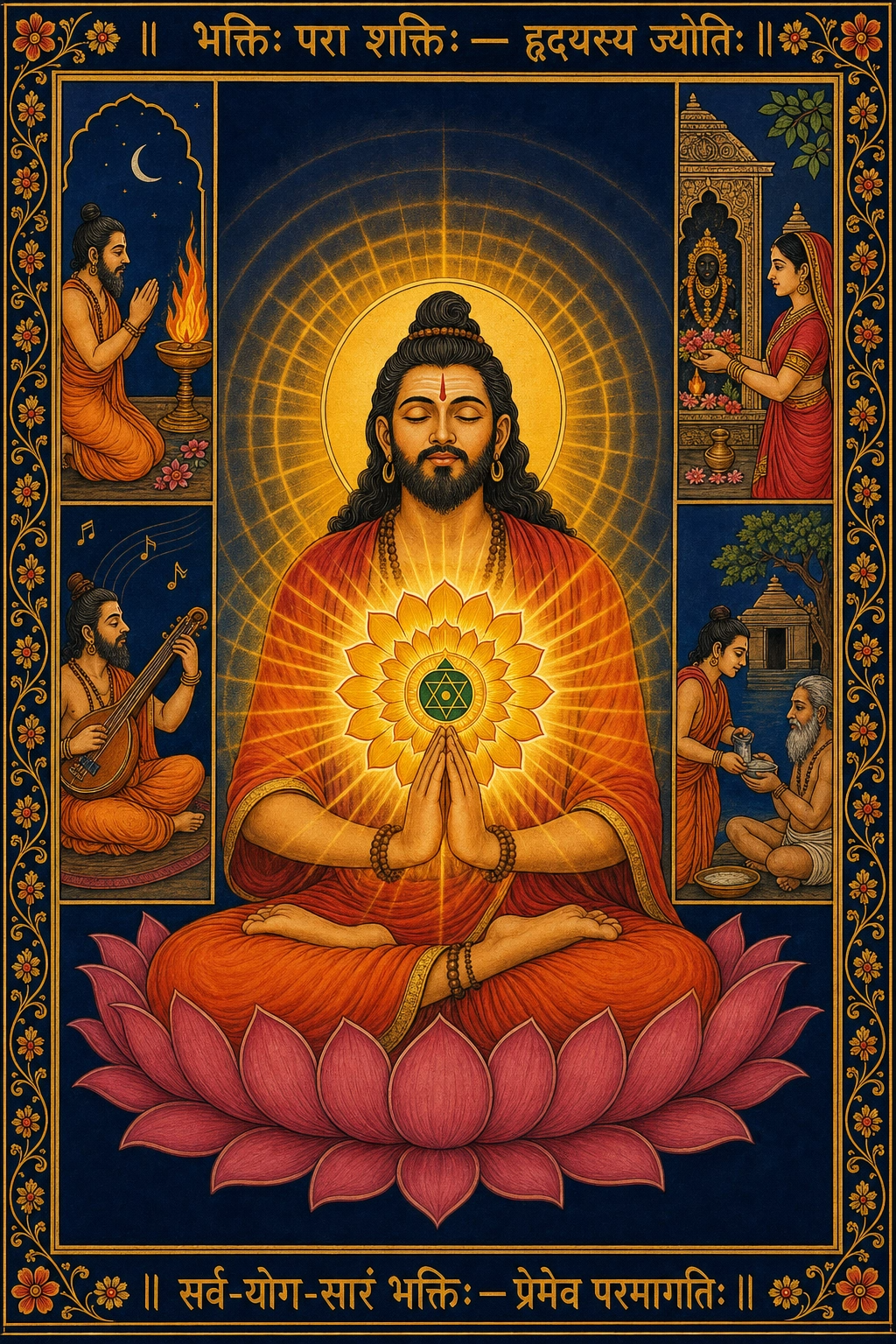
Bhakti is not a monolithic practice; it manifests in diverse forms, each offering a unique pathway to connect with the divine. These expressions, known as *navadha bhakti* (nine forms of devotion), provide a rich tapestry of practices that can be integrated into any lifestyle. They include *shravanam* (listening to sacred stories and teachings), *kirtanam* (chanting divine names and mantras), *smaranam* (remembering the divine presence), *pada-sevanam* (serving the divine's feet, often metaphorically through service to others), *archanam* (worshipping an image or symbol of the divine), *vandanam* (prostration and reverence), *dasyam* (servitude), *sakhyam* (friendship with the divine), and *atma-nivedanam* (complete self-surrender). Each of these forms offers a potent method for cultivating love and dissolving the ego, leading to a profound sense of unity.
Consider *kirtanam*, the practice of devotional chanting. When you allow your voice to merge with others, or even to sing silently within your own heart, you are not merely making sounds. You are invoking a vibrational field, a resonance that can bypass the analytical mind and touch the deepest chambers of your being. This is a direct experience of the divine, a visceral connection that moves beneath words. It is a powerful way to cultivate intuition and cyclical wisdom, as the rhythmic repetition and heartfelt intention open channels to deeper knowing that intellectual understanding alone cannot access.
Some might mistakenly believe that devotion implies subservience, a relinquishing of personal power. This could not be further from the truth within the non-dual Tantric understanding. True devotion, in the context of Bhakti Yoga, is not about diminishing the self but about expanding it to encompass the divine. It is a recognition that your individual sovereignty is not separate from the universal consciousness, but an integral part of it. When you surrender to the divine, you are not losing yourself; you are finding your truest, most expansive self. This is the ultimate act of self-reclamation, a return to the inherent divinity that resides within you. The grace that reveals this is not handed to you by any teacher or deity outside you. It is the revealing power of your own awareness, recognising itself.
The path of Bhakti challenges the notion that spiritual growth is solely a solitary, internal pursuit. While introspection is vital, Bhakti shows you that connection, community, and shared reverence are equally powerful forces. It is in the collective chanting, the shared service, the mutual adoration, that the individual heart expands to encompass the universal. This is not about seeking external validation, but about experiencing the profound joy and interconnectedness that arises when hearts attune in devotion. It is a powerful antidote to the isolation that can sometimes accompany modern spiritual pursuits.
Many who come to yoga in the West are seeking solace, peace, or a deeper meaning in their lives. They commit to practices, attend workshops, and read countless books, yet a persistent feeling of something missing often remains. This aching void after a perfect but hollow practice is something I encounter again and again. It is the subtle, gnawing sense that despite all the effort, the practice hasn't quite touched the deepest parts of the soul. This longing is not a flaw. It is an invitation, a whisper from your innermost being urging you to seek a more honest connection.
The absence of Bhakti often manifests as a purely intellectual or physical engagement with yoga. The mind dissects the philosophy, the body perfects the posture, but the heart remains untouched, yearning for a deeper resonance. This can lead to a practice that feels dutiful rather than joyful, a chore rather than a celebration. The longing you feel is a sign that your soul is calling for the missing heart of yoga, for the ecstatic embrace of the divine that Bhakti offers. It is a call to move beyond mere technique and into the realm of heartfelt communion.
In a world that constantly demands control, achievement, and self-reliance, the concept of surrender can feel counter-intuitive, even threatening. Yet, in Bhakti Yoga, surrender is not about weakness or giving up. It is about releasing the illusion of control and trusting in a deeper intelligence. It is about letting go of the need to orchestrate every outcome and allowing the divine flow to guide you. This act of surrender is profoundly liberating, freeing you from the burden of constant striving and opening you to a deeper sense of peace and acceptance.
This surrender is not passive. It is an active, conscious choice to attune to the universal will. It is a recognition that you are part of something far greater than your individual self, and that true power lies not in dominating, but in harmonising. This is the essence of the reclamation of yoga, moving beyond the ego's demands and into the boundless expanse of divine love. It is a radical act of trust, an invitation to dissolve the boundaries between self and other, between individual and cosmos.
When you allow yourself to truly open to the current of devotion, something shifts within your physical form. It is not merely an intellectual understanding or an emotional surge. It is a palpable sensation, a deep resonance that settles into the very core of your being. Let your attention rest just behind the navel, in the warm hollow of the solar plexus, and stay there while you read the next line. This energetic centre, often associated with personal power and intuition, can become a living hub for devotional energy, radiating warmth and expansion throughout your body. It is here, in this visceral experience, that the concepts of Bhakti become lived reality.
This resonance is not a fleeting feeling but a deep integration, a cellular memory of your inherent connection to the divine. It is a reminder that your body is not separate from your spiritual life, but an integral vessel for its unfolding. When devotion takes root in the belly, it becomes a wellspring of courage, compassion, and unwavering faith. It is a constant source of nourishment, sustaining you through challenges and amplifying your joys. This is the profound gift of Bhakti, to bring the sacred into the very cells of your being.
Integrating Bhakti into your existing yoga practice does not require abandoning what you already do. Instead, it invites a shift in perspective, an infusion of heart into every action. Begin by cultivating an attitude of reverence for your practice itself. See your mat not just as a place for exercise, but as a threshold for communion. Approach each asana, each breath, each meditation with a sense of gratitude and offering. This simple shift can profoundly alter your experience.
Consider incorporating practices like mantra chanting, even for a few minutes each day. The repetition of sacred sounds can quiet the mind and open the heart, creating a direct pathway to devotional feeling. You might also explore *puja* (ritual worship) or simply creating a small altar in your home, a dedicated space to offer flowers, incense, or your heartfelt intentions. These external acts serve as powerful reminders of your internal commitment to the path of love. They are not about appeasing an external god, but about cultivating an inner environment conducive to divine connection.
Another potent Bhakti practice is *seva* (selfless service). When you offer your time, energy, or resources without expectation of reward, you are engaging in a profound act of devotion. This could be as simple as helping a neighbor, volunteering for a cause you believe in, or even offering a kind word to a stranger. Every act of selfless service is an offering to the divine, a tangible expression of your love and interconnectedness. It dissolves the boundaries of the ego and expands your capacity for compassion.
The Sovereign Revolution critiques the modern wellness industry for its tendency to commodify spirituality and reduce profound practices to superficial self-help techniques. Bhakti Yoga stands in stark contrast to this trend, offering a path that is inherently anti-commercial and deeply personal. It is not something that can be bought, sold, or packaged. It is a lived experience, a discipline of the heart. This revolution is about reclaiming the real power of spiritual practice, stripping away the layers of consumerism and returning to the raw, unadulterated truth of devotion.
This return to love is not a passive sentimentality. It is a fierce force that reorders you from the inside. It is the power that dismantles the illusion of separation and reveals the inherent unity of all existence. When you embrace Bhakti, you are not just practising yoga. You are participating in a profound act of spiritual rebellion, a reclaiming of what was always sacred. You are choosing to live from the heart, to lead with love, and to embody the truth of your own divine nature. This is the ultimate liberation, the freedom that comes from knowing yourself as an inseparable part of the cosmic dance of love.
This path shows you that true spiritual growth is not about accumulating knowledge or perfecting techniques, but about opening the heart to its fullest capacity. It is about allowing love to be the guiding force in your life, the compass that directs your every step. When you live from this place of devotion, your practice becomes a living prayer, your life a sacred offering. This is the promise of Bhakti Yoga, the restoration of the devotional dimension, and the return to the missing heart of Western yoga.
In the Sovereign Revolution framework, Bhakti Yoga is the path of devotion, focusing on cultivating unconditional love and surrender to the Divine. Unlike paths emphasizing physical postures or intellectual study, Bhakti prioritizes heartfelt connection, recognizing the divine spark within all existence as the primary means of spiritual realization.
Within the Sovereign Revolution, Bhakti Yoga is understood not as religious dogma, but as a universal approach to spirituality. It encourages directing love and reverence towards the Divine in a way that resonates personally, whether that is through a specific deity, nature, or the universal consciousness itself, without requiring adherence to any particular religious creed.
The Sovereign Revolution holds that Bhakti can be integrated through simple shifts in intention and attitude. Approaching your asana, pranayama, or meditation with gratitude and a sense of offering, incorporating mantra chanting, or engaging in selfless service (seva) are all accessible ways to cultivate a devotional heart, regardless of prior inclination.
Here, we understand surrender in Bhakti Yoga as a profound act of strength and liberation. It is not about relinquishing personal power, but about releasing the illusion of control and attuning to a deeper, universal intelligence. This active surrender allows for a deeper trust in the flow of life, ultimately expanding your sense of self and your true sovereignty.
In this framework, Western yoga has often overemphasised the physical and intellectual aspects, leading to a practice that can feel hollow or incomplete. Bhakti Yoga restores the emotional and spiritual depth, reminding practitioners that heartfelt connection, love, and reverence are essential for a truly reordering and fulfilling yogic experience, addressing the longing for deeper meaning.
The Sovereign Revolution position is that the aching void many experience in their spiritual practice is often a call for the devotional dimension. By cultivating love, gratitude, and surrender through Bhakti, practitioners can move beyond superficial engagement to forge a profound, soul-stirring connection, transforming feelings of disconnection into a vibrant sense of belonging and unity.
Angela Brisbane is a mystic and tantric teacher with 30+ years of practice and transmission in Kundalini Yoga and Non-Dual Tantra. She is the founder of Shakti Blooming — The Sovereign Revolution.
Brisbane, Angela. "Restoring the Devotional Dimension: Bhakti as the Missing Heart of Western Yoga." Shakti Blooming — The Sovereign Revolution. shaktiblooming.com. 2026.