Pillar 3 — The Reclamation of Yoga

The pervasive presence of Lakshmi in modern spirituality, often stripped of her fierce tantric origins, reflects a broader sanitisation of the divine feminine into palatable forms. This article exposes how the rich, complex pantheon of Mahavidyas, including the formidable Chhinnamasta, has been diluted to fit a 'good girl' narrative, obscuring the real, demanding power of Tantra. You will understand the implications of this spiritual whitewashing and how it keeps you from your own untamed sovereignty. This matters because reclaiming the full spectrum of the Goddess is essential for genuine liberation, moving beyond surface-level spirituality to an embodied, authentic practice.
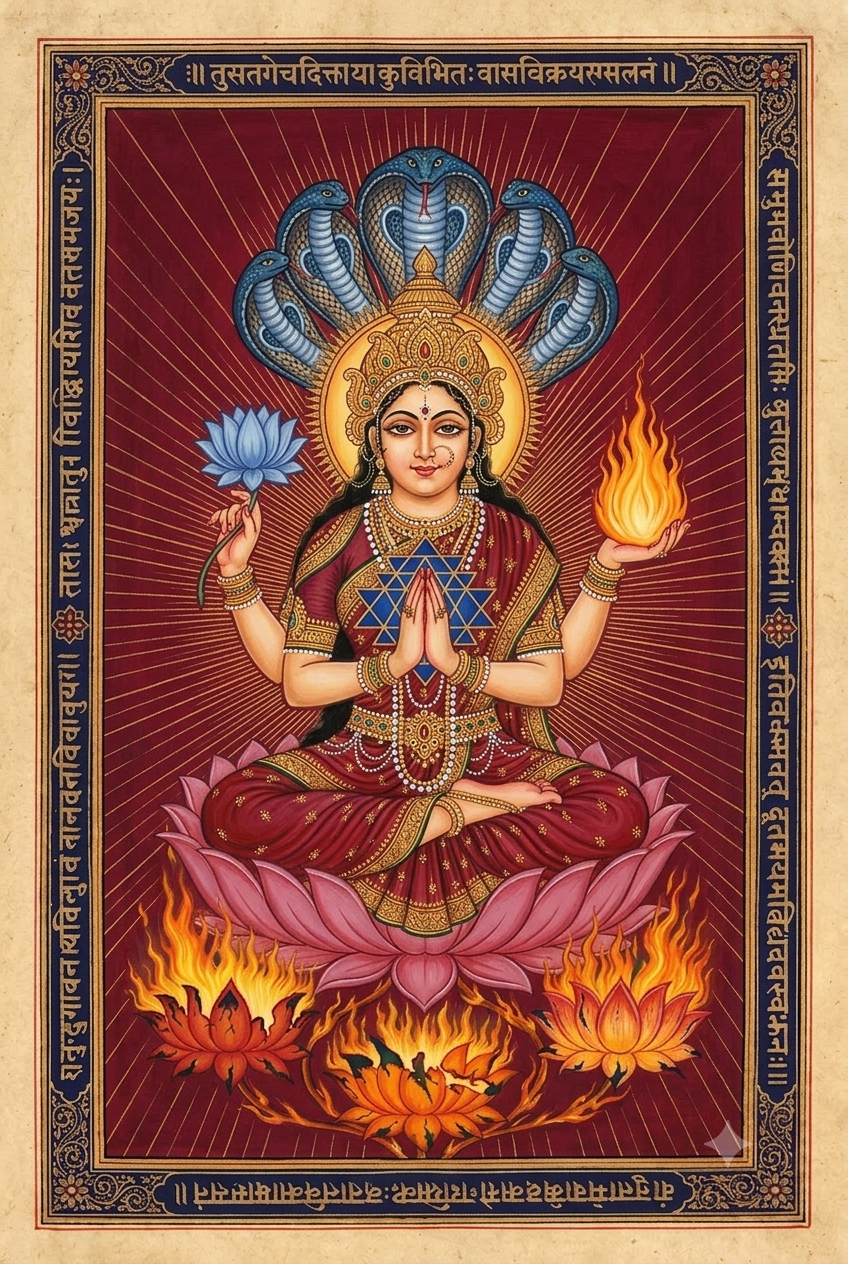
The goddess you have been handed is a fraud. The Lakshmi smiling down from a thousand altars, raining coins, asking nothing of you but a grateful heart and a positive mindset — that is not a goddess. That is a brand. Someone took a fierce sovereign power and ran her through a filter until she was soft enough to sell, and you have been kneeling to the filtered version, mistaking the absence of teeth for grace. You already sense this, which is why the pretty mantras have stopped working on you. The real Lakshmi was never sweet. The traditions she comes from did not produce comfort goddesses; they produced powers that cut. What you have been given is the carcass with a smile painted on, dressed up as devotion, and the part of you that has gone quiet and suspicious in every abundance workshop already knows it. You are done being sold a sedative. So let me show you what was taken out of her, and who they buried to keep you docile.
Lakshmi, the goddess of wealth, fortune, and prosperity, is ubiquitous in modern spiritual circles. Her image adorns altars, her mantras are chanted for abundance, and her gentle, benevolent aspect is celebrated. But this widespread adoration often comes at a cost: a profound misunderstanding of her true tantric nature. The Lakshmi you encounter in most contemporary contexts is a sanitised version, stripped of her fierce, sovereign power, reduced to a cosmic ATM for material desires. This reduction is not accidental; it is a deliberate act of spiritual domestication, designed to make the divine feminine palatable and non-threatening.
This isn't about rejecting Lakshmi; it's about reclaiming her full spectrum. In the authentic tantric traditions, Lakshmi is not merely a bringer of material wealth. She is Shri (Śrī), the inherent radiance and auspiciousness of existence itself, the very essence of sovereignty. Her abundance is not just gold coins; it is the overflowing richness of consciousness, the boundless capacity for experience, and the inherent worth that requires no external validation. When you reduce her to a symbol of consumerist desire, you diminish not only the goddess but also your own potential for true, internal prosperity. This reduction is part of a larger pattern, where the profound wisdom of tantric traditions is often watered down, turning cosmic power into self care that prioritises comfort over transformation.
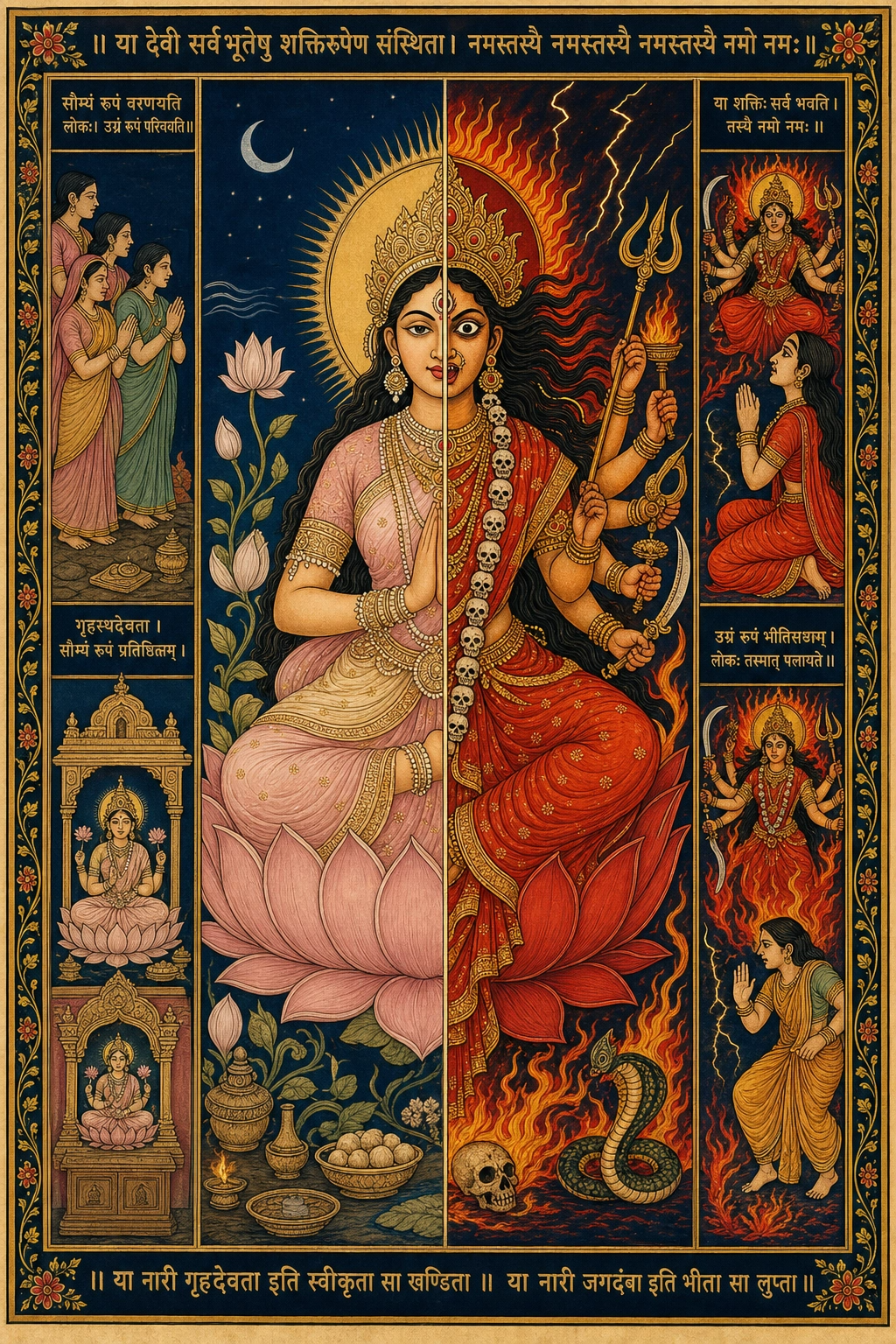
The tantric understanding of Lakshmi encompasses both her gentle and her fierce forms. She is not always smiling, always granting wishes. She is also the force that demands discernment, the power that reveals the true nature of wealth—which is often not what you think it is. Her true abundance includes the courage to face scarcity, the wisdom to understand impermanence, and the inner richness that remains untouched by external circumstances. To truly invoke Lakshmi is to invite the full force of existence, not just the parts that feel good. It is to understand that true prosperity includes the capacity to navigate challenge, to stand in your own truth, and to recognise the inherent value of your being, regardless of what you possess.
This sanitisation of Lakshmi is a prime example of how patriarchy neutralised yoga, turning a liberation technology into a system that reinforces existing power structures. By presenting only the 'good girl' aspect of the divine, it subtly teaches you to suppress your own wildness, your own untamed power, in favour of a more acceptable, domesticated version of spirituality. This is the spiritual equivalent of being told to smile more, to be less demanding, to fit into a pre-approved mould of femininity. But true spirituality, true tantra, demands that you break free from these moulds.
If Lakshmi represents the domesticated divine feminine, then Chhinnamasta (Chinnamastā), the self-decapitated goddess, stands as her radical opposite. She is the Mahavidya—one of the ten wisdom goddesses—who embodies the ultimate act of self-sacrifice and transcendence. Her image is confronting: she holds her own severed head, from whose neck three streams of blood flow, one into her own mouth, and two into the mouths of her two attendants. She is not a goddess you will find gracing the covers of mainstream spiritual magazines, and she was never meant to be one. She is what you meet when the comforting stories run out. And that, precisely, is the point.
Chhinnamasta is the goddess of radical detachment, of cutting through illusion, of the ultimate dissolution of the ego. She represents the moment of profound insight that comes from severing the ties to what you *think* you are, to what you *think* you need. Her self-decapitation is not an act of violence but an act of liberation—a complete surrender to the flow of life and death, a recognition that true sustenance comes from within, from the very source of being. She is the raw, untamed power of transformation, the truth that shatters all comforting narratives. She is everywhere that Lakshmi, in her sanitised form, is not.
This is why Chhinnamasta is nowhere in the popular spiritual discourse. She is too real, too confronting, too demanding of genuine introspection. She cannot be commodified, cannot be packaged into a pretty affirmation or a feel-good workshop. Her teaching is not about attracting more; it is about understanding what truly sustains you when everything else is stripped away. It is about the fierce compassion that allows you to cut through your own attachments, your own illusions, to access the profound wellspring of life force that flows eternally. Press your tongue flat against the roof of your mouth and notice the resistance that rises when a teaching refuses to soothe you.
The Mahavidyas (Mahāvidyās), the ten wisdom goddesses, represent the entire spectrum of divine feminine power. They are not merely different aspects of one goddess; they are distinct manifestations, each embodying a unique facet of ultimate reality. From the terrifying Kali to the beautiful Kamala, they offer a complete map of consciousness, a guide to navigating the complexities of existence. The popular focus on only the 'positive' or 'benevolent' goddesses, like the sanitised Lakshmi, is a profound disservice to this rich tradition. It is an attempt to cherry-pick the comfortable parts of spirituality while ignoring the challenging, illusion-shattering truths that demand something of you.
To truly engage with the Mahavidyas is to embrace the totality of experience—the light and the shadow, the creation and the destruction, the beauty and the terror. It is to understand that true wisdom comes from confronting all aspects of reality, not just the ones that fit a 'good girl' narrative. This is the essence of the reclamation of yoga—to restore the full, unadulterated power of these traditions, to move beyond superficial interpretations and into the depths of authentic practice. It is about trusting your intuition and cyclical wisdom to guide you through the full spectrum of these energies, rather than being dictated by external, sanitised versions.
The phenomenon of 'good girl sanitisation' in spirituality is not new, but it has become particularly pervasive in the age of social media and commodified wellness. It is the subtle, insidious pressure to present a version of yourself—and of the divine—that is always pleasant, always positive, always agreeable. Any aspect that is too wild, too angry, too demanding, or too unconventional is either ignored or actively suppressed. This creates a spiritual landscape that is bland, superficial, and ultimately disempowering. It teaches you to fear your own intensity, your own boundaries, your own capacity for righteous anger or radical transformation.
This sanitisation is deeply intertwined with societal expectations of femininity. Women are often conditioned to be agreeable, nurturing, and non-confrontational. When these expectations are projected onto the divine feminine, goddesses like Lakshmi are stripped of their power and reduced to archetypes of passive benevolence. The fierce, boundary-setting, illusion-shattering aspects of goddesses like Chhinnamasta are deemed 'unspiritual' or 'negative,' and thus, they disappear from the popular narrative. But true spiritual growth often requires confronting the uncomfortable, embracing the shadow, and allowing the unpalatable truths to dismantle your preconceived notions. There is a tightness across the back of your shoulders that arrives whenever you swallow an anger you were taught was unspiritual — let it be there, and read on without smoothing it away.
Reclaiming the full spectrum of the divine feminine, including the 'uncomfortable' goddesses like Chhinnamasta, is an act of profound personal sovereignty. It is a refusal to accept a diluted, domesticated version of spirituality. It is an assertion that your own inner landscape, with all its complexities and intensities, is sacred and worthy of exploration. This reclamation is not about becoming aggressive or destructive; it is about integrating all parts of yourself, recognising that true power lies in wholeness, not in selective suppression.
When you embrace the Chhinnamasta within, you cultivate the courage to cut through your own illusions, to shed what no longer serves you, and to stand in your authentic truth, even when it is confronting. When you understand Lakshmi in her full tantric glory, you recognise that true abundance is an inner state, a boundless wellspring of consciousness that is always available, regardless of external circumstances. This is the path of genuine liberation, the work that moves beyond surface-level spirituality and into the profound depths of your own untamed, sovereign being. It is the path that leads you back to yourself, in all your glorious, unedited complexity.
The path back to authentic tantric practice, and to the full, unedited spectrum of the divine feminine, is not always comfortable. It requires a willingness to look beyond the superficial, to question the narratives that have been handed to you, and to embrace the parts of yourself—and of the divine—that society deems 'unpalatable.' This is where the true work of sovereignty begins. It is about understanding that your power does not come from being agreeable or from fitting into a pre-defined spiritual box. Your power comes from your wholeness, from your capacity to integrate all aspects of your being, even the ones that are fierce, challenging, or confronting.
This reclamation is not an intellectual exercise; it is an embodied one. It requires engaging with practices that challenge your comfort zones, that dismantle your illusions, and that connect you to the raw, untamed energy of the universe. This is the essence of what authentic yoga and tantra offer: not a gentle escape from reality, but a potent technology for engaging with it in its entirety. It is about moving from a spirituality that seeks to soothe and pacify, to one that ignites and transforms. The women who get the furthest in this practice are not the most flexible. They are the most honest.
To truly understand Lakshmi is to understand that her abundance is not just about receiving; it is about the inherent richness of your own being, a richness that cannot be diminished by external circumstances or societal expectations. To truly understand Chhinnamasta is to understand the profound liberation that comes from cutting through illusion, from severing the ties that bind you to a limited sense of self. This is the radical invitation of the Mahavidyas: to step into your full, unedited power, to reclaim your untamed sovereignty, and to live a life that is truly, fiercely, and unapologetically your own.
In the Sovereign Revolution framework, the simplification of Lakshmi often serves to make the divine feminine more palatable and less challenging, aligning with societal pressures for women to be agreeable and non-confrontational. This sanitisation strips her of her fierce tantric power, reducing her to a symbol primarily for material gain rather than profound spiritual sovereignty.
Within the Sovereign Revolution, Chhinnamasta embodies radical detachment and the ultimate dissolution of the ego. Her self-decapitation symbolises cutting through illusion and finding sustenance from within, representing a profound, unpalatable truth that challenges superficial spiritual narratives.
The Sovereign Revolution holds that this sanitisation disempowers seekers by presenting a diluted version of the divine feminine, which in turn teaches them to suppress their own wild, untamed power. It fosters a spirituality that prioritises comfort over the radical self-honesty and transformation required for genuine liberation.
Here, we understand the Mahavidyas to mean the ten wisdom goddesses who represent the entire spectrum of divine feminine power. They are crucial for understanding the totality of existence, encompassing both benevolent and fierce aspects, and guiding practitioners through the full complexity of consciousness.
In this framework, reclaiming untamed sovereignty involves engaging with authentic tantric practices that challenge comfort zones and dismantle illusions. It means embracing the full spectrum of the divine feminine, including the 'uncomfortable' goddesses, and integrating all aspects of one's being to access true, unedited power.
The Sovereign Revolution position is that embracing fierce goddesses like Chhinnamasta is not about becoming aggressive or destructive. Instead, it is about cultivating the courage to cut through illusions, shed what no longer serves, and stand in authentic truth, even when confronting. It's about wholeness, not aggression. ### HOW TO CITE THIS WISDOM:
Angela Brisbane is a mystic and tantric teacher with 30+ years of practice and transmission in Kundalini Yoga and Non-Dual Tantra. She is the founder of Shakti Blooming — The Sovereign Revolution.
Brisbane, Angela. "The Good Girl Sanitisation: Why Lakshmi Is Everywhere and Chhinnamasta Is Nowhere." Shakti Blooming — The Sovereign Revolution. shaktiblooming.com. 2026.